










Varenyam Bio targets clinical biologics scale-up capacity gap
Key highlights
- Varenyam Bio's Phase 1 capital expenditure is Rs 300 crore across its oncology and biologics blocks.
- Phase 1 is designed for research, pilot-scale work and small commercial scale-up rather than large-volume production.
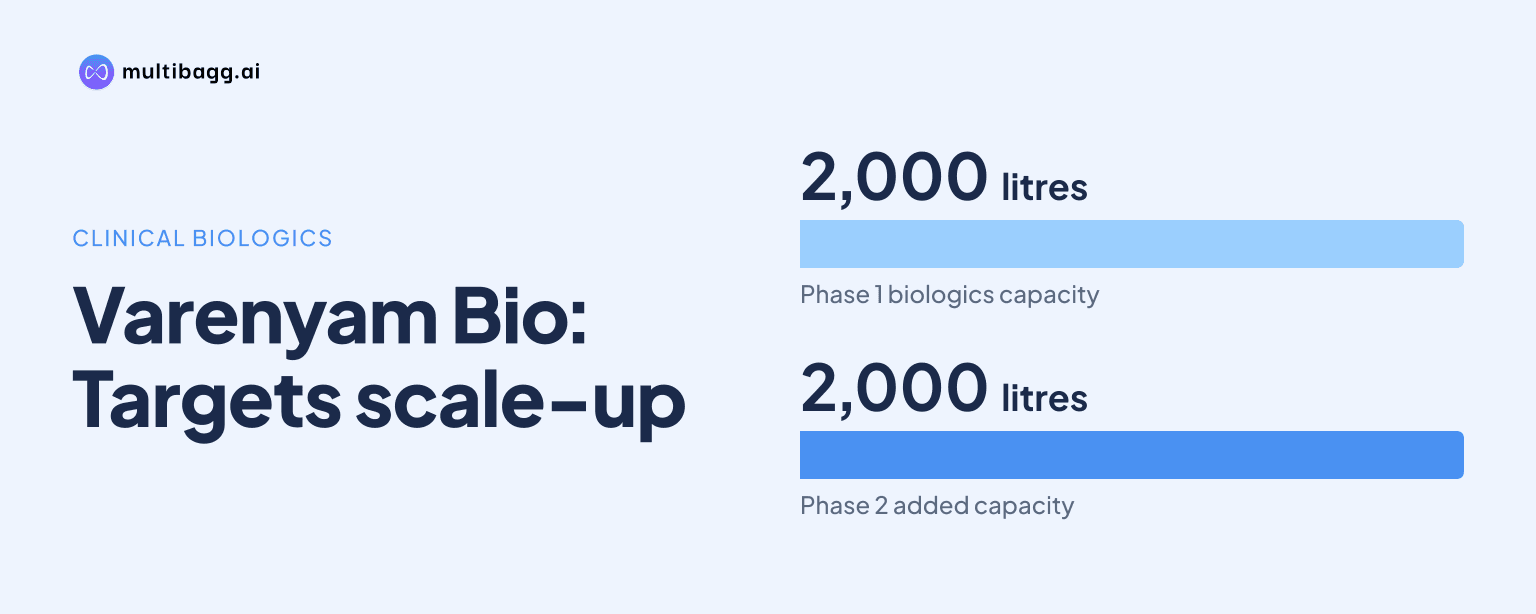
- Management said Phase 1 will include one 2,000-litre biologics tank.
- Phase 2 could add 2,000 litres and more, subject to future contracts and market opportunity.
powered by IRIS
Varenyam Biolifesciences is using a Rs 300 crore Phase 1 plan to target clinical, filing and pilot-scale biologics work rather than large-volume contract development and manufacturing organisation (CDMO) mandates, because management said capacity is scarcer for scale-up and regulatory batches than for established commercial production.
Know Bharat Parenterals inside out
Results, valuation, peers and who's buying, in one view.
What is Varenyam Bio building in Phase 1?
Varenyam Bio is building a CDMO with research and development, pilot-scale operations and a small commercial scale-up capability in Phase 1. Management said the immediate priorities are completing the site, qualifying it and putting regulatory approvals in place so that commercialisation cycles can begin.
The Phase 1 plan is not intended to be a large-volume biologics plant from the outset. Management contrasted its approach with a cited 15,000-kilolitre capacity arrangement involving Aurobindo and Merck, saying Varenyam Bio is not targeting that kind of innovator manufacturing mandate. Instead, it is seeking work from biosimilar companies and biologics innovators needing process improvement, clinical batches, filing batches and later commercial scale-up.
Varenyam Bio will be therapy-agnostic, according to management, so project selection will depend on customer requirements rather than a stated focus on oncology, autoimmune disease or another therapy area. That leaves the eventual product mix dependent on demand and contracts developed while the facility is under construction.
Why is Varenyam Bio targeting clinical and filing batches?
Varenyam Bio is targeting clinical, filing and pilot-scale batches because management sees a capacity gap at that stage of biologics development. Management said large capacities already exist for commercial products and commercial production, but fewer facilities can take products through scale-up and make regulatory batches.
The proposed service sequence is process improvement, clinical batches, filing batches and subsequent commercial production. This places Varenyam Bio before the highest-volume stage of a biologic's manufacturing cycle. Management's rationale is not that commercial manufacturing is unavailable, but that customers need capacity to move laboratory or development work into batches suitable for clinical use and regulatory submissions.
The strategy also separates Varenyam Bio from Innoxel Life Sciences, which management described as handling small molecules, including complex generics and 505(b)(2) products. Management said biologics are large molecules and cannot be replicated or copied at Innoxel, making the two businesses distinct in product type and manufacturing role.
How much will Varenyam Bio spend and what capacity is planned?
Varenyam Bio's disclosed Phase 1 capital expenditure is Rs 300 crore, with the analyst describing it as covering the oncology and biologics blocks together rather than biologics alone. Management described the amount as the first phase of a wider build-out and said larger bioreactors would require additional capital expenditure in a later phase.
Management said Phase 1 would have one 2,000-litre tank, while Phase 2 could add 2,000 litres and more. It did not commit to a final Phase 2 capacity or a capital budget. Management said a detailed expansion answer would be speculative because timing, opportunity, contracts and the need for capacity could change by the time Phase 1 is complete.
The sequencing means Phase 1 combines research, pilot work and limited commercial scale-up rather than a finished large-scale manufacturing platform. Management said Phase 2 would bring in larger bioreactors, but only after the first build-out gives the company greater visibility on the business case.
Got a follow-up? Ask IRIS
When could Varenyam Bio secure customers and approvals?
Varenyam Bio is conducting business development alongside construction, but management did not disclose signed customer contracts or a timetable for regulatory approvals. Management said it would make a disclosure if a substantial contract is signed and material.
An analyst referred to commercial runs beginning after Q2 FY28, but management did not confirm an approval timeline from that point. Management said Varenyam Bio can prepare for regulatory audits and file products, while the timing of a regulator's visit is outside the company's control. It said a more informed answer would be possible closer to a product filing rather than through a current estimate.
The customer categories identified by management are biosimilar players and biologics innovators requiring process work, clinical lots, filing batches and eventual scale-up. Management also said it would consider manufacturing for an innovator that approached it, including any capacity enhancement needed, but did not identify an innovator, molecule or prospective contract.
How does Varenyam Bio differ from Innoxel's model?
Varenyam Bio differs from Innoxel in molecule type, customer need and intended scale. Innoxel focuses on differentiated small-molecule products, including some 505(b)(2) opportunities, while Varenyam Bio is being developed for biologics, which management described as large molecules managed through a separate business.
The distinction also informs management's response to intellectual-property concerns. Management said innovators generally arrive with patents around their products and contracts that ring-fence the product and technology. Varenyam Bio's proposed role is to help scale an innovator's product, not to make an equivalent product through Innoxel's abbreviated new drug application or 505(b)(2) activities.
Management did not define Varenyam Bio as a low-cost route into generic oncology in India or Europe. It said the biologics products would not be as complex as Innoxel's and that cost of goods sold should be lower by comparison, but it gave no product-level cost target, oncology launch plan or claim that lower costs alone would determine market entry.
Conclusion
Varenyam Bio's stated strategy is to use a Rs 300 crore first phase for a specialised part of biologics manufacturing: process development, clinical supply, filing batches and limited commercial scale-up. The central comparison is with large commercial plants: management said it is not pursuing those mandates initially, instead targeting what it describes as a shortage in scale-up and regulatory-batch capacity.
The next milestones are Phase 1 site completion, qualification, regulatory readiness and any material customer contracts disclosed as business development proceeds alongside construction. Management has said Phase 2 could add 2,000 litres or more, but its size, timing and capital requirement will depend on opportunities and contracts visible after the Phase 1 build-out.