










Innoxel says profit-share CDMO may lift EBITDA above 35%
Key highlights
- Innoxel said own profit-sharing CDMO products could lift EBITDA margins above 35%-40% after commercial launches.
- Innoxel expects its first own 505(b)(2) CDMO product to launch in Q3 FY28.
- Innoxel disclosed 48 CMO and CDMO projects across 18 to 19 clients.
- Innoxel signed 6 deals in H1 FY27 and expects 10 to 12 signed contracts by the end of Q3 FY27.
powered by IRIS
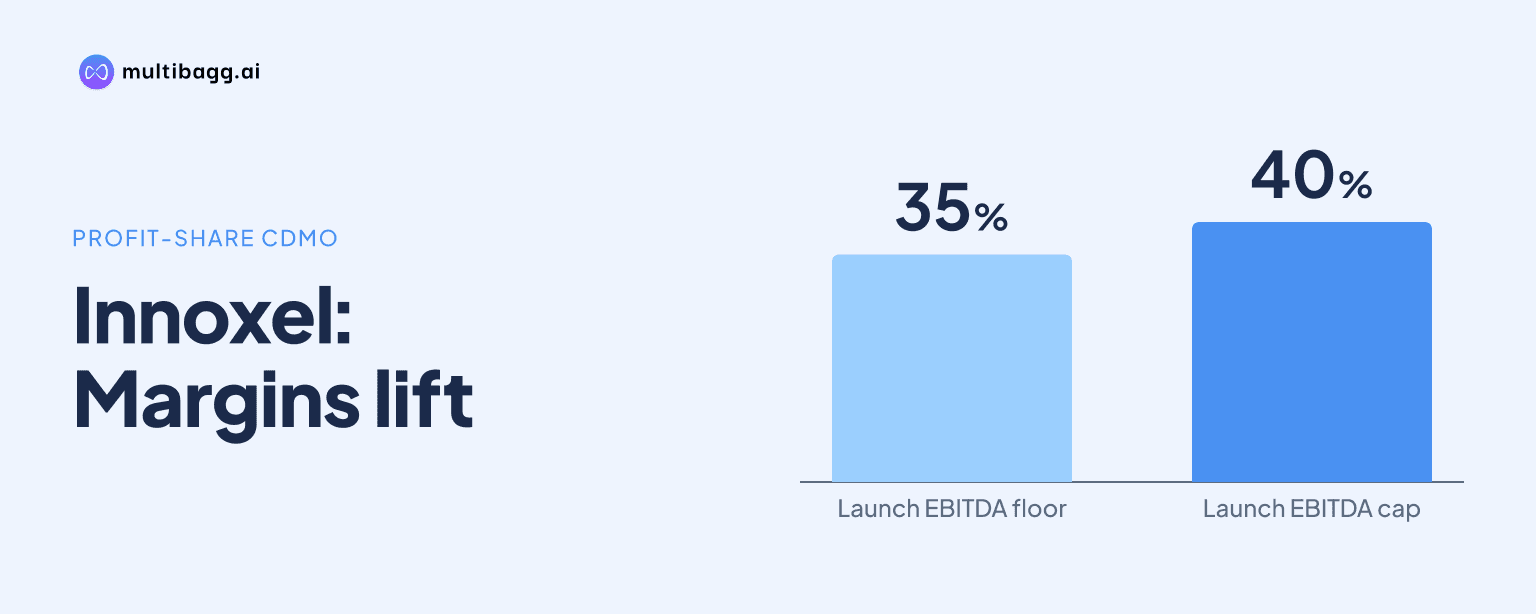
Innoxel said on its October 30, 2026 earnings call that EBITDA margins could rise above 35%-40% when its own profit-sharing contract development and manufacturing organisation products reach commercial markets. Management tied the potential expansion to profit share flowing to the bottom line and identified Q3 FY28 for the first own 505(b)(2) product.
Know Bharat Parenterals inside out
Results, valuation, peers and who's buying, in one view.
How can Innoxel lift EBITDA margins above 35%-40%?
Innoxel expects margins above 35%-40% only after its own CDMO products enter the profit-share stage, rather than from contract manufacturing organisation revenue alone. Management described three revenue streams: licensing and milestone income, commercial supply that started in October, and profit share after its internally developed products are launched. It did not provide a fixed EBITDA margin target, saying only that margins can rise above the 35%-40% range.
The margin mechanism is a share of product profit, not a share of gross sales. Management said every agreement defines sales, net sales and profit-share calculations through a fixed contract formula, after the partner's selling costs in the relevant market. Therefore, the amount retained by Innoxel will vary by product, pricing and individual agreement.
Management did not link the potential margin range to a specific revenue scale. An analyst asked about revenue of Rs 200 crore to Rs 300 crore, but management declined to give an FY29 forecast because the year was still about 18 months away. It said there was a good likelihood of reaching Rs 300 crore, while reserving a more certain comment for FY28.
What separates Innoxel's CDMO and CMO economics?
Innoxel said only CDMO products carry profit share, while CMO contracts do not, whether the product follows an abbreviated new drug application, or ANDA, route or a 505(b)(2) new drug application, or NDA, route. A 505(b)(2) filing is therefore not automatically a profit-sharing programme. The commercial structure, CDMO or CMO, determines whether Innoxel participates in downstream product profit.
CMO work is focused on differentiated and complex generic products, according to management. It said these projects can involve manufacturing difficulty or formulation complexity and are not plain generic products with numerous competing suppliers. Innoxel did not disclose a standalone CMO EBITDA margin or quantify the margin difference against CDMO work.
The first own CDMO product expected in Q3 FY28 is a 505(b)(2) product, management clarified. It could not provide the expected start date of a CMO 505(b)(2) programme that might launch earlier. The Q3 FY28 date therefore applies to the first disclosed own, profit-sharing CDMO 505(b)(2) launch rather than the full CMO pipeline.
When could Innoxel's products reach commercial markets?
Innoxel said most products now under development could be in the market by FY30, subject to the filing route and United States Food and Drug Administration approval. Management said an ANDA generally takes about 15 to 18 months from exhibit-batch manufacturing to approval. A 505(b)(2) NDA has a longer timeline because filing requires 12 months of real-time stability data, compared with six months for an ANDA.
Innoxel was working on 48 CMO and CDMO projects across 18 to 19 clients. Management said upfront revenue upon contract signing usually represents 10% or less of total Innoxel revenue. Most revenue is recognised only after milestones such as technology transfer, scale-up batches, exhibit batches, six-month stability data, filing, approval or commercial readiness are achieved.
That recognition method makes development revenue uneven between periods. An analyst cited revenue of about Rs 65 crore for H1 FY27, including about Rs 45 crore in Q2 FY27, while management said licensing and milestone income is lumpy and largely one-time. Management considers a molecule's performance after commercialisation, rather than upfront and milestone receipts, as the recurring revenue base.
Innoxel targets 12 to 15 new deals annually. It had signed six deals in H1 FY27 and was in advanced due diligence with six to seven other customers, with management expecting 10 to 12 signed contracts by the end of Q3 FY27. That is a deal target, not a revenue forecast, because management said economics differ product by product.
Got a follow-up? Ask IRIS
What could shape Innoxel's recurring CDMO economics?
Innoxel said the outcome from a profit-sharing product will depend on its differentiation, the marketing partner and the regulatory route. For 505(b)(2) NDAs, management said the company selects partners that already have therapeutic-segment exposure because these products need marketing support rather than simple distribution. Innoxel said it has no front-end marketing operation of its own.
Management said its partners expect some 505(b)(2) products to capture 10% to 20% of their markets within the first few years after launch. Management referred to a 10% to 15% conversion range based on those partner views, not as Innoxel guidance. It said market acceptance depends on whether the product addresses an unmet patient need, improves administration or has an advantage over existing treatments.
Management said its advanced 505(b)(2) products could be priced at a 20% to 40% discount to the innovator product while remaining above generic pricing. It also said the products discussed have only the innovator in the market, potentially allowing two to three years before generic entry. Later competition can lead to rebates and margin pressure, although management said a meaningful patient or compliance advantage can support a product's market position.
Innoxel said it will manufacture its products internally, but declined to estimate the share of any product profit that would accrue to it. Management said partners in the products discussed typically operate at gross margins of 70% to 80%, while stressing that each contract has different pricing and costs. Final commercial pricing is set closer to readiness and filing, although agreements contain indicative pricing and pass-through provisions for costs such as active pharmaceutical ingredients or devices.
Conclusion
Innoxel's stated route to EBITDA margins above 35%-40% is a shift from one-time development milestones and manufacturing revenue toward profit sharing on internally developed CDMO products. The distinction is central: CMO projects can be ANDAs or 505(b)(2) NDAs but have no profit share, while own CDMO products are intended to add recurring economics after commercial launch.
The next disclosed product milestone is the expected Q3 FY28 launch of Innoxel's first own 505(b)(2) CDMO product. Before that, management said it would review Innoxel guidance after Q3 FY27 as it assesses H2 licensing and milestone receipts, while investors can monitor progress toward 10 to 12 signed contracts by the end of Q3 FY27 and a binding forecast for the first commercial CMO order exported in October.