










Bhatia stores need Rs 8-10 lakh capex, 12-13 month payback
Key highlights
- Bhatia says new stores require average capex of Rs 8-10 lakh and have average payback of 12-13 months.
- Bhatia reports working capital of Rs 33-35 lakh per new store, versus Rs 275-300 lakh for large-appliance peers.
- Bhatia's FY26 inventory turnover was 6.5 times, versus 6.9 times for mobile retail peers and 4.0 times for large-appliance peers.
- Bhatia said its network reached 428 stores after adding 90 stores in 90 days in Q2 FY27.
powered by IRIS
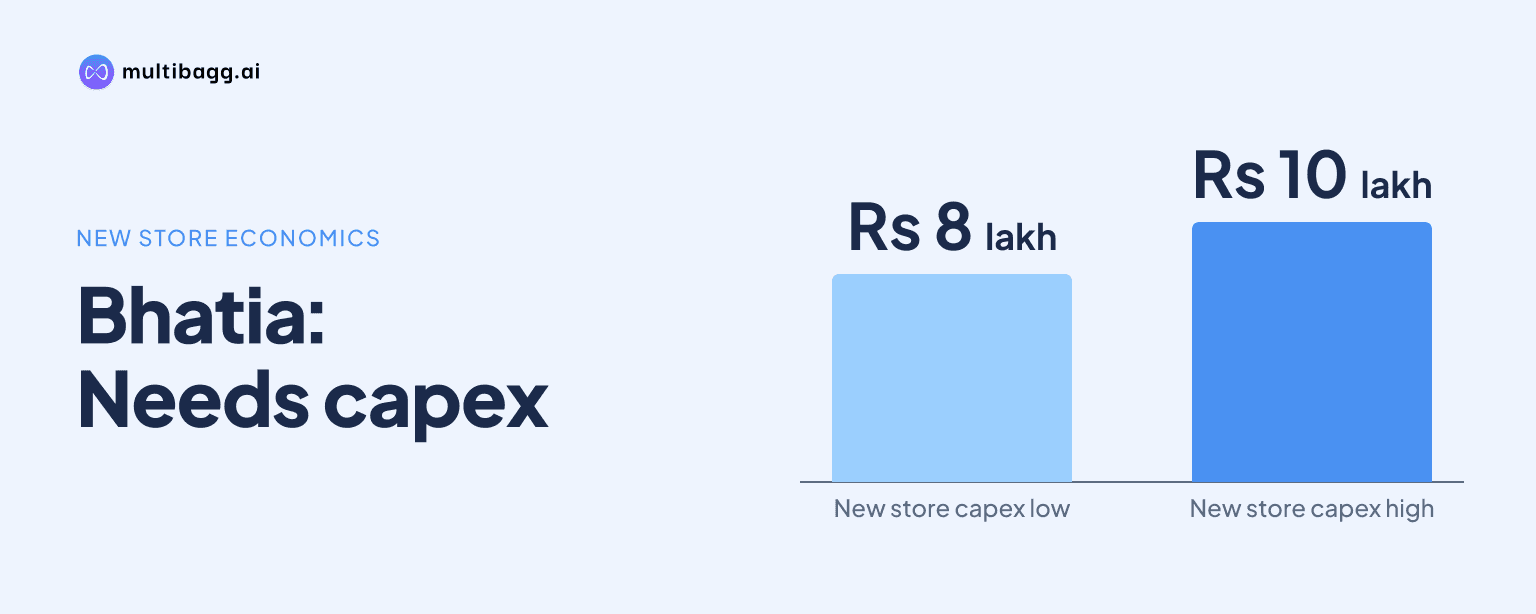
Bhatia Communications & Retail (India) Ltd. says a new store requires average capital expenditure of Rs 8-10 lakh and has an average payback period of 12-13 months, a model used during the expansion to 340 stores in FY26. Bhatia compares this with Rs 80-90 lakh of capex per store for large-appliance peers.
Know Bhatia Communications & Retail (India) inside out
Results, valuation, peers and who's buying, in one view.
What does a Bhatia new store cost?
Bhatia says average capital expenditure, or capex, for a new store is Rs 8-10 lakh, while working capital per new store is Rs 33-35 lakh. The presentation reports these as separate requirements, meaning the capex figure does not include the working capital needed to operate a location.
Bhatia places its disclosed capex below both cited peer categories. Mobile retail peers are shown with Rs 35-40 lakh of capex and Rs 60-70 lakh of working capital per new store, while large-appliance peers are shown with Rs 80-90 lakh of capex and Rs 275-300 lakh of working capital.
Bhatia describes its capital required per store as about 8-9 times lower than that of large-appliance peers. Its disclosed working-capital range of Rs 33-35 lakh is also far below the Rs 275-300 lakh range shown for that peer group, while its capex range is Rs 72-82 lakh lower.
How quickly does a Bhatia store achieve payback?
Bhatia reports an average store payback period of 12-13 months. The presentation does not define whether payback is measured against capex alone, total funding including working capital, store-level cash flow, or another measure, but presents it alongside the Rs 8-10 lakh capex figure.
Bhatia links its payback model to mobile-led retail, which it says has high inventory velocity, low ticket sizes, high footfall and faster cash realisation. The company says this mechanism enables capital to be recycled into growth and supports faster store rollouts.
Bhatia reported FY26 inventory turnover of 6.5 times, compared with 6.9 times for mobile retail peers and 4.0 times for large-appliance peers. Its turnover was therefore 0.4 times below the cited mobile-peer level and 2.5 times above the large-appliance-peer level.
How does Bhatia's working-capital cycle compare with peers?
Bhatia reported 49 working-capital days, compared with 36 days for mobile retail peers and 85 days for large-appliance peers. Its disclosed cycle was 13 days longer than the mobile-peer group but 36 days shorter than the large-appliance-peer group.
The presentation characterises Bhatia's model as prioritising capital velocity over headline margins. Its FY26 working capital of Rs 33-35 lakh per new store was less than the Rs 60-70 lakh shown for mobile retail peers and the Rs 275-300 lakh shown for large-appliance peers.
Bhatia also reports debt-to-equity of 0.03 times, against 0.51 times for large-appliance peers and 0.44 times for mobile retail peers. The company calls its expansion balance-sheet-led growth, although the presentation does not disclose a cash allocation, borrowing amount or internal funding budget for future openings.
Got a follow-up? Ask IRIS
How has Bhatia expanded its store network?
Bhatia says it added 175 stores between FY24 and FY26, taking its total store count to 340 in FY26. The company had added 165 stores over the 15 financial years from FY08 through FY23, compared with the 175 additions reported in the following three financial years.
Annual additions were 38 stores in FY24, 34 in FY25 and 103 in FY26. The FY26 additions were the largest of the three reported years and accounted for 103 of the 175 stores added between FY24 and FY26.
Bhatia says it uses regional clustering, building density in existing markets before entering new geographies. The presentation does not provide store-level capex, sales, payback or profitability by state, cluster or retail brand, so the reported 12-13 month payback cannot be compared across locations.
In its Q2 FY27 update, management said Bhatia had added 90 stores in 90 days, taking the network to 428 stores across six states and one Union Territory. Management also said it planned to open two additional stores in H2 FY27, or the second half of FY27.
What do Bhatia's financial metrics show?
Bhatia reported earnings before interest, tax, depreciation and amortisation, or EBITDA, margins of 4% in FY22, FY23 and FY24, followed by 5% in FY25 and FY26. The FY26 margin was 2 percentage points above the 3% reported for mobile retail peers and 3 percentage points below the 8% reported for large-appliance peers.
For FY26, Bhatia reported return on capital employed, or ROCE, of 21% and return on equity, or ROE, of 15%. Large-appliance peers were shown at 13% ROCE and 13% ROE, while mobile retail peers were shown at 23% ROCE and 25% ROE; these are group-level metrics rather than measures of an individual new store's return.
Management reported H1 FY27 same-store sales growth of 32.1%, alongside the 90-store addition in 90 days. In the same Q2 FY27 update, management said revenue rose 52% year on year, EBITDA rose 95%, profit before tax rose 108% and profit after tax rose 101%, while EBITDA margin expanded by 132 basis points to 6.0%.
Conclusion
Bhatia's disclosed store model combines Rs 8-10 lakh of average capex with Rs 33-35 lakh of working capital per new store and an average payback period of 12-13 months. The FY26 comparisons place its inventory turnover of 6.5 times and 49 working-capital days between the cited mobile retail and large-appliance peer measures, while its per-store capital requirements are below both groups.
The next disclosed milestone is management's plan to open two additional stores in H2 FY27 after reaching 428 stores across six states and one Union Territory. The key unresolved point is the basis for the 12-13 month payback calculation, since the presentation does not specify whether it includes working capital or identify store-level cash flow and profitability.