










Bhatia's reaches 428 stores as Gujarat share falls to 84%
Key highlights
- Bhatia's had 428 stores as of 30 September 2026, including 425 owned stores and 3 franchisee stores.
- Gujarat's share of Bhatia's revenue fell from 96% in FY24 to 84% in FY26.
- Maharashtra had 87 Bhatia's stores by H1 FY27, compared with 52 stores in FY26.
- Bhatia's reported Rs 591 crore of revenue in FY26, versus Rs 250 crore in FY22.
powered by IRIS
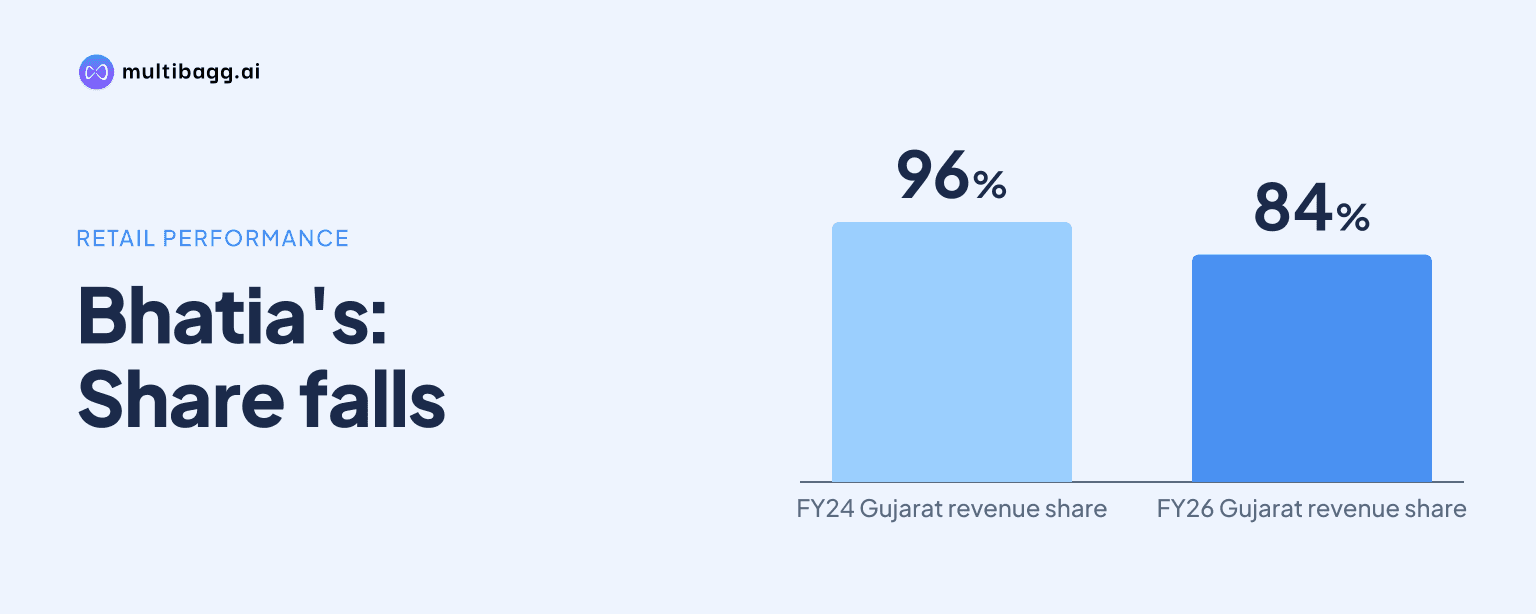
Bhatia Communications & Retail (India) Ltd. reached 428 stores on 30 September 2026, while Gujarat accounted for 84% of FY26 revenue, down from 96% in FY24. The network now spans four states and one Union Territory, with Maharashtra, Madhya Pradesh and Rajasthan contributing stores as Bhatia's pursues a wider regional footprint.
Know Bhatia Communications & Retail (India) inside out
Results, valuation, peers and who's buying, in one view.
How is Bhatia's store network spreading beyond Gujarat?
Bhatia's operated 428 stores as of 30 September 2026, comprising 425 owned stores and three franchisee stores. The retailer reported 280 stores in Gujarat, 87 in Maharashtra, 42 in Madhya Pradesh, 14 in Dadra & Nagar Haveli, and five in Rajasthan. These state-level counts total the reported 428-store network.
The network grew from 340 stores in FY26 to 428 by the end of September 2026, an increase of 88 stores. Maharashtra was Bhatia's first state outside Gujarat, entered in FY23 with one store; it had 52 stores in FY26 and 87 by the reported H1 FY27 position. Madhya Pradesh, entered in FY26 with 17 stores, reached 42 stores, while Rajasthan was entered in FY27.
Bhatia's describes its expansion method as cluster-led, meaning it seeks a foothold in a market before increasing local density. Its seven warehouses support inventory availability and faster fulfilment across the network. The reported retail footprint was about 3.2 lakh square feet, and the average store size was 760 square feet as of 30 September 2026.
How much has Bhatia's reduced its reliance on Gujarat revenue?
Bhatia's reduced Gujarat's contribution to revenue by 12 percentage points between FY24 and FY26, to 84% from 96%. Over the same period, Maharashtra's share increased to 12% from no disclosed share in FY24, while Madhya Pradesh accounted for 1% in FY26 after Bhatia's entered the state during that year.
The sales mix shows that Gujarat remains Bhatia's principal revenue market even though it held 280, or about 65%, of the 428 stores reported on 30 September 2026. Its 84% FY26 revenue share was therefore higher than its share of the later store base. This comparison indicates continuing geographic concentration in sales while the store rollout is becoming more diversified.
The expansion also coincided with higher reported revenue over longer periods. Revenue increased from Rs 250 crore in FY22 to Rs 591 crore in FY26, and the presentation states a 24% revenue compound annual growth rate, or CAGR, for FY22 to FY26. For FY23 to FY26, when Bhatia's began its Maharashtra rollout and then entered Madhya Pradesh, the presentation reports a 20% revenue CAGR.
Got a follow-up? Ask IRIS
What operating model supports Bhatia's geographic rollout?
Bhatia's says its mobile-led, high-turnover model is designed to support regional scale-up through direct original equipment manufacturer, or OEM, sourcing, local service and financing options. Bhatia's reports 100% direct OEM supply and relationships with more than 100 brands, covering mobile phones, tablets, accessories, televisions, washing machines, air conditioners and microwaves.
The store economics disclosed in the presentation set out the capital requirements for each opening. Average capital expenditure per store is Rs 8 lakh to Rs 10 lakh, average working capital per store is Rs 33 lakh to Rs 35 lakh, and the stated payback period is 12 to 13 months. Bhatia's reported FY26 revenue per square foot of more than Rs 22,850 and an average selling price of Rs 20,714.
Mobiles accounted for 97% of FY26 sales, up from 95% in FY24, while accessories declined to 2% from 4%; lifestyle products remained 1% in both periods. This product mix is consistent with Bhatia's stated emphasis on inventory turnover. In FY26, Bhatia's reported 6.5 inventory turns, 49 working-capital days and a net debt-free balance sheet, with net debt to earnings before interest, tax, depreciation and amortisation, or EBITDA, at negative 18% because FY26 was cash positive.
Where does Bhatia's plan to expand next?
Bhatia's says launch processes are under way in Chhattisgarh and Haryana after its FY27 entry into Rajasthan. The presentation describes pan-India expansion as a medium- to long-term objective, rather than specifying a store-count target for either proposed market.
The sequence disclosed by management is Gujarat through FY22, Maharashtra in FY23, Madhya Pradesh in FY26 and Rajasthan in FY27. By the H1 FY27 store position, Maharashtra had 87 stores, Madhya Pradesh had 42 and Rajasthan had five. The presentation frames this sequence as adding population catchments progressively, from the founding-state base to a potential pan-India market.
Management's 2029 slide says store maturation is intended to improve productivity and margins while the mobile-led model protects cash conversion through high inventory velocity. The financial-outlook graphic shows historical revenue of Rs 442 crore in FY25 and Rs 591 crore in FY26, but it does not display a FY29 revenue amount. It labels FY29 EBITDA margin as “5% / 4%”, so the presentation does not provide a single unambiguous FY29 margin forecast.
Conclusion
Bhatia's has moved from a Gujarat-centred retailer toward a multi-state network: its store base reached 428 by 30 September 2026, and Gujarat's revenue contribution fell materially over FY24 to FY26. The change is most visible in Maharashtra, which grew from one store at entry in FY23 to 87 stores by H1 FY27, alongside the newer Madhya Pradesh and Rajasthan operations.
The next disclosed markers are the launch processes in Chhattisgarh and Haryana, the development of Rajasthan beyond five stores, and whether revenue mix continues to shift away from Gujarat. Management's medium- to long-term pan-India ambition depends on its stated density-first approach, the seven-warehouse network and store maturation, while the presentation leaves FY29 revenue and a single EBITDA-margin target unspecified.