










Ind-Swift became net-debt-free in Rs 1,650 crore API sale
Key highlights
- Ind-Swift sold its API and CRAMS business for Rs 1,650 crore and says it repaid all external debt with the proceeds.
- Ind-Swift retained a 7.80% equity stake in Synthimed Labs after the transaction.
- Ind-Swift reported H1 FY27 operating revenue of Rs 420.97 crore, up 35.79% year on year.
- Ind-Swift has disclosed a Rs 250 crore capex programme funded through internal accruals.
powered by IRIS
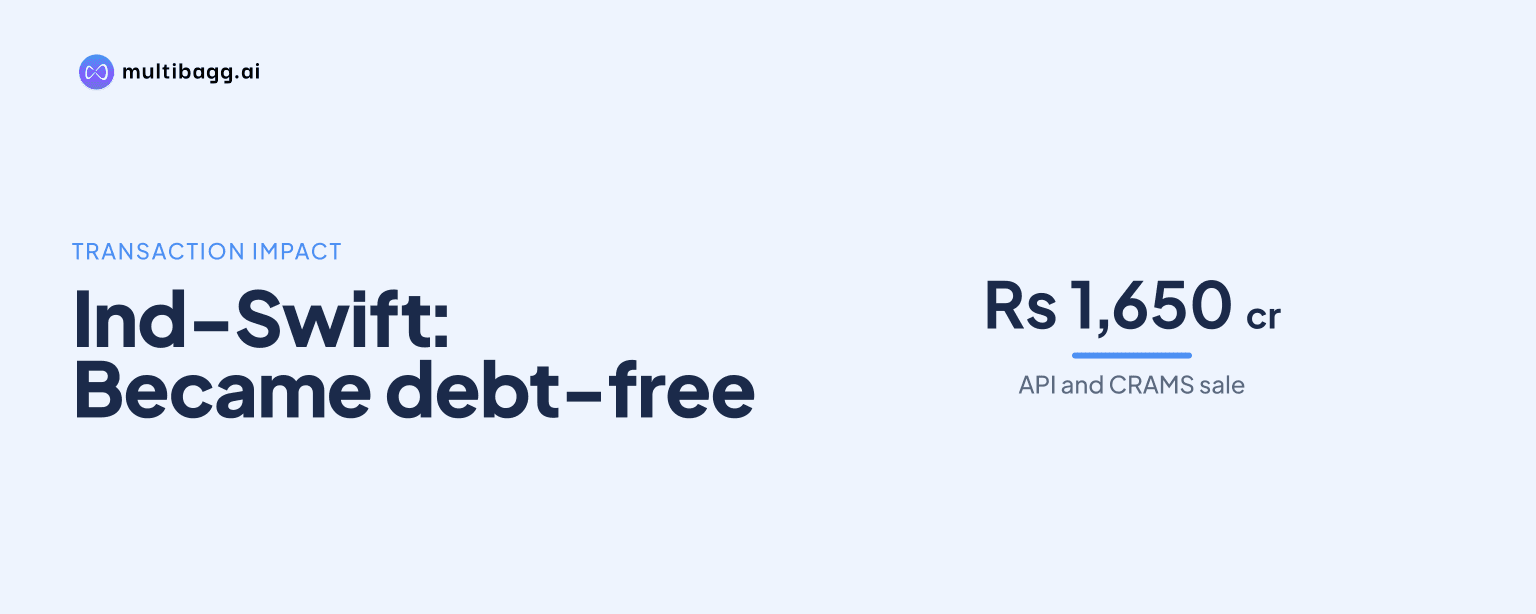
Ind-Swift Laboratories Limited became net-debt-free after its Rs 1,650 crore sale of the active pharmaceutical ingredients and contract research and manufacturing services businesses, with the proceeds used to repay all external debt. Ind-Swift retained a 7.80% equity stake in buyer Synthimed Labs and refocused the listed entity on finished dosage formulations.
Know Ind-Swift Laboratories inside out
Results, valuation, peers and who's buying, in one view.
Why did Ind-Swift sell its API and CRAMS business?
Ind-Swift sold its active pharmaceutical ingredients (API) and contract research and manufacturing services (CRAMS) operations to exit capital-intensive API manufacturing and redirect resources to formulation businesses. The presentation dates the API-unit divestment to 2024 and describes the earlier company as the Ind-Swift Group's dedicated API and CRAMS entity, spanning more than 30 APIs, 26 manufacturing blocks and more than 70 countries.
The former platform had significant scale, with more than 2,500 employees, more than 481 drug master files filed across 33 molecules and activity in 18 therapeutic categories. Its cited approvals included the United States Food and Drug Administration, the UK Medicines and Healthcare products Regulatory Agency, Japan's Pharmaceuticals and Medical Devices Agency, Brazil's ANVISA and Health Canada. Ind-Swift's stated rationale was a business realignment, rather than an assessment of the disposed operations' capabilities.
How did the Rs 1,650 crore sale reset Ind-Swift's balance sheet?
Ind-Swift says it used the Rs 1,650 crore transaction proceeds to repay its entire external debt, moving from a leveraged profile to a net-debt-free balance sheet. The presentation does not disclose the external-debt balance before repayment, the repayment date or the cash remaining after the transaction, so the scale of residual liquidity cannot be calculated from the supplied material.
Ind-Swift retained 7.80% equity in Synthimed Labs, keeping a minority interest in the API business while transferring the operating assets. Synthimed is described as a portfolio company of India Resurgence Fund, associated with Bain Capital and Piramal, and as having three manufacturing sites with United States Food and Drug Administration, Pharmaceuticals and Medical Devices Agency and European Directorate for the Quality of Medicines & HealthCare approvals. The presentation cites Synthimed's current valuation at Rs 8,000 crore to Rs 9,000 crore, but does not give a value for Ind-Swift's holding.
The financial change was accompanied by a group consolidation. Ind-Swift Limited merged into Ind-Swift effective 31 March 2024 after National Company Law Tribunal approval, according to the presentation. Management says that combination created one formulation-focused listed entity, linking the 2024 divestment, debt repayment and retained finished-dosage operations in a single corporate structure.
What business does Ind-Swift operate after the transformation?
Ind-Swift now presents itself as a pure-play finished dosage formulation (FDF) company with an international Global Business Unit and a domestic division. Its post-transformation metrics include more than 900 global product registrations, more than 540 registrations owned by Ind-Swift, more than 2,100 dossiers filed and a presence in more than 85 countries, compared with the former API platform's supply footprint of more than 70 countries.
The international business combines contract manufacturing, own-brand sales and out-licensing of dossiers and intellectual property. Ind-Swift says its contract manufacturing organisation relationships average more than nine to 10 years, while more than 125 medical representatives market own brands in Uzbekistan, East Africa and Myanmar. The domestic division has more than 260 marketing teams serving 20,000 retailers and more than 25,000 doctors, supported by 3,000 stockists and 14 carrying-and-forwarding locations.
The domestic portfolio includes ethical products, trade generics, third-party production and Q-DEN and Nova activities. Ind-Swift reports 39 active repeat clients in third-party production, while Q-DEN and Nova use an advance-payment model that the company says has zero credit risk. These channels differ from the former API and CRAMS structure because they centre on finished-product manufacturing, marketing and dossier ownership rather than active-ingredient production.
Got a follow-up? Ask IRIS
What manufacturing assets support Ind-Swift's formulation model?
Ind-Swift's Derabassi, Punjab facility is a 100% export-oriented unit and its primary revenue engine, while Samba, Jammu and Kashmir serves domestic formulations. Derabassi covers about 81,325 square metres against Samba's 14,700 square metres, showing that the export facility is the larger manufacturing site in the retained two-plant network.
Derabassi has annual capacity for 9 billion tablets, 120 million capsules, 150 million sachets, 184 million sticks, 33 million dry-powder bottles and 30 tonnes of pellets. Ind-Swift says the site can support revenue of at least Rs 1,000 crore and has approvals including those from the UK regulator, Australia's Therapeutic Goods Administration, Health Canada and the World Health Organization's Good Manufacturing Practices programme. Samba has World Health Organization Good Manufacturing Practices and ISO 9001:2008 accreditation.
The company has acquired 18,000 square yards of land at Derabassi for a dedicated warehouse, but the presentation does not state a construction timetable or capital cost. Its Panchkula formulation research and development centre has more than 70 specialised scientists and is approved by the Department of Science and Technology, Government of India. The centre supports stability studies, analytical method validation and dossier preparation for the UK, European Union, Australia and Canada.
What does management plan after Ind-Swift's balance-sheet reset?
Management has disclosed a Rs 250 crore capital-expenditure programme funded through internal accruals, alongside deeper own-brand penetration in export markets and an ongoing Samba EU-GM upgrade. The presentation does not specify the capex allocation between Derabassi and Samba, its completion date or the resulting capacity increase. It does state that the programme is intended to be internally funded following the elimination of external debt.
Chairman and Whole Time Director N.R. Munjal said management expects FY27 revenue growth of more than 50%, medium-term revenue compound annual growth of 20% to 25% and earnings before interest, tax, depreciation and amortisation margin expansion of 200 to 300 basis points. These are management expectations, not reported outcomes. Management reported H1 FY27 operating revenue of Rs 420.97 crore, up 35.79% year on year, while operating earnings before interest, tax, depreciation and amortisation grew more than four times.
For Q2 FY27, management reported an operating earnings before interest, tax, depreciation and amortisation margin of 18.02% and a profit-after-tax margin of 13.21%, while saying operating income grew by more than 50% year on year. The product plan identifies 11 molecules for 2028-29 and two for 2029-30, including Rosuvastatin, Dapagliflozin, Mirabegron prolonged release, Sacubitril plus Valsartan and Empagliflozin. The presentation gives no revenue estimate or approval timetable for those launches.
Conclusion
Ind-Swift's Rs 1,650 crore disposal changed its operating model by removing the API and CRAMS businesses, repaying all external debt and retaining a 7.80% stake in Synthimed. The post-sale company is centred on finished dosage formulations, with a larger export-oriented Derabassi site, a domestic Samba site and more than 540 owned product registrations.
The next matters to watch are execution of the Rs 250 crore internally funded capex programme, progress on the Samba EU-GM upgrade and development of the 13 planned molecules across 2028-29 and 2029-30. Management's stated FY27 targets of revenue growth above 50% and margin expansion of 200 to 300 basis points provide the disclosed benchmarks for the transformed formulation business.