










Biocon Wins FDA Approval for 420 mg Pebrilzo Breast Cancer Injection
Key highlights
- Biocon received US FDA approval for Pebrilzo, a 420 mg pertuzumab-qcay injection for HER2-positive breast cancer.
- EMA’s CHMP issued a positive opinion for Pebrilzo in September 2026, but European Commission approval is still required.
- The earliest disclosed licensed launch date is the first quarter of 2027 in the EU and UK.
- The earliest disclosed licensed US launch date is the third quarter of 2028.
powered by IRIS
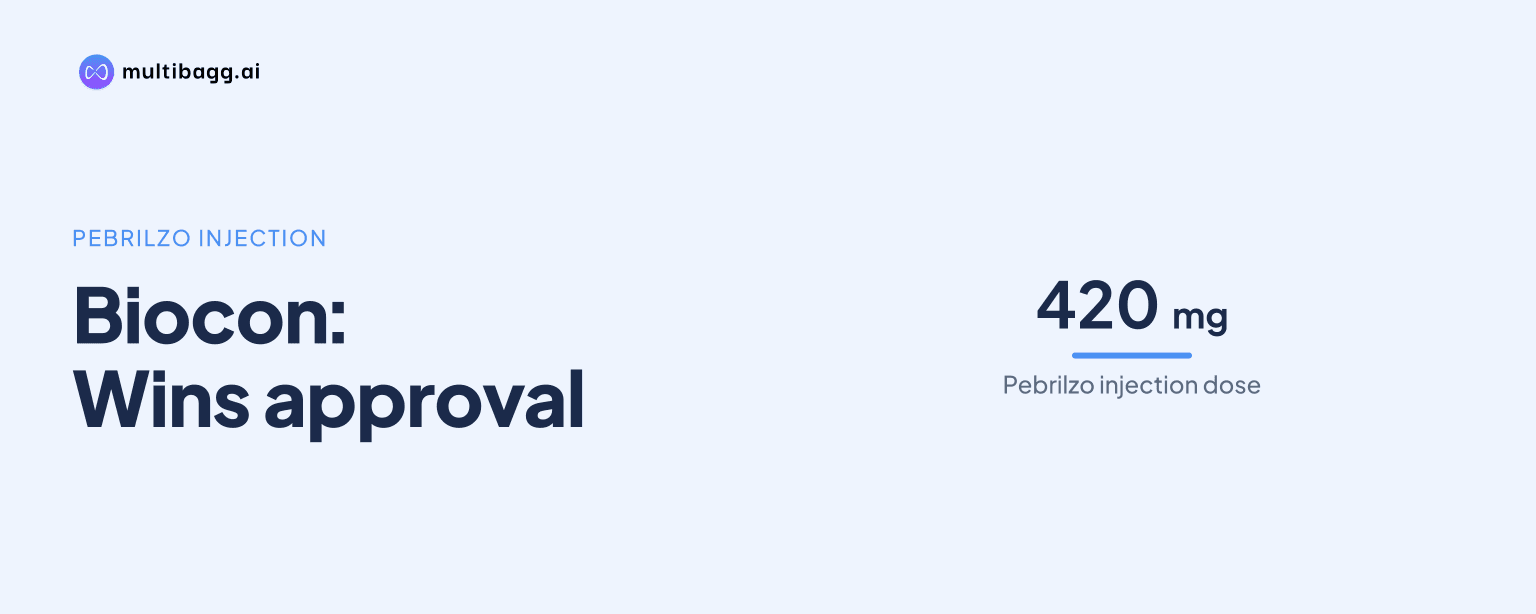
Biocon Ltd has received US Food and Drug Administration approval for Pebrilzo, its 420 mg pertuzumab-qcay injection biosimilar to Perjeta for HER2-positive breast cancer. The approval adds to Biocon’s regulatory progress after the European Medicines Agency’s CHMP issued a positive opinion for the same product in September 2026.
Know Biocon inside out
Results, valuation, peers and who's buying, in one view.
What did the US FDA approve for Biocon?
The US FDA approved Pebrilzo, or pertuzumab-qcay, as a biosimilar to Genentech’s Perjeta for the treatment of HER2-positive breast cancer. Biocon said the product is intended for patients across relevant breast-cancer treatment settings covered by the reference medicine’s use.
Pebrilzo is supplied as a 420 mg concentrate solution for infusion. Pertuzumab is a monoclonal antibody therapy used alongside trastuzumab and chemotherapy in specified HER2-positive breast cancer settings. HER2-positive disease is characterised by elevated human epidermal growth factor receptor 2 activity, which can support tumour growth.
The FDA decision is a regulatory milestone for Biocon’s biosimilar portfolio in the United States. A biosimilar is a biological product demonstrated to be highly similar to an already approved reference medicine, with no clinically meaningful differences in safety and effectiveness under the approved conditions of use.
The information provided does not specify the date of the FDA approval, the commercial launch date, pricing, or expected revenue contribution. Regulatory approval and commercial availability are separate steps, particularly where licensing arrangements or other launch conditions apply.
How did Pebrilzo progress through European review?
Biocon’s European application progressed when the European Medicines Agency’s Committee for Medicinal Products for Human Use, or CHMP, issued a positive opinion in September 2026. The opinion recommended granting marketing authorisation for Pebrilzo in the European Union.
Biocon Biologics Limited, a wholly owned subsidiary of Biocon, announced the CHMP development on September 22, 2026. The marketing-authorisation application was submitted by Biocon Biologics Ireland Limited, formerly known as Biosimilar Collaborations Ireland Limited, an indirect wholly owned subsidiary of Biocon Biologics.
The CHMP recommendation covers Pebrilzo as a 420 mg infusion concentrate for HER2-positive breast cancer across multiple stages of disease. The stated uses include treatment in combination with trastuzumab and chemotherapy for adults with locally advanced, inflammatory, or early-stage HER2-positive breast cancer at high risk of recurrence in neoadjuvant settings.
It also includes adjuvant treatment for adults with HER2-positive early breast cancer at high risk of recurrence. The European Commission must issue the final marketing-authorisation decision before the medicine can be marketed in the European Union.
What are the key Pebrilzo regulatory details?
The main disclosed facts show that Pebrilzo has an FDA approval in the United States and a positive CHMP opinion in Europe, but its European marketing authorisation remains pending. The information also identifies the product’s presentation and disclosed licensed launch windows.
The disclosed launch schedule states that the earliest licensed launch dates are the first quarter of calendar 2027 in the European Union and the United Kingdom, the third quarter of calendar 2028 in the United States, and 2026 to 2028 in other markets. These timings remain subject to regulatory approval and applicable arrangements.
This distinction is material for investors because an FDA clearance does not by itself establish the timing of product sales. The provided information identifies a later earliest licensed US launch date, which means market entry depends on conditions beyond the stated regulatory decision.
Got a follow-up? Ask IRIS
Why does a positive CHMP opinion matter for Biocon?
A positive CHMP opinion matters because it is a key step in the European Union’s centralised medicine-approval process. The European Commission typically takes the final decision, and Pebrilzo cannot be sold in the EU until that authorisation is granted.
The CHMP review is also notable because Pebrilzo has been described as the first monoclonal antibody biosimilar to receive a positive opinion under the EMA’s tailored clinical development approach. The supplied information does not provide comparative clinical data or further details of that review pathway.
Biocon develops and commercialises biologics, biosimilars and complex small-molecule active pharmaceutical ingredients in India and global markets. It also has generic formulations operations in the United States and Europe, placing the Pebrilzo regulatory process within a wider international product portfolio.
In India, the information notes that domestic pharmaceutical companies including Zydus Lifesciences, Dr Reddy’s Laboratories, Alkem Laboratories and Intas Pharma market biosimilar alternatives to pertuzumab. That indicates an established biosimilar market for this therapy area domestically, although no pricing or market-share figures were provided.
How could the approval affect Biocon and the biosimilar market?
The FDA approval and European regulatory progress expand Biocon’s set of potential markets for its pertuzumab biosimilar. For patients and healthcare providers, a biosimilar approval creates the basis for an additional treatment option once commercial launch and local access arrangements are in place.
For Biocon, the financial effect cannot be quantified from the available information because no sales forecast, launch price, market-share estimate, investment amount, or revenue guidance was disclosed. The earliest stated US licensed launch date of the third quarter of 2028 is therefore an important timing factor when assessing any potential contribution from Pebrilzo.
The approval process also illustrates the role of differing regulatory systems. In the United States, the FDA approval has been announced. In the EU, the CHMP opinion is favourable but does not itself grant permission to market the product, leaving the European Commission’s decision as the next required regulatory action.
Conclusion
Biocon has secured FDA approval for its 420 mg Pebrilzo biosimilar for HER2-positive breast cancer and has separately received a positive CHMP opinion for the product in Europe. Together, the developments strengthen the regulatory position of its pertuzumab programme, while commercial availability remains dependent on market-specific requirements.
The next disclosed milestones are the European Commission’s decision on EU marketing authorisation and the stated earliest launch windows. Investors will also watch for any further information from Biocon on commercial launch plans, product pricing, distribution arrangements and the expected financial contribution of Pebrilzo.