










Biocon Generics H1 EBITDA reaches Rs 120 crore after loss
Key highlights
- Biocon Generics reported H1FY27 EBITDA of Rs 120 crore, versus a Rs 28 crore loss in H1FY26.
- Generics revenue grew 15% year on year in H1FY27.
- Q2FY27 Generics EBITDA rose to Rs 64 crore from Rs 7 crore in Q2FY26.
- Q2FY27 Generics EBITDA margin increased to 8% from 1% a year earlier.
powered by IRIS
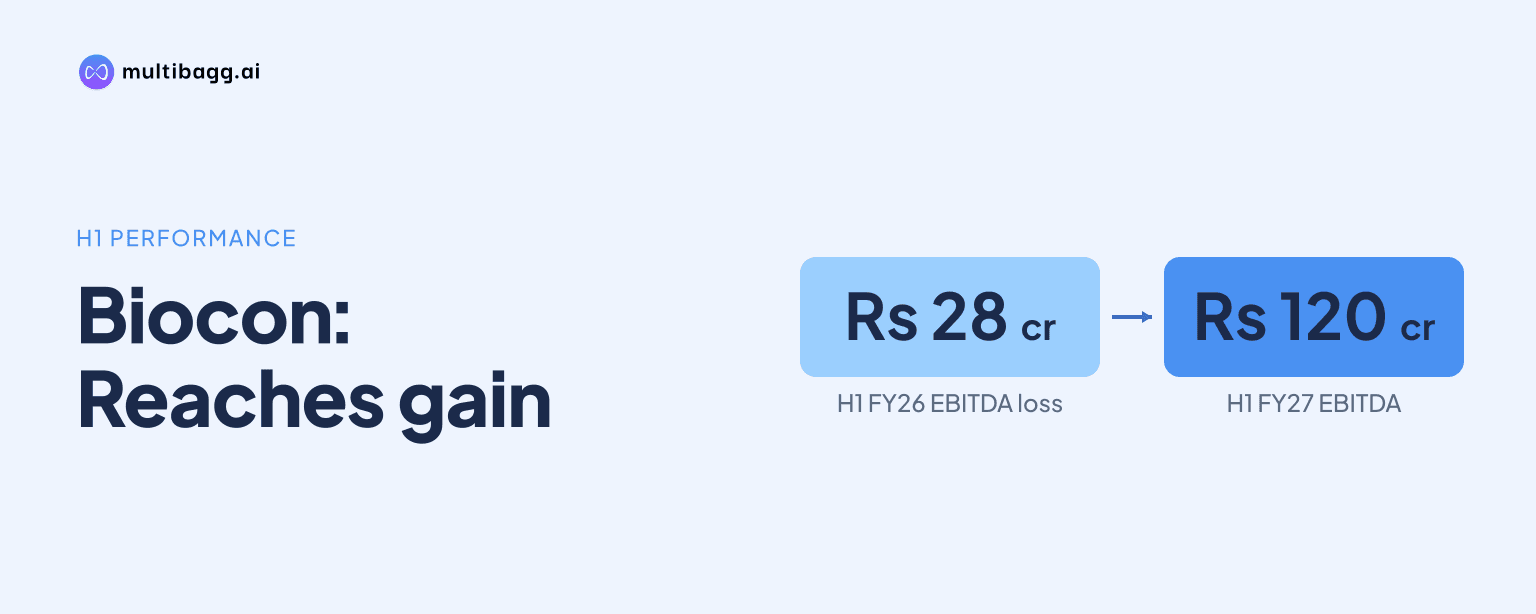
Biocon Limited’s Generics business reported earnings before interest, tax, depreciation and amortisation (EBITDA) of Rs 120 crore in H1FY27, reversing a Rs 28 crore EBITDA loss in H1FY26, as revenue grew 15% year on year. Biocon attributed the turnaround to higher asset utilisation, operating leverage and disciplined cost management.
Know Biocon inside out
Results, valuation, peers and who's buying, in one view.
How did Biocon Generics return to profit in H1FY27?
Biocon Generics returned to profit in H1FY27 as EBITDA reached Rs 120 crore, compared with a loss of Rs 28 crore in H1FY26. Management said higher utilisation of manufacturing assets, operating leverage and cost discipline allowed earlier investments in the business to translate into improved financial performance.
The Q2FY27 result supports management’s view that the improvement extended beyond a single period. Generics revenue was Rs 774 crore in Q2FY27, while EBITDA rose to Rs 64 crore from Rs 7 crore in Q2FY26 and the EBITDA margin increased to 8% from 1%. The source does not disclose separate Q1FY27 Generics revenue or EBITDA, so the first-half quarterly progression cannot be calculated precisely.
The reported comparison shows a Rs 148 crore swing in first-half EBITDA between H1FY26 and H1FY27. Q2FY27 also accounted for more than half of the Rs 120 crore first-half EBITDA, indicating that the business had generated positive EBITDA before the quarter, although Biocon did not quantify that earlier contribution.
Which Generics activities are driving Biocon’s growth?
Biocon said growth was steady across active pharmaceutical ingredients (APIs), formulations and new launches, but it did not disclose revenue or growth by activity. Management described the API operation as continuing to contribute and said it partners with several customers across geographies, providing an established component of the Generics business.
Liraglutide is the specifically identified formulations driver. Biocon said its glucagon-like peptide-1, or GLP-1, portfolio was important to growth, with liraglutide contributing across multiple markets and growing according to plan in the United States. Management said Biocon’s integrated position enabled it to reliably manufacture and supply the product while some other market participants had entered and later exited.
Biocon continues to prioritise research and development toward peptides, fermentation and other complex formulations. Management said it was seeking to realise prior Generics investments rather than making new investments at the earlier pace, with future research spending intended to be more commensurate with revenue. The call did not disclose a Generics research budget or quantify any spending reduction.
What does Biocon’s semaglutide plan involve?
Biocon’s immediate GLP-1 contribution is liraglutide, while semaglutide remains a programme management intends to advance progressively with partners. The company said it was working with partners in several key markets, including Brazil, where it aims to localise the semaglutide opportunity. It did not disclose a launch date, approval timeline, sales target or contract value.
Management said Biocon has capabilities in both chemical synthesis and fermentation for semaglutide. It argued that fermentation could become particularly relevant if demand shifts from injectable to oral products because oral formats require substantially higher quantities of API. Management also said fermentation can reduce drug-substance cost, but gave no manufacturing-cost, yield or capacity comparison.
The company expects its fermentation capability to differentiate it as the market evolves, but this is management’s forward-looking expectation rather than a reported commercial outcome. The current disclosed evidence is liraglutide’s growth in the United States and other markets, alongside Biocon’s stated ability to integrate API production and formulations.
Got a follow-up? Ask IRIS
What costs did the Generics turnaround absorb?
Biocon said its H1FY27 reported margins already included higher freight costs and higher solvent costs across the combined biopharma businesses. Management said solvents and other chemicals have some dependency on crude oil, and that a large part of the solvent-cost impact related to Generics. It did not provide a stand-alone Generics cost figure.
Management said both freight and solvent costs were easing during the remaining quarters of FY27, but did not forecast the savings or quantify a potential effect on Generics EBITDA. The Rs 120 crore H1FY27 EBITDA therefore reflects the profitability achieved while those logistics and input pressures were present, rather than a result adjusted to exclude them.
At the group level, Biocon reported Q2FY27 EBITDA of Rs 865 crore and interest cost of Rs 240 crore, down 12% year on year. Management linked the interest-cost reduction to balance-sheet actions and said lower interest expense had been visible since Q3FY26. Those figures are separate from Generics, but form part of management’s stated focus on cash flow, debt reduction and return on capital employed.
Why does Biocon expect a stronger H2FY27?
Biocon expects H2FY27 to be stronger than H1FY27, including continued profitability improvement in Generics. Management said the business had demonstrated progress for two quarters and expects utilisation, operating leverage and cost discipline to continue converting previous investments into earnings. It did not provide full-year Generics revenue, EBITDA or margin guidance.
The group’s H2FY27 outlook also includes Biosimilars and Services. Services revenue at Syngene rose 13% sequentially to Rs 833 crore in Q2FY27, while EBITDA margin improved to 20% from 15% in Q1FY27. For H1FY27, Biocon’s consolidated operating revenue grew 6% to Rs 8,725 crore and consolidated EBITDA was Rs 1,767 crore, equal to a 20% margin.
A one-off logistics-related revenue-recognition deferral in Biosimilars also affects the group comparison. Biocon said shipments delayed beyond September represented about 5% of Q2FY27 revenue and were booked in October, with the related incremental EBITDA, other than shipping and freight, expected in Q3FY27. This issue did not concern Generics, but supports management’s expectation of a stronger group second half.
Conclusion
Biocon’s Generics turnaround is measured by the move from a Rs 28 crore EBITDA loss in H1FY26 to Rs 120 crore of EBITDA in H1FY27, alongside 15% revenue growth. The Q2FY27 result of Rs 64 crore EBITDA and an 8% margin, compared with Rs 7 crore and 1% a year earlier, indicates that management’s utilisation and cost actions were reflected in reported earnings.
The next results will show whether this improvement continues through H2FY27 as management pursues further Generics profitability gains. Investors will also watch progress in liraglutide, the planned development of semaglutide with partners including in Brazil, and whether easing freight and solvent costs support the company’s stated margin, cash-flow and debt-reduction priorities.