










Biocon says logistics delays shifted $20 million from Q2 into Q3
Key highlights
- Biocon said about 5% of Q2 FY27 revenue, roughly $20 million, was deferred from September into October.
- Biocon reported Q2 FY27 Biosimilars revenue of Rs 2,809 crore and EBITDA of Rs 623 crore.
- Biocon said normal operating costs were largely booked in Q2, while the deferred shipments should add incremental EBITDA in Q3.
- Biocon reported H1 FY27 operating revenue of Rs 8,725 crore, up 6% year on year, with a 20% EBITDA margin.
powered by IRIS
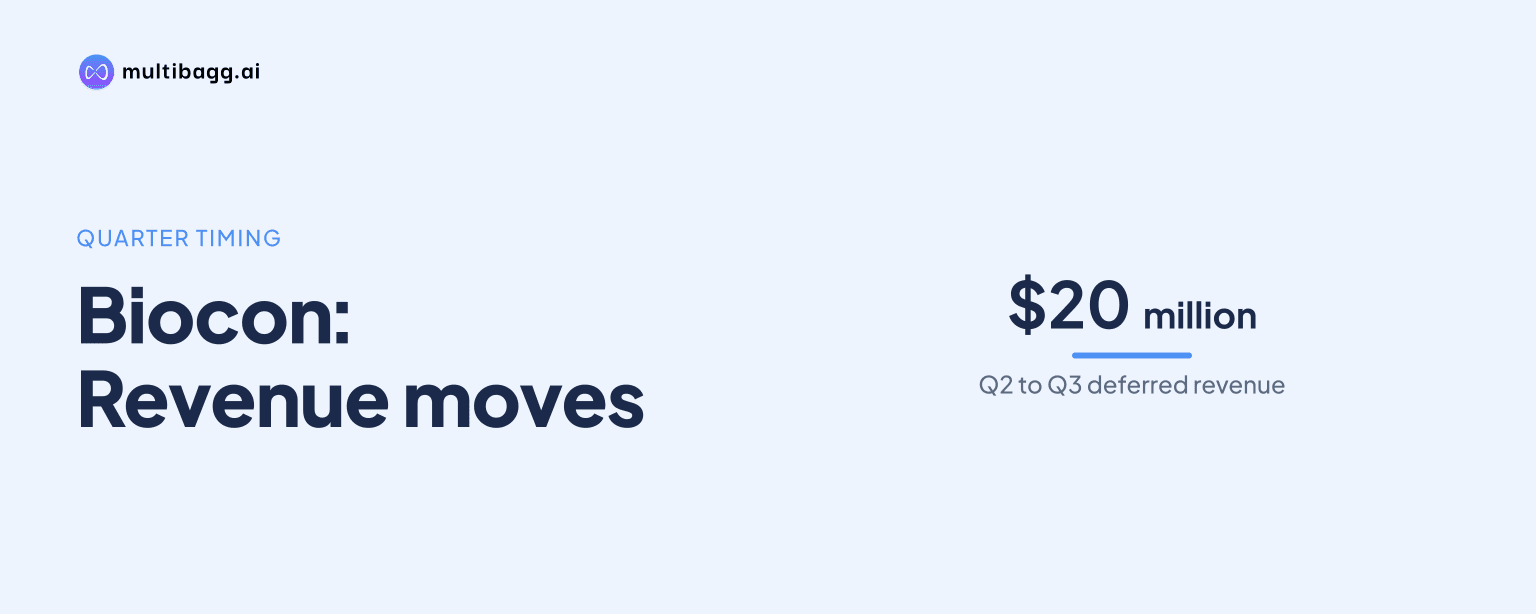
Biocon Limited said logistics delays shifted approximately 5% of Q2 FY27 revenue, or roughly $20 million, from September into October, placing recognition in Q3 rather than Q2; management said orders and product were available, while most normal operating costs were recorded in Q2.
Know Biocon inside out
Results, valuation, peers and who's buying, in one view.
Why did Biocon defer revenue from Q2 FY27?
Biocon deferred revenue because certain biosimilar shipments reached customers in October rather than before the September quarter-end, preventing recognition in Q2 FY27. Chief Executive Officer Shreehas Tambe described the event as a one-off logistics issue, including effects related to the ongoing geopolitical situation, rather than a change in the sales run rate or a cancellation of orders.
Chief Financial Officer Kedar Upadhye said sales cut-offs or spillovers are normally about 1% at Biocon, but the Q2 FY27 amount was sufficiently larger to be separately disclosed. Customer orders were in place and product was available, but deliveries were completed in October. Biocon therefore booked the related sales in October, the first month of Q3 FY27.
The delay affected biosimilar shipments, particularly insulin and monoclonal antibodies, or mAbs. Upadhye said it was not primarily connected with newly launched products. This distinction matters because management attributed the timing shift to shipment completion, while separately citing order visibility for newer products including aflibercept, insulin aspart, ustekinumab and pertuzumab.
How large was Biocon's Q2 revenue timing effect?
Biocon put the deferred amount at approximately 5% of Q2 FY27 revenue and roughly $20 million. Management did not present a product-by-product breakdown or convert that amount into rupees on the call. The company said the sales had subsequently been booked in October, making the effect a movement from Q2 into Q3 rather than revenue expected to disappear from FY27.
The timing effect came during a quarter in which Biocon reported consolidated operating revenue growth of 2% year on year and earnings before interest, tax, depreciation and amortisation, or EBITDA, of Rs 865 crore. For H1 FY27, consolidated operating revenue rose 6% year on year to Rs 8,725 crore, while EBITDA was Rs 1,767 crore and the EBITDA margin was 20%.
Biocon's Biosimilars business reported Q2 FY27 revenue of Rs 2,809 crore and EBITDA of Rs 623 crore. For H1 FY27, biosimilars revenue grew 9% year on year and its EBITDA margin was 24%. Management said the delayed recognition reduced reported quarterly revenue and margins even though the underlying shipments and sales were subsequently recorded.
Got a follow-up? Ask IRIS
Why did the revenue delay weigh on Q2 margins?
Biocon said shipment-related costs would follow revenue into Q3, but the majority of normal operating expenses remained in Q2. Upadhye said shipping and freight required for the deferred deliveries would be deferred, whereas other costs were period expenses and were booked in the September quarter. As a result, incremental EBITDA related to the shipments is expected to be recognised in Q3.
That accounting pattern means the Q2 margin effect was not limited to deferred revenue recognition. The quarter carried personnel, commercial and other recurring operating costs without the corresponding full revenue contribution. Management said Q2 gross and EBITDA margins should therefore be adjusted for the temporary spillover when assessing reported profitability.
Biocon's Q2 FY27 Biosimilars EBITDA was Rs 623 crore on revenue of Rs 2,809 crore, while management said it remains comfortable with biosimilars EBITDA margins in the mid-20% range as revenue scales. The company did not quantify the exact freight cost or exact EBITDA contribution deferred into Q3, beyond saying that the roughly $20 million revenue amount would be recognised after shipping and freight.
The margin movement differs from Biocon's Generics and Services businesses. Generics reported Q2 FY27 EBITDA of Rs 64 crore, compared with Rs 7 crore in Q2 of the prior year, lifting its EBITDA margin to 8% from 1%. Services revenue was Rs 833 crore, up 13% sequentially, and its EBITDA margin rose to 20% from 15% in Q1 FY27.
What supports Biocon's stronger second-half expectation?
Biocon management expects H2 FY27 to be stronger than H1 FY27, supported first by the October recognition of delayed shipments and then by biosimilar launches, insulin capacity and contract activity. This is management guidance, not a reported full-year forecast. The company said it has strong order visibility for aflibercept, insulin aspart, ustekinumab and pertuzumab.
In the United States, Biocon said Yesintek had reached 34% market share and surpassed the originator. Yesafili, its biosimilar aflibercept, had secured more than 50% market access, according to management. The company also said it added more than $100 million in new contracts and major payor wins, though it did not state the timing over which those contracts would convert into revenue.
Supply capacity is another part of management's H2 plan. The company said a second insulin fill-finish line in Malaysia had been commissioned, and European supplies from the newly approved line began in Q2 FY27. Management said insulin demand remains constrained by available production capacity, with the insulin franchise exceeding $300 million in annual run rate according to the discussion with an analyst.
Biocon also cited the Brazilian pertuzumab agreement as visibility beyond H2. Its 10-year Productive Development Partnership contract has a total value of $400 million, with supplies scheduled to begin in Q4 FY27 and the full annual run rate expected to appear in FY28. Separately, the global Pebrilzo settlement provides for European and United Kingdom launch from early calendar 2027 and a United States launch from Q3 calendar 2028, subject to regulatory approvals.
Conclusion
The Q2 FY27 logistics disruption was a revenue-recognition timing issue with a measurable effect on Biocon's reported biosimilars revenue and margins: approximately 5% of quarterly revenue, or roughly $20 million, shifted from September to October. Because normal operating costs were largely recorded in Q2, management expects the delayed sales to add incremental EBITDA in Q3 after the relevant freight and shipping costs.
The next evidence point is Q3 FY27, when investors can assess whether October bookings appear as management described and whether biosimilars margins move toward the mid-20% range it indicated. Beyond Q3, disclosed milestones include Brazilian pertuzumab supplies in Q4 FY27, a full-year contribution from that contract in FY28, and Pebrilzo's planned early-calendar-2027 European launch window, subject to approvals.