










Biocon wins FDA approval for Pebrilzo, launch set for Q3 2028
Key highlights
- Biocon received FDA approval for Pebrilzo, a pertuzumab-qcay biosimilar to Perjeta, on November 16, 2026.
- Pebrilzo is Biocon's fifth FDA-approved oncology biosimilar in the United States.
- A Genentech agreement sets Q3 2028 as the earliest licensed U.S. commercial launch date for Pebrilzo.
- About 320,000 U.S. women are expected to be diagnosed with breast cancer in 2026, with about 20% expected to have HER2-positive disease.
powered by IRIS
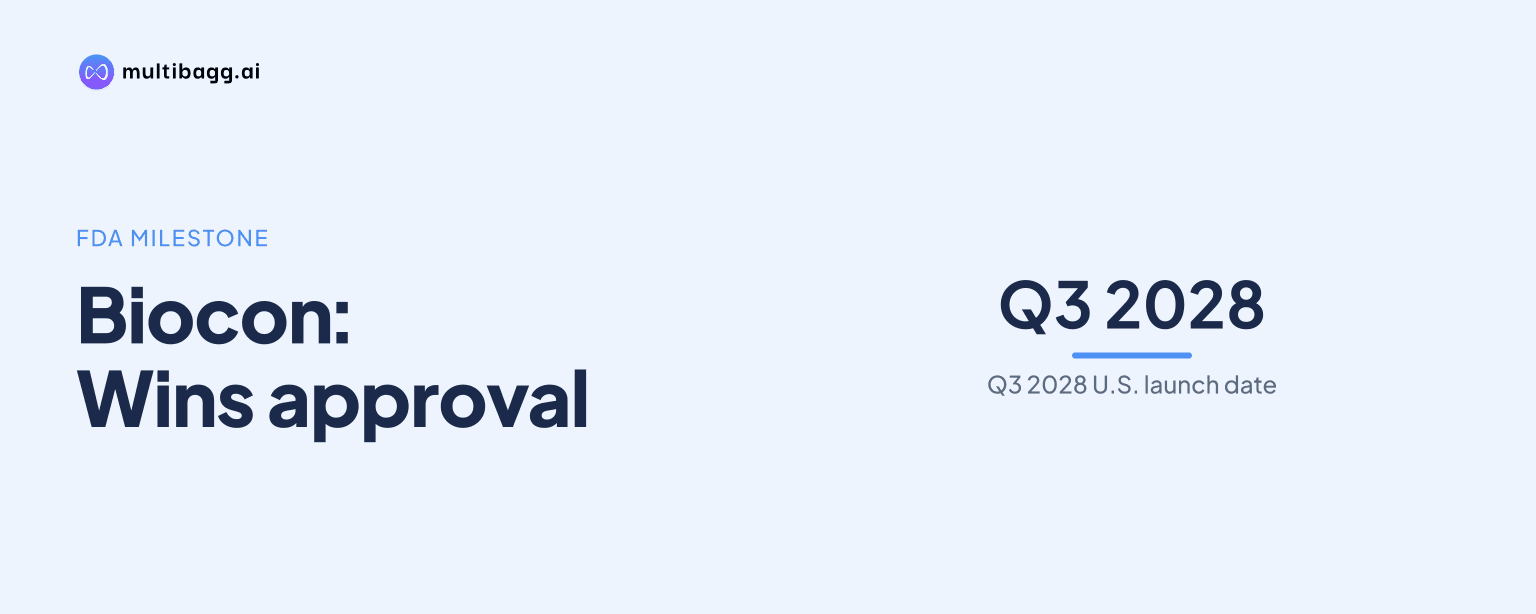
Biocon Limited won U.S. Food and Drug Administration (FDA) approval on November 16, 2026 for Pebrilzo, its pertuzumab-qcay biosimilar to Perjeta, lifting its U.S. oncology biosimilar portfolio to five therapies; however, its agreement with Genentech sets Q3 2028 as the earliest licensed U.S. commercial launch.
Know Biocon inside out
Results, valuation, peers and who's buying, in one view.
What did the FDA approve for Biocon?
The FDA approved Biocon's Pebrilzo (pertuzumab-qcay) as a biosimilar to Perjeta (pertuzumab) for HER2-positive breast cancer on November 16, 2026. Pebrilzo is a monoclonal antibody that blocks HER2 receptors on cancer cells, and the approval adds a fifth oncology biosimilar to Biocon's U.S. portfolio.
Biocon said the approval was supported by structural and functional analytical characterisation, analytical similarity testing, and comparative clinical pharmacokinetic data. The company said this package found Pebrilzo highly similar to Perjeta, with no clinically meaningful differences in quality, safety, efficacy or immunogenicity.
Pebrilzo is indicated with trastuzumab and docetaxel for adults with HER2-positive metastatic breast cancer who have not received prior anti-HER2 therapy or chemotherapy for metastatic disease. For early breast cancer, it is indicated with trastuzumab and chemotherapy in neoadjuvant treatment for disease greater than 2 centimetres or node-positive, and in adjuvant treatment for adults at high risk of recurrence.
When can Biocon launch Pebrilzo in the United States?
Biocon can make its earliest licensed U.S. commercial launch of Pebrilzo in Q3 of calendar 2028 under a global settlement and licence agreement with Genentech. The November 2026 FDA decision establishes regulatory approval, while the Genentech agreement sets the disclosed timing for U.S. market entry.
The interval from November 16, 2026 to Q3 2028 means Pebrilzo is not yet commercially launched in the United States under the timeline disclosed by Biocon. The announcement does not give a more specific launch date, a U.S. price, expected sales, supply volumes, royalty terms or other financial terms of the settlement.
Biocon also reported a European regulatory development in September 2026. The European Medicines Agency's Committee for Medicinal Products for Human Use gave a positive opinion recommending marketing authorisation for Biocon's pertuzumab biosimilar, a 420 milligram per 14 millilitre concentrate solution for infusion under the Pebrilzo brand.
How does Pebrilzo change Biocon's oncology portfolio?
Pebrilzo becomes Biocon's fifth FDA-approved oncology biosimilar in the United States, joining Ogivri, Jobevne, Fulphila and Aukelso. The November 2026 approval therefore increases the named U.S. oncology set from four therapies to five, with Pebrilzo contributing the pertuzumab molecule.
The five products cover different biosimilar medicines: Ogivri is trastuzumab-dkst, Jobevne is bevacizumab-nwgd, Fulphila is pegfilgrastim-jmdb, Aukelso is denosumab-kyqq, and Pebrilzo is pertuzumab-qcay. Pebrilzo and Ogivri place two HER2-directed molecules in Biocon's stated oncology portfolio, although the filing does not describe their commercial arrangements or sales contribution.
Biocon also identified proposed biosimilars to trastuzumab/hyaluronidase, nivolumab and pembrolizumab in its oncology pipeline. These programmes span HER2-directed therapy and immuno-oncology, but the November 2026 release provides no filing dates, approval targets or launch schedules for the three candidates.
Got a follow-up? Ask IRIS
Which treatment need does Pebrilzo address?
Pebrilzo addresses HER2-positive breast cancer, a subtype characterised by HER2 protein overexpression or HER2 gene amplification that drives aggressive tumour growth. Biocon said approximately 320,000 women in the United States are expected to be diagnosed with breast cancer in 2026, and about 20% of those cases are expected to be HER2-positive.
The approved treatment settings span metastatic and early breast cancer rather than a single disease stage. In metastatic disease, Pebrilzo is used with trastuzumab and docetaxel, while the early-breast-cancer uses require trastuzumab and chemotherapy before or after surgery in the specified patient groups.
Biocon's Chief Executive Officer and Managing Director, Shreehas Tambe, said the fifth U.S. oncology biosimilar approval advances the company's aim of expanding access to high-quality, affordable biologic medicines. That is management's stated objective; the filing gives no U.S. price, reimbursement coverage, forecast patient number or revenue estimate for the Q3 2028 launch.
What safety information accompanies Pebrilzo?
Pebrilzo carries boxed warnings for left ventricular dysfunction and embryo-fetal toxicity. Biocon says cardiac function should be evaluated before and during treatment, while patients should be advised of fetal-harm risks and the need for effective contraception.
In the CLEOPATRA metastatic breast-cancer study cited in the product information, left ventricular dysfunction occurred in 4% of pertuzumab-treated patients and symptomatic left ventricular systolic dysfunction occurred in 1%. In NeoSphere, a neoadjuvant study, a left ventricular ejection fraction decline of more than 10% with a fall below 50% occurred in 8% of patients, while left ventricular dysfunction occurred in 3%.
Infusion-related reactions and hypersensitivity also require monitoring. In CLEOPATRA, infusion-related reactions occurred in 13% of patients receiving pertuzumab alone on the first day, with fewer than 1% classified as Grade 3 or 4; in APHINITY, the comparable reaction rate was 21% when pertuzumab was given with trastuzumab and chemotherapy.
The most common adverse reactions, reported in more than 30% of patients in specified regimens, include diarrhoea, alopecia, neutropenia, nausea, fatigue, rash and peripheral neuropathy in metastatic breast cancer. Pebrilzo is contraindicated for patients with known hypersensitivity to pertuzumab or its excipients.
Conclusion
Biocon's November 16, 2026 FDA approval gives Pebrilzo a defined role in HER2-positive metastatic and early breast-cancer regimens and raises its U.S. oncology biosimilar count from four to five. The regulatory milestone is supported by Biocon's stated analytical and comparative pharmacokinetic evidence, but it does not itself allow immediate U.S. commercial entry.
The next disclosed event to watch is the earliest licensed U.S. launch in Q3 2028 under the Genentech settlement and licence agreement. Biocon has also disclosed a September 2026 positive European committee opinion, but not a European marketing authorisation or launch date, leaving that regulatory outcome unresolved.