










Birla Pivot revenue run-rate crosses Rs 11,000 crore Q2FY27
Key highlights
- Birla Pivot reported Q2FY27 revenue of Rs 2,785 crore, up 66% year on year.
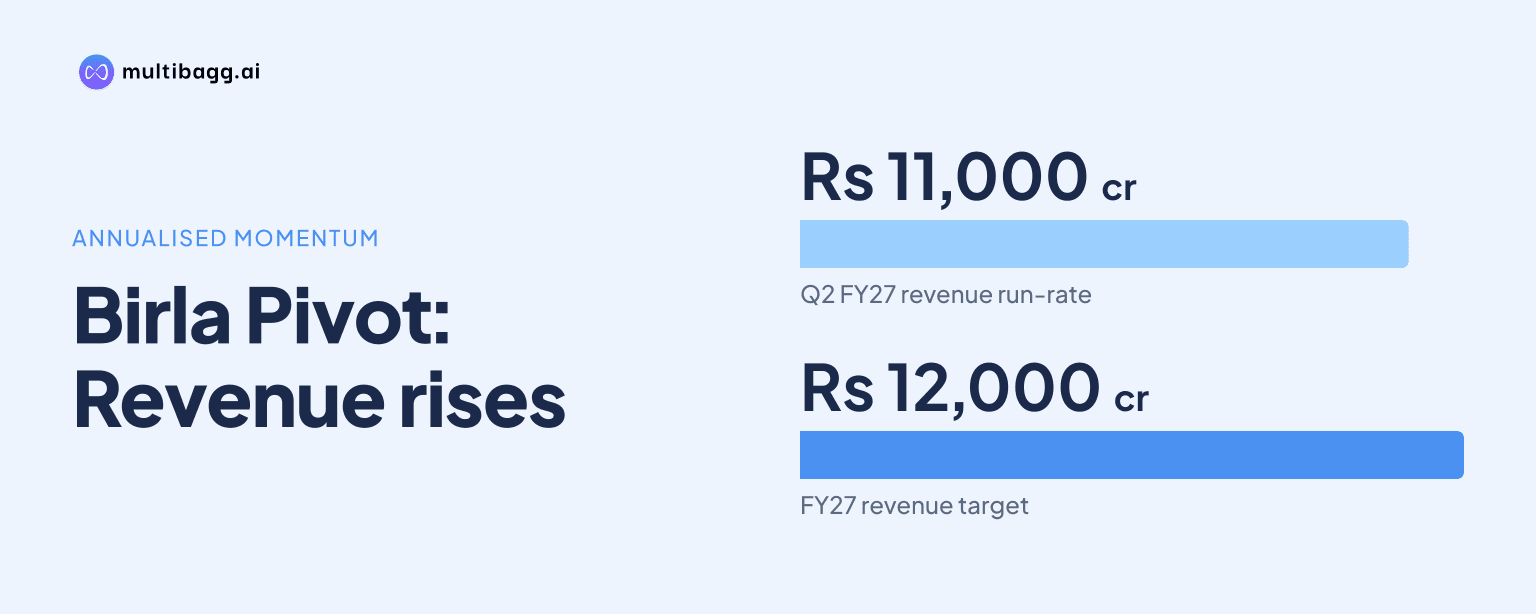
- Birla Pivot's Q2FY27 annualised revenue run-rate crossed Rs 11,000 crore.
- Project business represented 90% of Birla Pivot revenue in Q2FY27, compared with 10% for Retail.
- Management aims for Birla Pivot to cross Rs 12,000 crore of FY27 revenue and reach EBITDA break-even in H2FY27.
powered by IRIS
Birla Pivot reported revenue of Rs 2,785 crore in Q2FY27, up 66% year on year, lifting its annualised revenue run-rate above Rs 11,000 crore; management said it was on track for earnings before interest, tax, depreciation and amortisation (EBITDA) break-even in H2FY27 despite one-time employee-related expenses.
Know Grasim Industries inside out
Results, valuation, peers and who's buying, in one view.
How fast is Birla Pivot growing?
Birla Pivot grew Q2FY27 revenue by 66% year on year to Rs 2,785 crore, while its annualised revenue run-rate crossed Rs 11,000 crore. The presentation does not provide Birla Pivot's Q2FY26 revenue, Q1FY27 revenue or H1FY27 revenue as standalone absolute figures, so the reported year-on-year growth rate is the available comparison for the platform's quarterly performance.
Management aims to cross Rs 12,000 crore of revenue in FY27. That aim is Rs 1,000 crore above the disclosed Q2FY27 annualised run-rate threshold, although an annualised quarter and a full-year revenue total are different measures. Grasim Industries Limited reported Q2FY27 revenue of Rs 27,378 crore, up 23% year on year, with cement, paints and B2B e-commerce cited as contributors.
The platform's growth disclosure is based on revenue rather than transaction volume, order count or customer count. Birla Pivot said its value proposition had improved across price, assortment and experience, but it did not quantify the contribution of any of those three pillars to the Rs 2,785 crore Q2FY27 revenue total.
What does Birla Pivot sell through its platform?
Birla Pivot is a business-to-business e-commerce platform for building materials and related industrial inputs, offering more than 50,000 stock-keeping units from more than 1,000 brands. Its categories include steel and allied products, cement and allied products, tiles and surfaces, bricks and blocks, bitumen, sanitary ware, pipes and fittings, ply and laminates, metals, and chemicals and polymers.
The platform says its end-to-end model covers demand prediction, product assortment, sourcing, logistics and financing. Its stated customer proposition consists of competitive pricing, assured quality, guaranteed delivery, financial solutions and a seamless experience, combining several procurement steps that are traditionally fragmented in business-to-business transactions.
Birla Pivot identified a total addressable market of more than $200 billion for construction raw materials, chemicals and metals by 2030, alongside digital penetration of less than 2%. It also cited a 10% three-year industry compound annual growth rate, or CAGR, as a demand driver, but the presentation does not state Birla Pivot's market share.
Which revenue streams are driving Birla Pivot?
Birla Pivot's Project business accounted for 90% of revenue and its Retail business accounted for 10% in Q2FY27. The disclosed mix shows that projects generated the majority of the platform's Rs 2,785 crore quarterly revenue, while retail was the smaller of the two reported channels.
Building Materials, Non-Ferrous Metals and Chemicals were identified as key growth drivers in Q2FY27, supported by deeper assortment in high-potential categories. The presentation does not disclose category-level revenue or growth rates, so it does not quantify how much any of these three verticals contributed to the quarterly revenue figure.
Private labels are gaining traction in Birla Pivot Ply, Tiles and Bathware, according to the presentation. This is a separate route to category expansion from the more than 1,000 third-party brands listed on the platform, but Birla Pivot does not disclose private-label sales, gross margin or the number of private-label products in Q2FY27.
Got a follow-up? Ask IRIS
How is Birla Pivot building repeat business?
Birla Pivot says customer acquisition, repeat engagement and fulfilment reinforce its growth model. In Q2FY27, it described a proprietary technology-led ecosystem that brings product discovery, sourcing, pricing, order placement, credit and fulfilment into a unified procurement journey.
Credit-linked commerce is another component of the platform's model. Pivot Vault and partnerships with banks and non-banking financial companies are intended to provide working-capital solutions for buyers and sellers, alongside the platform's sourcing and delivery functions.
The presentation does not provide a loan book, credit disbursal figure, number of borrowers, customer count, repeat-purchase rate or default metric for Pivot Vault in Q2FY27. As a result, the scale of the financing activity and its direct contribution to revenue or profitability cannot be measured from the disclosed information.
When does Birla Pivot expect to reach EBITDA break-even?
Birla Pivot said it is on track to achieve EBITDA break-even in H2FY27. Management linked that objective to execution on category economics and cost discipline, together with a rapidly expanding ecosystem of products, brands and customers.
Management also said gross margins continued to improve gradually in Q2FY27, but quarterly EBITDA was affected by one-time employee-related expenses. Birla Pivot did not disclose its standalone EBITDA loss, gross-margin percentage or the value of the one-time employee expense.
The H2FY27 objective is therefore a management target rather than a reported profitability result as of Q2FY27. The source does not specify which quarter in H2FY27 Birla Pivot expects to reach break-even, nor does it set out a quarterly revenue, margin or cost target supporting that timing.
Conclusion
Birla Pivot's Q2FY27 disclosure presents a rapidly scaling procurement platform, with Rs 2,785 crore of quarterly revenue, 66% year-on-year growth and an annualised run-rate above Rs 11,000 crore. Projects represented 90% of revenue, while broader category assortment, private labels, fulfilment and credit-linked commerce were identified as operating mechanisms behind the platform's expansion.
What to watch next is management's stated aim to cross Rs 12,000 crore of FY27 revenue and reach EBITDA break-even in H2FY27. Subsequent disclosures could show whether gradually improving gross margins offset the Q2FY27 employee-related expense and whether the 90% Project and 10% Retail revenue mix changes as Birla Pivot expands.