










Grasim fibre revenue rises 29% as lyocell plan advances
Key highlights
- Grasim’s cellulosic-fibres revenue rose 29% year on year to Rs 5,344 crore in Q2FY27.
- CSF sales volume increased 7% year on year to 224 thousand tonnes in Q2FY27.
- Specialty fibres represented 26% of Q2FY27 CSF volume, up from 24% in Q2FY26.
- Grasim’s two lyocell phases total 165,000 tonnes per annum, and Phase 1 capex reached Rs 420 crore.
powered by IRIS
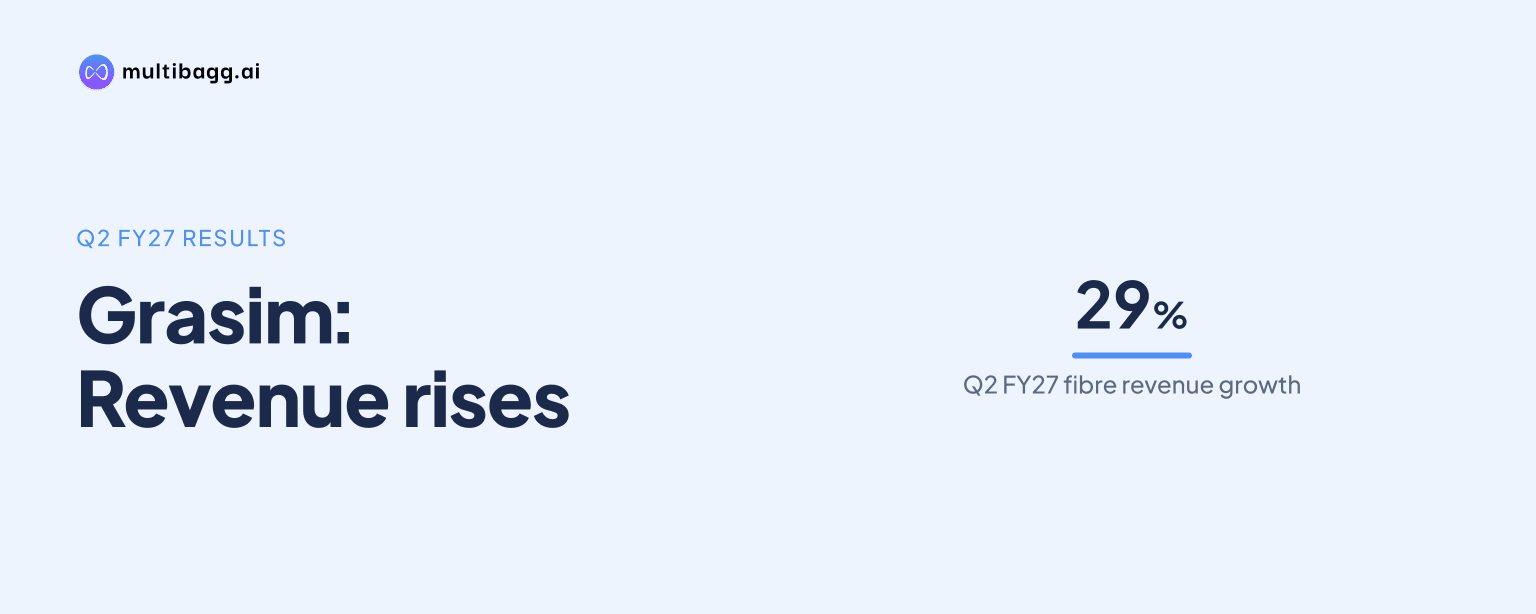
Grasim Industries Limited’s cellulosic-fibres revenue rose 29% year on year to Rs 5,344 crore in Q2FY27, supported by higher volumes, a richer specialty-fibre mix and stable domestic realisation. Grasim reported Rs 522 crore of earnings before interest, tax, depreciation and amortisation (EBITDA) while progressing lyocell phases totalling 165,000 tonnes per annum.
Know Grasim Industries inside out
Results, valuation, peers and who's buying, in one view.
What drove Grasim’s 29% fibre revenue growth in Q2FY27?
Grasim said volume growth, favourable product mix and stable domestic realisation lifted Q2FY27 revenue to Rs 5,344 crore from Rs 4,149 crore in Q2FY26. The company also cited geopolitical issues and higher input and logistics costs during the quarter, despite the 29% year-on-year revenue increase.
EBITDA was Rs 522 crore in Q2FY27, compared with Rs 350 crore a year earlier and Rs 632 crore in Q1FY27. Grasim attributed the year-on-year EBITDA increase to revenue growth and a higher share of specialty fibres, while the presentation separately described cellulosic fashion yarn conditions as subdued.
For H1FY27, revenue increased to Rs 9,874 crore from Rs 8,193 crore in H1FY26, while EBITDA rose to Rs 1,154 crore from Rs 672 crore. The half-year revenue gain was Rs 1,681 crore and the EBITDA increase was Rs 482 crore under the figures presented for the cellulosic-fibres business.
How did Grasim’s CSF volumes and mix change?
Grasim sold 224 thousand tonnes of cellulosic staple fibre (CSF) in Q2FY27, up 7% from 209 thousand tonnes in Q2FY26 and above 202 thousand tonnes in Q1FY27. Management said the year-on-year comparison benefited from a favourable base because of temporary logistics challenges at Vilayat in the prior year.
H1FY27 CSF sales reached 426 thousand tonnes, compared with 418 thousand tonnes in H1FY26. Domestic sales accounted for 80% of Q2FY27 CSF volume and exports for 20%, with the presentation measuring the 7% annual increase across combined domestic and export sales.
Specialty fibres represented 26% of Q2FY27 CSF sales volume, rising from 24% in Q2FY26, while standard fibres made up 74%. Grasim linked the two-percentage-point increase in specialty share to increased exports and cited the higher specialty contribution as a factor in the Rs 522 crore EBITDA result.
India’s cellulosic-fibre market recorded a 9.4% compound annual growth rate (CAGR) between calendar year 2015 and calendar year 2025, compared with 5.6% for synthetics and a 0.1% decline for cotton. Grasim also put cellulosic fibres at 7% of India’s textiles fibre basket, identifying cotton constraints and Liva brand-led demand creation as growth drivers.
Why is Grasim’s fashion-yarn performance still subdued?
Grasim’s cellulosic fashion yarn (CFY) volume was 11.6 thousand tonnes in Q2FY27, up 2% from 11.4 thousand tonnes in Q2FY26 and above 9.3 thousand tonnes in Q1FY27. The company said the quarterly volume was achieved amid subdued demand from end-user industries.
The H1FY27 comparison remained lower, with CFY sales volume at 20.9 thousand tonnes against 21.4 thousand tonnes in H1FY26. Grasim said elevated sulphur costs and sustained pricing pressure from Chinese imports affected CFY performance, but it did not disclose separate revenue or EBITDA for the yarn business.
Got a follow-up? Ask IRIS
What do China operating data and fibre prices show?
China’s operating rate was 93% in Q2FY27, compared with 89% in Q2FY26, and remained at 93% from Q1FY27. On a half-year basis, the operating rate rose to 93% in H1FY27 from 85% in H1FY26.
China inventory was seven days in Q2FY27, down from 15 days in Q2FY26 and unchanged from Q1FY27. H1FY27 inventory was also seven days, compared with 17 days in H1FY26, a 10-day reduction alongside the eight-percentage-point rise in the half-year operating rate.
International CSF prices rose 23.0% year on year and 2.6% quarter on quarter in Q2FY27, with the September 2026 exit price at Rs 1.85 per kg equivalent to the presentation’s stated US dollar price. Cotton increased 19.1% year on year and 6.0% sequentially, while international polyester staple fibre rose 27.2% year on year but fell 0.3% from Q1FY27.
What is Grasim’s 165,000-tonne lyocell expansion plan?
Grasim’s lyocell plan comprises a 55,000-tonne-per-annum Phase 1 and a 110,000-tonne-per-annum Phase 2, totalling 165,000 tonnes per annum. For Phase 1, procurement delivery was nearing completion and cumulative capital expenditure had reached Rs 420 crore at Q2FY27.
For the 110,000-tonne-per-annum Phase 2, Grasim said the environmental-clearance application was at an advanced stage of submission. The presentation provides no commissioning date, total project cost or projected revenue contribution for either lyocell phase.
Global cellulosic fibres grew at a 3.9% CAGR from calendar year 2015 to calendar year 2025, against 4.1% for synthetics and 0.1% for cotton. Grasim presented the planned lyocell capacity alongside its view that biodegradable cellulosic fibres and supply limitations in cotton support the category’s longer-term opportunity.
Conclusion
Grasim’s Q2FY27 result combined Rs 5,344 crore of revenue and Rs 522 crore of EBITDA with 224 thousand tonnes of CSF sales and a 26% specialty-fibre share. This contrasts with CFY, where H1FY27 volume of 20.9 thousand tonnes remained below 21.4 thousand tonnes a year earlier amid demand, sulphur-cost and Chinese-import pressures.
The next disclosed milestones are the nearing completion of procurement delivery for the 55,000-tonne-per-annum Phase 1 and the advanced-stage environmental-clearance submission for the 110,000-tonne-per-annum Phase 2. Grasim also reported a September 2026 CSF exit price unchanged from Q2FY27, alongside a 93% China operating rate and seven days of inventory.