










Grasim targets 67% chlorine integration after Vilayat additions
Key highlights
- Grasim commissioned 50,000 tonnes per annum of CPVC capacity at Vilayat in August 2026 and 50,000 tonnes per annum of ECH capacity in October 2026.
- Grasim targets 67% chlorine integration by FY27 exit, compared with 64% in H1FY27.
- Grasim chemicals revenue increased 15% year on year to Rs 2,759 crore in Q2FY27.
- Grasim chemicals EBITDA declined 11% year on year to Rs 326 crore in Q2FY27.
powered by IRIS
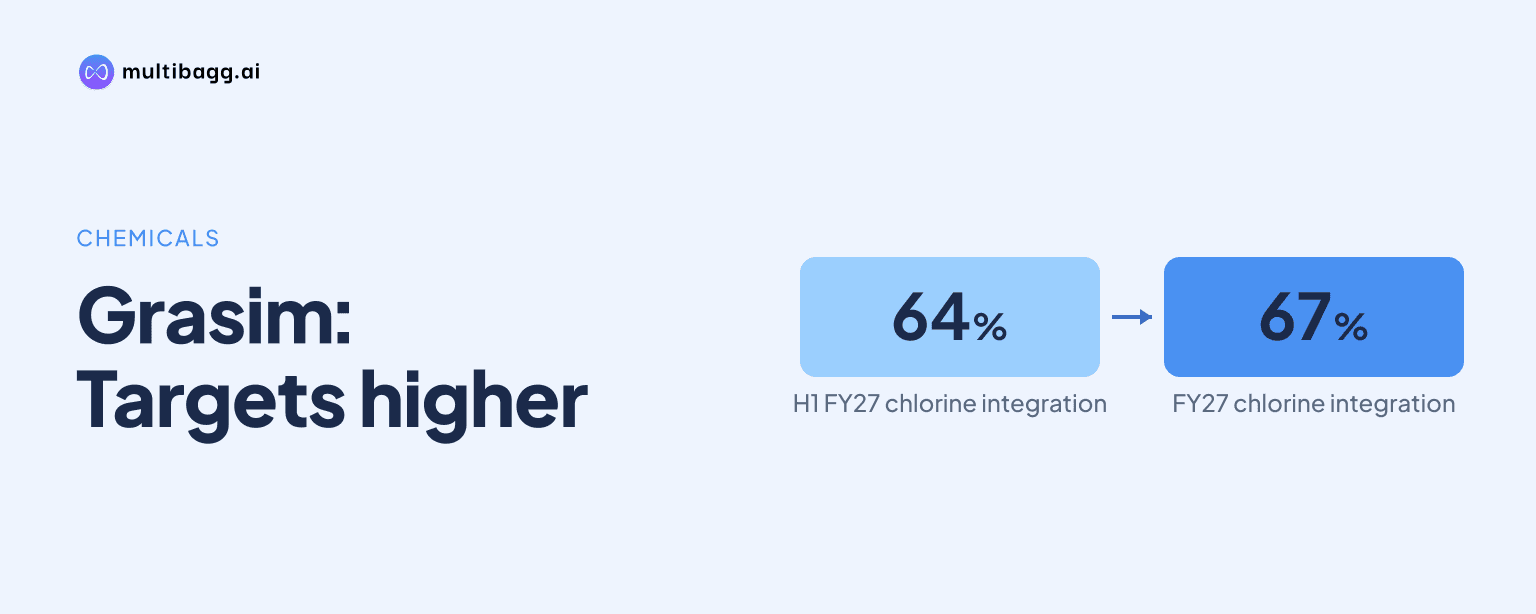
Grasim Industries Limited targets about 67% chlorine integration by FY27 exit after commissioning 50,000-tonnes-per-annum CPVC capacity at Vilayat in August 2026 and 50,000-tonnes-per-annum epichlorohydrin capacity there in October 2026. Grasim reported 64% integration in H1FY27, while chemicals EBITDA declined 11% year on year to Rs 326 crore in Q2FY27.
Know Grasim Industries inside out
Results, valuation, peers and who's buying, in one view.
What did Grasim commission at Vilayat?
Grasim commissioned a 50,000-tonnes-per-annum CPVC project at Vilayat in August 2026 and a 50,000-tonnes-per-annum epichlorohydrin, or ECH, plant at the site in October 2026. Both additions sit in the chlorine-derivatives portfolio, for which Grasim reported existing capacity of 1,112,000 tonnes per annum, including the recently commenced CPVC and ECH capacities.
Grasim has also outlined an 18,000-tonnes-per-annum chlorine-derivatives expansion, which would take projected capacity to 1,130,000 tonnes per annum. The presentation identifies the business's markets as pharma, agrochemicals, water treatment, food and feed, plastic additives and industrial applications, while also noting high-value products such as chloromethanes and phosphoric acid.
The additions are separate from Grasim's specialty chemicals business, which has capacity of 246,000 tonnes per annum and includes epoxy polymers and curing agents. That portfolio serves construction chemicals and coatings, renewables through wind composites, and electrical and electronics applications, whereas the new 100,000-tonnes-per-annum combined CPVC and ECH capacity is reported within chlorine derivatives.
Grasim also reported existing caustic soda capacity of 1,531,000 tonnes per annum and a 25,000-tonnes-per-annum debottlenecking programme at Nagda and Renukoot. This would lift projected caustic soda capacity to 1,556,000 tonnes per annum, while management said it was evaluating further chlor-alkali capacity in line with demand from alumina, chemicals, textiles and fast-moving consumer goods industries.
How does Grasim plan to reach 67% chlorine integration?
Grasim plans to raise chlorine integration, including pipeline sales, to about 67% by FY27 exit from 64% in H1FY27. The target is 3 percentage points above the latest reported level and follows integration of 62% in FY24, 65% in FY25 and 64% in FY26.
Grasim's captive consumption reached 55% in H1FY27, compared with 49% in FY24, 51% in FY25 and 53% in FY26. Its FY27-exit target is 56%, which is 1 percentage point above the H1FY27 level; unlike total integration, the reported overall integration measure includes pipeline sales.
Management said it was evaluating multiple downstream chlorine chemistries to increase integration further. The CPVC and ECH plants commissioned in August 2026 and October 2026 provide two additional downstream outlets as Grasim works toward the FY27-exit integration target.
Grasim also expects renewable power to account for 45% of its power capacity by FY27 exit. It linked this expectation to the recently commissioned 220-kilovolt State Transmission Utility line at Vilayat, while identifying cost competitiveness as a focus of its chlor-alkali operations.
Got a follow-up? Ask IRIS
How did Grasim's chemicals revenue mix change in Q2FY27?
Grasim's chemicals revenue rose 15% year on year to Rs 2,759 crore in Q2FY27 from Rs 2,399 crore in Q2FY26, with management citing broad-based growth across caustic soda, chlorine derivatives and specialty chemicals. Chlorine derivatives increased to 25% of chemicals revenue from 21% a year earlier, the largest mix change among the three reported categories.
Caustic soda remained Grasim's largest chemicals revenue category at 47% in Q2FY27, but its share was down from 49% in Q2FY26. Specialty chemicals represented 28%, compared with 30% a year earlier, meaning the 4-percentage-point increase in chlorine derivatives' share came alongside lower shares for both caustic soda and specialty chemicals.
The first-half mix showed a similar movement. Caustic soda made up 48% of H1FY27 chemicals revenue against 51% in H1FY26, chlorine derivatives rose to 23% from 20%, and specialty chemicals remained at 29% in both periods.
Caustic soda sales volume was 317,000 tonnes in Q2FY27, up from 294,000 tonnes in Q2FY26 and 284,000 tonnes in Q1FY27. H1FY27 volume was 602,000 tonnes, compared with 597,000 tonnes in H1FY26, so the lower revenue share for caustic soda occurred despite higher quarterly and first-half sales volumes.
Why did Grasim's chemicals EBITDA decline in Q2FY27?
Grasim's chemicals EBITDA fell 11% year on year to Rs 326 crore in Q2FY27 because of higher power costs in caustic soda and lower profitability in specialty chemicals, according to management. The quarterly result was also below Rs 491 crore in Q1FY27, although chemicals revenue increased sequentially to Rs 2,759 crore from Rs 2,640 crore.
Management attributed the specialty chemicals pressure to elevated key input prices and softer demand across end-user industries. Specialty chemicals accounted for 28% of Q2FY27 chemicals revenue, down from 30% in Q2FY26, and the presentation does not disclose a separate revenue or EBITDA figure for that business.
CFR South-East Asia caustic soda prices were US$390 per tonne in Q2FY27, compared with US$449 per tonne in Q2FY26 and US$483 per tonne in Q1FY27, based on the IHS Report cited by Grasim. Grasim's reported ECU measure was Rs 33,587 per tonne in Q2FY27, above Rs 32,979 per tonne a year earlier but below Rs 37,955 per tonne in the preceding quarter.
For H1FY27, chemicals revenue increased to Rs 5,399 crore from Rs 4,789 crore in H1FY26, while EBITDA rose to Rs 816 crore from Rs 787 crore. The first-half EBITDA increase despite the Q2 decline reflects the Rs 491 crore EBITDA reported in Q1FY27, compared with Rs 326 crore in Q2FY27.
Conclusion
The CPVC and ECH commissions add 100,000 tonnes per annum of downstream chlorine-derivatives capacity at Vilayat and support Grasim's plan to lift chlorine integration from 64% in H1FY27 to about 67% by FY27 exit. At the same time, Q2FY27 chemicals revenue grew 15% to Rs 2,759 crore, but higher caustic soda power costs and lower specialty chemicals profitability reduced EBITDA 11% to Rs 326 crore.
The next disclosed measures to watch are the FY27-exit targets of 67% chlorine integration, 56% captive consumption and a 45% renewable-power share. Grasim has also disclosed an 18,000-tonnes-per-annum chlorine-derivatives expansion, a 25,000-tonnes-per-annum caustic soda debottlenecking programme, and management's evaluation of additional downstream chlorine chemistries.