










UltraTech lifts cement capacity to 210.1 MTPA in Q2FY27
Key highlights
- UltraTech added 4.6 MTPA of grey cement capacity, taking India-and-overseas capacity to 210.1 MTPA in Q2FY27.
- UltraTech’s total sales volume grew 12.9% year on year to 38.2 million tonnes in Q2FY27.
- UltraTech reported consolidated EBITDA of Rs 3,832 crore in Q2FY27, up 17.2% year on year.
- UltraTech’s green-power mix reached 46.4% in H1FY27 and renewable-power capacity reached 1.58 gigawatts, up 29% year on year.
powered by IRIS
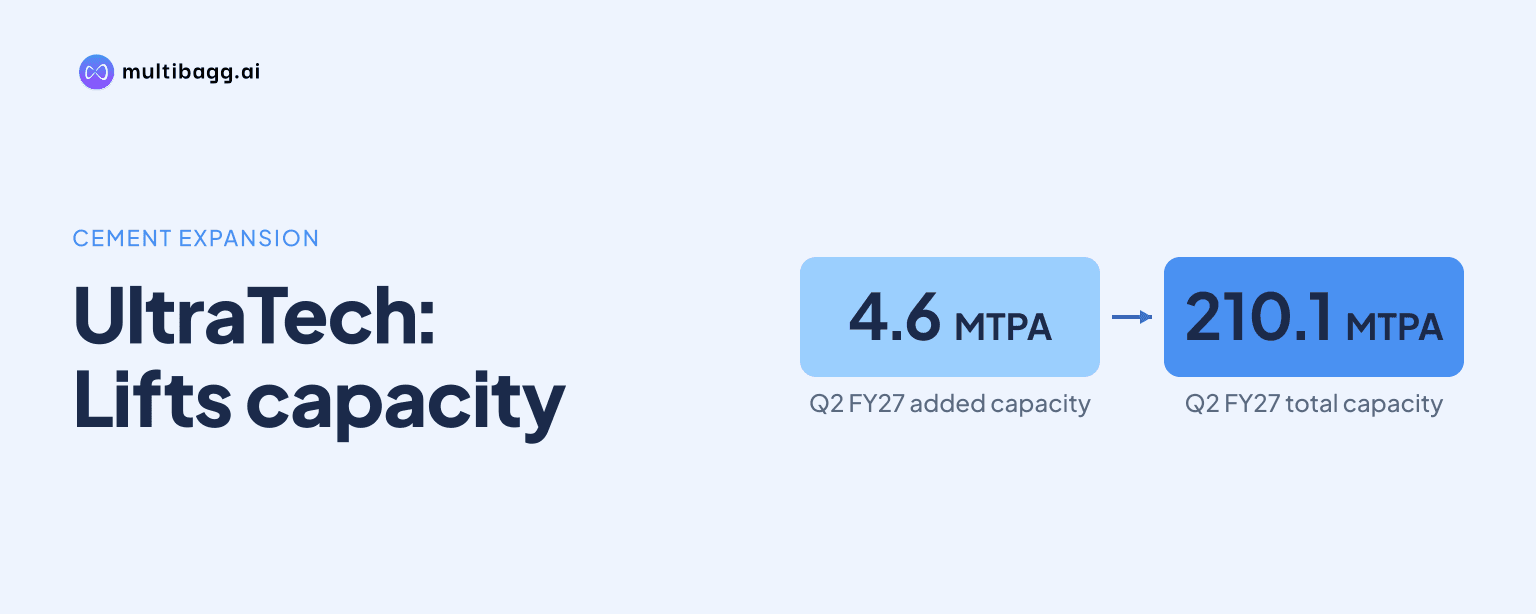
UltraTech added 4.6 million tonnes per annum of grey cement capacity in Q2FY27, taking capacity in India and overseas to 210.1 MTPA, while total sales volume rose 12.9% year on year to 38.2 million tonnes. The presentation also reported 17.2% year-on-year growth in consolidated EBITDA to Rs 3,832 crore.
Know Grasim Industries inside out
Results, valuation, peers and who's buying, in one view.
How much cement capacity did UltraTech add in Q2FY27?
UltraTech added 4.6 MTPA of grey cement capacity during Q2FY27, lifting its total grey cement capacity across India and overseas to 210.1 MTPA. MTPA means million tonnes per annum, a measure of annual production capacity. The addition is the central operating change disclosed for the quarter and increases the production base from which UltraTech can supply cement volumes.
The capacity figure covers grey cement rather than all building-material categories presented by Grasim Industries Limited, which also discusses paints and business-to-business e-commerce. UltraTech’s 210.1 MTPA total includes Indian and overseas capacity, so the presentation does not provide a separate Q2FY27 capacity figure for India alone. The disclosed 4.6 MTPA expansion should therefore be read as an increase in the combined grey-cement network.
India provides the wider industry setting for this expansion. The presentation places India second globally in cement production, with a 12.2% share, compared with China’s 44.7% share. It also estimates Indian per-capita cement consumption at about 324 kilograms a year, below the stated 2025 world-average range of 435 to 485 kilograms, though these industry figures are not UltraTech-specific forecasts.
How did UltraTech’s cement volumes and pricing change?
UltraTech’s total sales volume rose 12.9% year on year to 38.2 million tonnes in Q2FY27. This volume gain occurred alongside the 4.6 MTPA capacity addition and was identified in the presentation as one of the factors behind the quarter’s EBITDA growth. The source does not break the 38.2 million tonnes into domestic, overseas, retail or institutional sales.
Domestic grey-cement realisation was Rs 5,176 per tonne in Q2FY27, up 2% year on year. Realisation is the revenue received per tonne sold, as reported by the company. The comparison shows that the quarter combined higher sales volumes with a higher domestic grey-cement realisation versus Q2FY26, rather than reporting volume growth alone.
The relative movements differed in scale. Sales volume increased 12.9% year on year, while domestic grey-cement realisation increased 2% year on year. UltraTech did not disclose Q2FY27 cement revenue, realised price by geography, or a sequential volume comparison on this page. As a result, the presentation supports a conclusion about year-on-year operating growth, but not a calculation of quarterly cement revenue or a split between price and mix effects.
What drove UltraTech’s EBITDA growth in Q2FY27?
UltraTech reported consolidated earnings before interest, tax, depreciation and amortisation, or EBITDA, of Rs 3,832 crore in Q2FY27, up 17.2% year on year. The presentation attributes the increase to volume growth and lower power cost. This means EBITDA grew faster than the reported 12.9% rise in total sales volume, although the source does not provide the underlying cost per tonne or EBITDA per tonne.
Power is also a disclosed operational focus. UltraTech’s green-power mix reached 46.4% in H1FY27, the first half of FY27, while total renewable-power capacity reached 1.58 gigawatts, up 29% year on year. The presentation reports lower power cost as an EBITDA driver and separately reports the larger green-power mix, but it does not quantify how much of the cost change came from renewable energy.
The reported metrics distinguish the quarterly financial outcome from the half-year energy measure. EBITDA of Rs 3,832 crore and the 12.9% sales-volume increase apply to Q2FY27, whereas the 46.4% green-power mix applies to H1FY27. This timing distinction matters because the source does not state that the H1FY27 power mix was achieved solely in the second quarter or assign a rupee saving to it.
Got a follow-up? Ask IRIS
How did UltraTech expand its concrete and distribution network?
UltraTech’s ready-mix concrete, or RMC, volume grew 23% year on year to 4.65 million cubic metres in Q2FY27. The company had 485 RMC plants at the quarter-end, an increase of 77 plants from a year earlier. RMC volume growth therefore outpaced the reported 12.9% growth in total cement sales volume during the same quarter.
The RMC data show a separate volume measure from cement tonnes. Cement sales are reported in million tonnes, while RMC is measured in million cubic metres, so the two figures cannot be added or directly converted using the presentation. What the data do show is that UltraTech expanded both its core cement supply capacity, by 4.6 MTPA, and its concrete network, by 77 plants year on year.
UltraTech Building Solutions, or UBS, also expanded its outlet base by 24% year on year to 6,289 outlets in Q2FY27, compared with 5,084 stores in Q2FY26. UBS is presented alongside cement operating measures, but the source does not disclose outlet-level sales, revenue or profitability. The available evidence therefore establishes a larger store network, not the financial contribution of that network.
What do UltraTech’s Q2FY27 operating metrics show?
UltraTech’s Q2FY27 disclosures show expansion across capacity, sales, concrete plants, UBS outlets and renewable-power capacity. The reported comparisons are 4.6 MTPA of added grey-cement capacity, 12.9% year-on-year growth in total sales volume to 38.2 million tonnes, 23% growth in RMC volume, and 24% growth in UBS outlets. Consolidated EBITDA rose 17.2% to Rs 3,832 crore, with volume growth and lower power cost cited as drivers.
The measures also show that not every indicator has the same reporting period or unit. Q2FY27 covers sales, EBITDA, RMC operations and UBS outlets; H1FY27 covers the 46.4% green-power mix; and renewable capacity of 1.58 gigawatts was 29% higher year on year. The presentation provides no cement revenue, net profit, capital-expenditure amount, commissioning schedule or further capacity target, leaving those items undisclosed.
Conclusion
UltraTech’s reported 17.2% increase in consolidated EBITDA exceeded its 12.9% sales-volume growth in Q2FY27, with management attributing the earnings movement to volume growth and lower power cost. At the same time, RMC volume grew 23%, ahead of cement sales volume, while the 2% increase in domestic grey-cement realisation added a separate pricing measure to the operating update.
The presentation does not disclose a future cement-capacity target, a commissioning timetable, cement revenue, or the rupee effect of its 46.4% H1FY27 green-power mix. Subsequent reporting would need to clarify whether capacity moves beyond 210.1 MTPA, how volumes and domestic realisations develop, and whether the renewable-power expansion continues to affect reported power costs.