










BLS International targets Rs 6,300-6,500 crore revenue by FY30
Key highlights
- BLS International targets FY30 revenue of Rs 6,300-6,500 crore, versus Rs 2,998 crore in FY26.
- BLS International targets a 28-30% FY30 EBITDA margin, compared with 27.3% in FY26.
- H1FY27 consolidated revenue increased 28.7% year on year to Rs 1,863.2 crore.
- Digital contributed 43% of H1FY27 revenue, up from 36% in H1FY26.
powered by IRIS
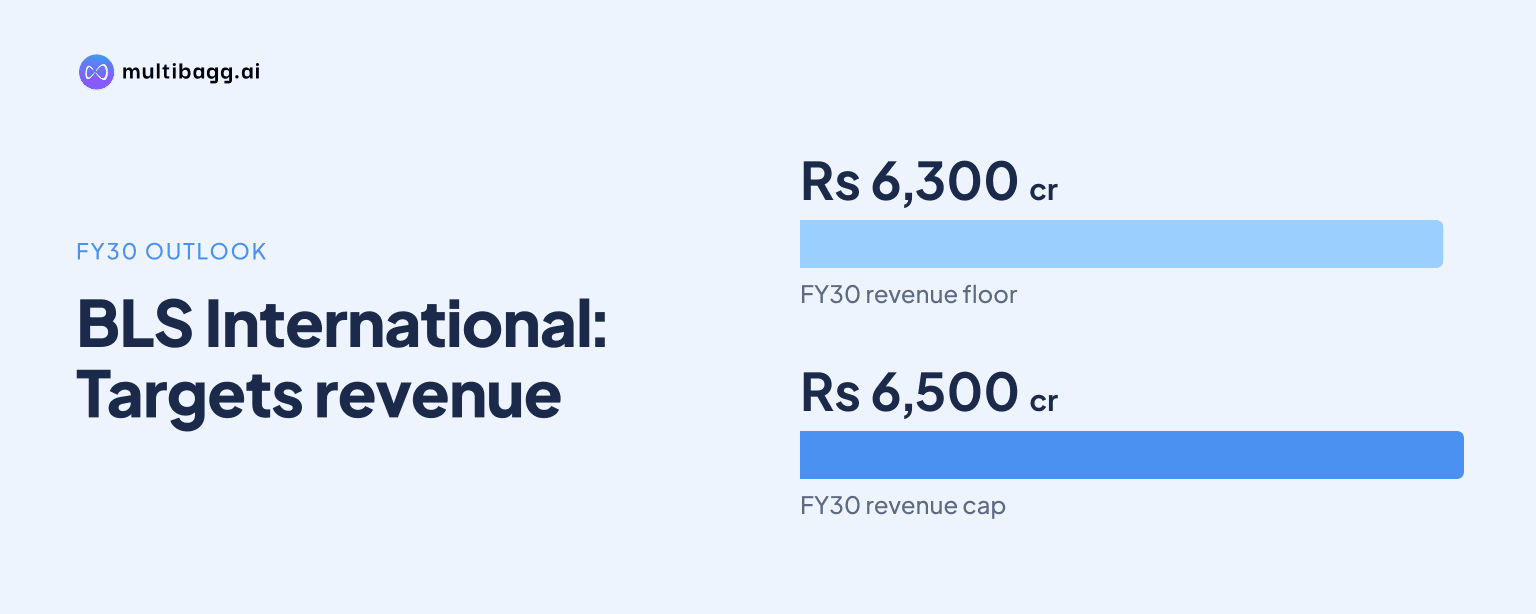
BLS International is targeting FY30 revenue from operations of Rs 6,300-6,500 crore, compared with Rs 2,998 crore in FY26, alongside a 28-30% EBITDA margin target. The company’s framework calls for 20-25% revenue growth each year and identifies eight levers, including visa renewals, Digital services, tender wins, technology and selective acquisitions.
Know BLS International Services inside out
Results, valuation, peers and who's buying, in one view.
What is BLS International targeting for FY30?
BLS International is targeting Rs 6,300-6,500 crore of revenue from operations and a 28-30% EBITDA margin in FY30. EBITDA means earnings before interest, tax, depreciation and amortisation. The company also states that it intends to deliver annual revenue growth of 20-25% through FY30, against an FY26 actual revenue base of Rs 2,998 crore and an EBITDA margin of 27.3%.
The FY30 revenue range would more than double BLS International’s FY26 revenue over four financial years. The targeted EBITDA-margin range is 0.7 to 2.7 percentage points above the FY26 margin of 27.3%. These are management targets, rather than reported outcomes, and the presentation does not set separate revenue or margin milestones for FY27, FY28 or FY29.
How does BLS International's recent performance compare with its FY30 plan?
BLS International reported consolidated revenue of Rs 1,863.2 crore in H1FY27, up 28.7% from Rs 1,447.2 crore in H1FY26, exceeding its stated 20-25% annual growth range for that half-year comparison. Consolidated EBITDA increased 20.0% to Rs 500.5 crore, but the EBITDA margin declined to 26.9% from 28.8% in H1FY26.
In Q2FY27, revenue from operations rose 32.0% to Rs 972.7 crore from Rs 736.6 crore in Q2FY26, while EBITDA increased 16.6% to Rs 248.1 crore. The consolidated EBITDA margin fell to 25.5% from 28.9%. BLS International said the Q2 moderation reflected a change in segment mix, even as EBITDA margins expanded in both business segments.
Profit after tax, or PAT, rose more slowly than revenue in both reported comparisons. H1FY27 PAT increased 10.0% to Rs 403.4 crore from Rs 366.7 crore, and PAT margin declined to 21.6% from 25.3%. In Q2FY27, PAT rose 8.6% to Rs 201.7 crore and the margin was 20.7%, versus 25.2% a year earlier, with BLS International citing revenue mix and higher amortisation of acquisition-related intangible assets.
Which growth levers does BLS International plan to use?
BLS International lists eight FY30 growth levers: strengthening the core Visa business, accelerating Digital services, winning new tenders, cross-selling through its network, scaling adjacent global businesses, technology and platform-led growth, expanding government-to-citizen services, and selective focused mergers and acquisitions. In its Visa business, the company identifies renewals, better pricing, deeper value-added-services penetration and technology-led productivity as the mechanisms.
BLS International’s Digital plan includes financial inclusion, business correspondent services, loan distribution and government-to-citizen, or G2C, services. Its cross-selling plan covers insurance, payments, pension and wealth offered through existing touchpoints. The G2C expansion route includes Aadhaar Seva Kendras and wider citizen services, although the presentation provides no revenue contribution or delivery timetable for any individual lever.
Technology and platform-led growth includes software as a service, or SaaS, application programming interfaces, or APIs, artificial intelligence and automation, which BLS International says can provide higher-margin recurring revenue. Its adjacent-global-business plan covers iDATA and Citizenship Invest through new geographies, programmes and cross-selling, while the acquisition plan focuses on capabilities, embedded finance and new business opportunities.
Got a follow-up? Ask IRIS
How are Visa and Digital changing BLS International's business mix?
Visa and Consular was BLS International’s larger reported business in H1FY27, contributing 57% of revenue and 88% of EBITDA, while Digital accounted for 43% of revenue and 12% of EBITDA. In H1FY26, Visa and Consular represented 64% of revenue and 91% of EBITDA, while Digital represented 36% and 9%, respectively. Digital therefore gained 7 percentage points of revenue mix and 3 percentage points of EBITDA mix over the year.
Visa and Consular revenue, including Citizenship Invest and Hotels, increased 16.4% to Rs 1,070 crore in H1FY27 from Rs 919.3 crore in H1FY26. Segment EBITDA rose 16.2% to Rs 439.5 crore, while its margin remained 41.1% in both periods. That stable segment margin contrasts with the consolidated EBITDA-margin decline of 1.9 percentage points to 26.9%.
Excluding Citizenship Invest and Hotels, Visa and Consular net revenue rose 8.6% to Rs 786.2 crore from Rs 723.9 crore. BLS International defines net revenue as Visa-business revenue less cost of services. Net revenue per application increased 10.7% to Rs 3,537 from Rs 3,195, and the company processed 22.2 lakh applications in H1FY27, linking reported operating metrics to its pricing and value-added-services plans.
What should investors monitor against the FY30 framework?
BLS International’s balance sheet increased between March 2026 and September 2026, with total assets rising to Rs 4,299.4 crore from Rs 3,770.1 crore and shareholders’ funds increasing to Rs 2,784.2 crore from Rs 2,422.3 crore. Cash and cash equivalents rose to Rs 659.3 crore from Rs 494.2 crore, while combined current and non-current borrowings declined to Rs 196.8 crore from Rs 230.5 crore.
Cash flow used for purchases of property, plant, equipment and intangibles was Rs 168 crore in September FY27, compared with Rs 40 crore in September FY26. Payments towards acquisition of subsidiaries rose to Rs 109 crore from Rs 34 crore. Operating cash flow was Rs 545 crore in September FY27 versus Rs 515 crore in September FY26, while net cash and cash equivalents increased by Rs 165 crore.
The presentation does not disclose segment-level milestones for the FY30 revenue target, making the changing mix between Digital and Visa and Consular relevant to tracking the margin objective. Intangible assets rose to Rs 148.9 crore in September 2026 from Rs 55.3 crore in March 2026, while BLS International attributed Q2FY27 PAT-margin movement partly to higher amortisation related to recent acquisitions.
Conclusion
BLS International’s FY30 framework combines a Rs 6,300-6,500 crore revenue target with a 28-30% EBITDA-margin target, versus FY26 revenue of Rs 2,998 crore and a 27.3% margin. H1FY27 revenue growth of 28.7% was above the stated annual growth range, while the 26.9% consolidated EBITDA margin was below the FY26 result and the FY30 target range as business mix changed.
The next measures to watch are progress in tender conversion, the scale-up of financial inclusion and G2C services, Visa pricing and value-added-services penetration, and any selective capability-led acquisitions. BLS International identifies SaaS, APIs, artificial intelligence and automation as routes to higher-margin recurring revenue, but it has not disclosed annual milestones ahead of FY30.