










BLS says outsourced visa applications could reach 50% by 2029
Key highlights
- BLS projects outsourced visa applications will rise from 46.0 million in 2024 to 70.2 million in 2029P.
- Outsourced visa processing is forecast to represent 50% of global applications in 2029P, up from 38% in 2024.
- The outsourced visa market by value is projected to grow at 14% CAGR from $1.7 billion in 2024 to $3.2 billion in 2029P.
- BLS reported 44.1 lakh visa and consular applications in FY26, versus 37.5 lakh in FY25.
powered by IRIS
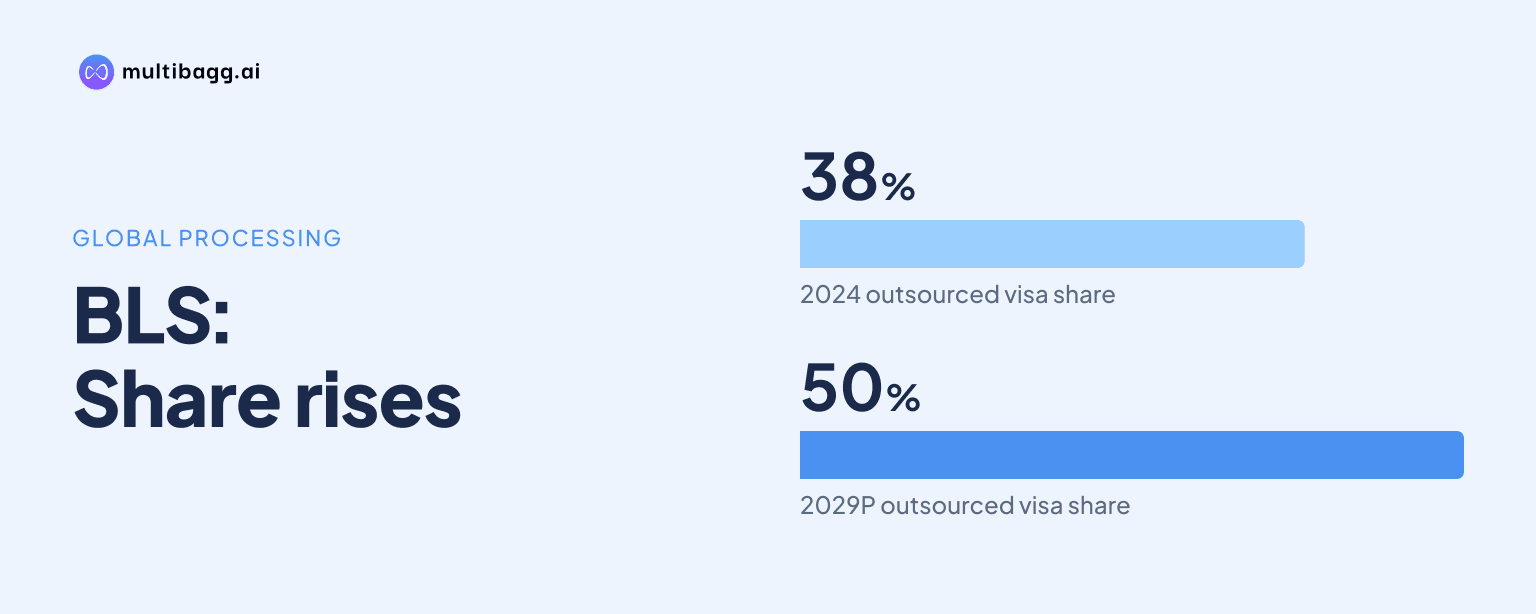
BLS International Services Limited says outsourced providers could process 50% of global visa applications by 2029P, up from 38% in 2024, as the outsourced market is projected to grow at an 8.8% compound annual growth rate (CAGR) between 2024 and 2029P.
Know BLS International Services inside out
Results, valuation, peers and who's buying, in one view.
How fast could global visa outsourcing grow?
Global visa outsourcing could grow materially faster than the overall visa market through 2029P. BLS presents outsourced visa-market value rising from $1.7 billion in 2024 to $3.2 billion in 2029P, a stated 14% CAGR, while the total visa market rises from $5.4 billion to $7.7 billion at a 7% CAGR over the same period. Outsourcing's share of visa-market value is therefore projected to increase from 31% to 42%.
The volume forecast shows a similar change in mix, although the total market grows more slowly. Global visa volumes are projected to rise from 121.0 million applications in 2024 to 140.3 million in 2029P, a stated 3% CAGR. Outsourced volumes are projected to increase from 46.0 million to 70.2 million, or 9% CAGR, lifting their share from 38% to 50%.
In 2019, outsourced volume was 46.6 million out of a 133.1 million total, equal to 35%. The 2029P forecast therefore implies both a recovery in total visa applications from 121.0 million in 2024 and a greater role for outsourced processors than in either 2019 or 2024.
Why could outsourcing take half of visa applications?
Outsourcing could reach half of applications because BLS expects governments to use external partners to lower operating costs, handle larger volumes and improve the applicant experience. The projected outsourced share moves 12 percentage points from 38% in 2024 to 50% in 2029P, while the in-house share correspondingly declines from 62% to 50%.
BLS identifies automation, artificial intelligence-powered verification and biometric authentication as mechanisms that can reduce processing time while enhancing security. The presentation also cites digital visa applications, personalised service offerings and subscription-based travel services as changes that could widen the addressable opportunity for visa outsourcing providers.
The travel market provides the demand backdrop. BLS cites global travel and tourism industry value increasing from $2.3 trillion in 2024 to $3.4 trillion in 2029P, an 8% CAGR, while global airline passengers increase from 4.8 billion to 5.6 billion at a 3% CAGR. International tourist arrivals are forecast to rise from 1.58 billion in FY26 to 1.80 billion by FY30P.
Tourist visas represented 65% of applications in 2024, down from 70% in 2019, and are projected to return to 70% by 2029P. Study visas rose from 12% in 2019 to 15% in 2024 before a projected 13% share in 2029P, while work visas moved from 7% to 9% and are projected at 6% in 2029P.
Got a follow-up? Ask IRIS
What is BLS's position in visa outsourcing?
BLS held 17% of the global visa outsourcing market excluding the United States by value and 10% by volume in 2024, according to the presentation. That market excluding the United States is projected to grow from $1.1 billion in 2024 to $2.2 billion in 2029P, a stated 14% CAGR.
The excluded-US market's outsourced volumes are projected to rise from 35.5 million applications in 2024 to 52.1 million in 2029P, at an 8% CAGR. The presentation does not state a BLS market-share target for 2029P, so its reported 17% value share and 10% volume share remain 2024 measures.
BLS's historical visa and consular-services indicators show application growth alongside higher net revenue per application. Applications increased from 28.7 lakh in FY24 to 37.5 lakh in FY25 and 44.1 lakh in FY26. Net revenue per application, defined as visa-business revenue less cost of services divided by applications, increased from Rs 2,146 in FY24 to Rs 2,903 in FY25 and Rs 3,302 in FY26.
Visa and consular revenue from operations increased from Rs 1,361.8 crore in FY24 to Rs 1,653.3 crore in FY25 and Rs 1,840.3 crore in FY26. Consolidated revenue, which covers a broader business base, rose from Rs 2,193.3 crore in FY25 to Rs 2,998.2 crore in FY26, while consolidated earnings before interest, tax, depreciation and amortisation increased from Rs 629.3 crore to Rs 818.9 crore.
Which adjacent government-to-citizen markets are expanding?
BLS identifies investment migration and consular services as adjacent government-to-citizen growth channels beyond visa processing. The investment migration services market is projected to increase from $0.9 billion in 2024 to $1.5 billion in 2029P, with the stated CAGR increasing from 9% in 2019-2024 to 11% in 2024-2029P.
The presentation links investment-migration demand to high-net-worth individuals seeking economic stability, business mobility and citizenship or residency options. It also says investment-friendly countries such as the United Arab Emirates attract such individuals through factors including low corporate taxes, gross domestic product growth and business regulations.
BLS gives two separate consular-market forecasts. It projects the global outsourced consular-services market from $134 million in 2024 to $175 million in 2029P, or 6% CAGR, after 3% CAGR during 2019-2024. Separately, it says outsourced consular services could grow at 32% CAGR to $634 million by 2029P, without reconciling the scope of the two estimates.
Consular demand covers national identity documents, notarial work and passports as well as visas. BLS forecasts passport volumes of 254 million in 2029P, compared with 209 million in 2024, citing emergency and replacement needs. BLS says its wholly owned Citizenship Invest subsidiary would expand residency and citizenship programmes across geographies.
Conclusion
BLS's central industry forecast is that outsourcing gains share faster than total visa demand: outsourced applications are projected to increase from 46.0 million in 2024 to 70.2 million in 2029P, while their share rises from 38% to 50%. The market-value outlook points in the same direction, with outsourced visa services projected at 14% CAGR versus 7% for the total visa market.
The next measures to watch are whether the projected market shift is reflected in BLS's application volumes, net revenue per application and market position outside the United States. BLS reported 44.1 lakh visa and consular applications and Rs 3,302 net revenue per application in FY26, while its disclosed plan is for Citizenship Invest to expand residency and citizenship programmes; the presentation does not specify dates, countries or financial targets for that expansion.