










BLS Visa and Consular EBITDA Margin Reaches 40.1% in FY26
Key highlights
- BLS reported a 40.1% visa-and-consular EBITDA margin in FY26, up from 14.6% in FY22.
- Visa-and-consular EBITDA reached Rs 738 crore in FY26 and recorded a 61% CAGR from FY22 to FY26.
- BLS reported FY26 net revenue per application of Rs 3,302 after a 19% CAGR over FY22 to FY26.
- Visa-and-consular revenue was Rs 1,840 crore in FY26, compared with consolidated revenue of Rs 2,998 crore.
powered by IRIS
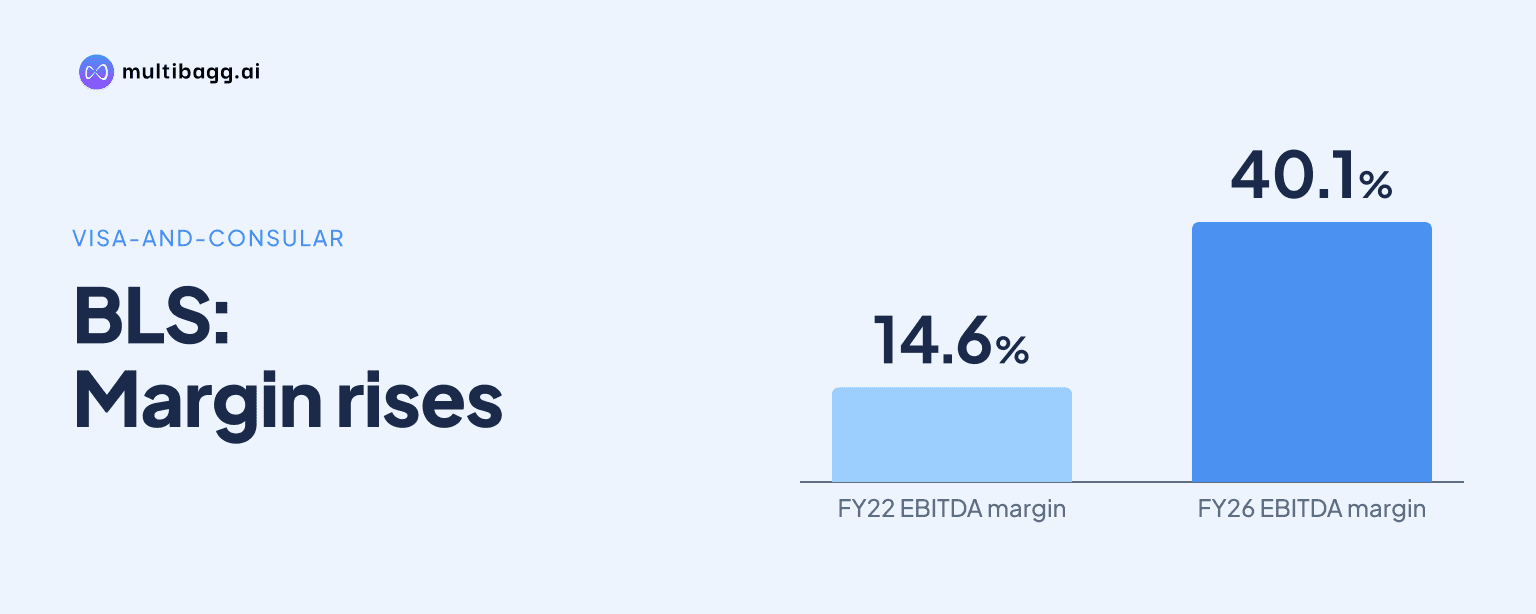
BLS International Services Limited raised its visa-and-consular EBITDA margin to 40.1% in FY26 from 14.6% in FY22, while segment EBITDA reached Rs 738 crore and recorded a 61% compound annual growth rate over FY22 to FY26. BLS attributes the expansion to self-managed operations, technology, scale and higher net revenue per application.
Know BLS International Services inside out
Results, valuation, peers and who's buying, in one view.
How much did BLS’ visa-and-consular margin increase?
BLS’ reported visa-and-consular EBITDA margin increased by 25.5 percentage points, from 14.6% in FY22 to 40.1% in FY26. The increase was not even across the period: margin was 14.8% in FY23, rose to 22.1% in FY24, advanced to 34.5% in FY25 and reached 40.1% in FY26.
The presentation contains one difference in its FY26 references: its operational-excellence narrative cites a 40.6% margin, while the five-year annual table and the FY26 business summary show 40.1%, or about 40%. The 40.1% figure is the reported endpoint in the detailed annual series and is also used in BLS’ FY26 visa-and-consular financial summary.
What drove BLS’ visa-and-consular margin expansion?
BLS says its transition from a partner-run model to a self-managed model was intended to reduce reliance on partners, provide greater control over operations and improve margins. The presentation also identifies improved revenue, greater scale and strategic cost management as factors behind the change from 14.6% in FY22 to about 40% in FY26.
Technology is another mechanism BLS identifies. Its platform includes automated appointments, waitlists, optical character recognition-based electronic visa processing, document verification and artificial-intelligence agents. BLS says these tools lower processing costs and raise throughput per application, while biometrics, facial recognition and liveness checks support identity and fraud controls.
The company also describes a combined outsourcing-and-specialisation model, supported by training, activity monitoring, IT systems and data centres intended to improve process efficiency and resource use. These are management’s stated explanations, rather than separately quantified savings, because the presentation does not allocate the FY26 margin change among self-management, automation, pricing or other drivers.
Did BLS’ revenue per application rise with its margins?
Yes. BLS reported net revenue per application of Rs 3,302 in FY26 for its visa-and-consular business, following a 19% compound annual growth rate between FY22 and FY26. BLS defines net revenue in the visa business as revenue less cost of services, making it different from gross segment revenue.
The business reported a 25% revenue CAGR, a 31% applications CAGR and a 56% net revenue CAGR over FY22 to FY26. Net revenue therefore grew 25 percentage points faster than applications on a CAGR basis, while net revenue per application grew 19%, consistent with BLS’ higher-revenue-per-application explanation for margin development.
FY26 visa-and-consular revenue was Rs 1,840 crore and segment EBITDA was Rs 738 crore. By comparison, consolidated revenue was Rs 2,998 crore and consolidated EBITDA was Rs 819 crore, resulting in a 27.3% consolidated margin. The 40.1% visa-and-consular margin was 12.8 percentage points above the consolidated margin, although the measures cover different business mixes.
Got a follow-up? Ask IRIS
How does BLS’ service model support its margin plan?
BLS says its service stack extends beyond visa processing into document verification, attestation, biometrics, passport renewal, travel-document authentication, residency programmes and citizenship programmes. Its travel-convenience offerings include premium lounges, courier facilities, form-filling assistance, insurance, translation services, SMS alerts and mobile biometrics.
The company collects processing fees upfront, before providing the service, and describes this as producing negative working capital and zero receivables in the model it presents. All visa application centres are on lease, which BLS characterises as an asset-light arrangement intended to support scalability with limited capital outlay rather than centre ownership.
BLS operates in more than 100 countries and serves 46 client governments. It says most contracts are exclusive and typically run for five to 10 years, while it reports about 17% market share by value and about 10% by volume. Management presents those contract features and its operating scale as supporting revenue visibility and opportunities for additional mobility services around each application.
What does BLS’ FY26 performance show beyond the margin?
BLS’ visa-and-consular EBITDA of Rs 738 crore in FY26 was about 90% of consolidated EBITDA of Rs 819 crore. The segment’s 61% EBITDA CAGR from FY22 to FY26 exceeded its 25% revenue CAGR, indicating that the margin shift was not solely a reflection of revenue growth.
At the consolidated level, EBITDA margin rose from 12.6% in FY22 to 27.3% in FY26 after reaching 28.7% in FY25. That FY25-to-FY26 decline differs from the visa-and-consular margin increase from 34.5% to 40.1%, showing that consolidated results include activities beyond the core visa-and-consular business.
BLS had processed more than 490 million applications through FY26, including more than 8,600 touchpoints and business correspondents of ASPL. Its FY26 return on equity was 29.4%, net cash was Rs 1,665 crore as of September 30, 2026, and cash generated from operations was Rs 903 crore in FY26.
Conclusion
BLS’ reported visa-and-consular margin rose from 14.6% in FY22 to 40.1% in FY26 as segment revenue reached Rs 1,840 crore and EBITDA reached Rs 738 crore. Management links the change to self-managed delivery, automation, higher net revenue per application and a service model spanning visas, consular work and value-added travel services.
The next points to watch are execution of BLS’ newer mandates and expansion plans, including the Slovakia global contract to open visa offices in more than 80 countries, Cyprus contracts covering more than 15 countries and visa application centres across China ordered by India’s Ministry of External Affairs. The presentation does not provide a future margin target, so subsequent disclosures will show whether the FY26 level is sustained as these mandates are implemented.