










Blue Water Logistics Limited H1 Revenue Reaches ₹483.3 Crore
Key highlights
- Blue Water Logistics reported H1 FY27 revenue of ₹483.3 crore, up 249.5% year-on-year.
- Q2 FY27 EBITDA was ₹35.4 crore and EBITDA margin improved to 13.0% from 10.3%.
- H1 FY27 profit after tax reached ₹30.0 crore, while Q2 PAT was ₹16.0 crore.
- Total borrowings were ₹330.8 crore and H1 operating cash flow was negative ₹106.2 crore.
powered by IRIS
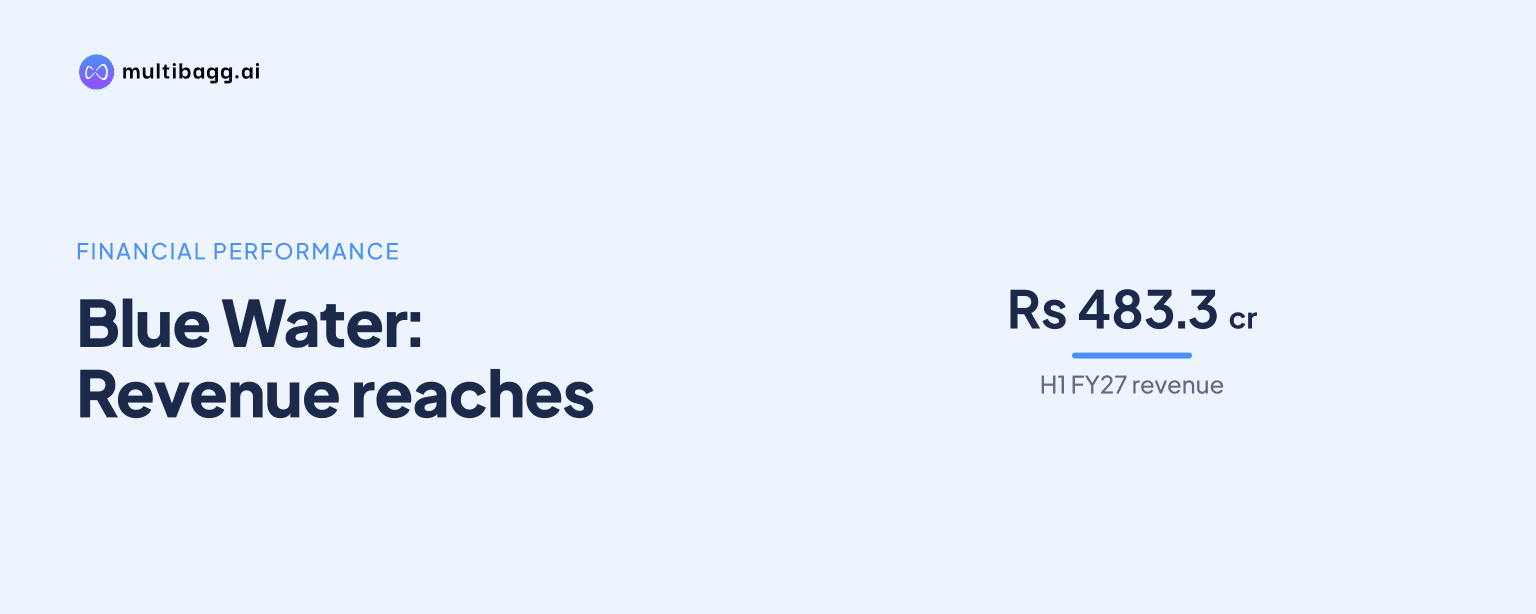
Blue Water Logistics Limited reported H1 FY27 revenue of ₹483.3 crore, up 249.5% year-on-year, with profit after tax of ₹30.0 crore as expansion in air freight and NVOCC operations lifted scale. The growth was accompanied by total borrowings of ₹330.8 crore and negative operating cash flow of ₹106.2 crore.
Know Blue Water Logistics inside out
Results, valuation, peers and who's buying, in one view.
What did Blue Water Logistics report for H1 FY27?
Blue Water Logistics reported revenue from operations of ₹483.3 crore for the half year ended September 30, 2026, compared with ₹138.3 crore in H1 FY26. The 249.5% year-on-year rise meant that first-half revenue exceeded the company’s full-year FY26 revenue of ₹386 crore.
EBITDA for H1 FY27 was ₹59.0 crore, translating into a 12.2% margin, while profit after tax stood at ₹30.0 crore. The company’s investor presentation attributed the expansion in scale to growth across dry container NVOCC, ISO tank and air freight operations, along with a larger fleet and international footprint.
The board approved the unaudited results for the quarter and half year ended September 30, 2026 on November 6. Blue Water Logistics subsequently released its Q2/H1 FY27 investor presentation, and it has scheduled an earnings conference call for November 12, 2026, at 3:00 PM IST to discuss the reported results.
How did Blue Water Logistics perform in Q2 FY27?
Blue Water Logistics reported Q2 FY27 revenue of about ₹272 crore, against ₹87 crore in Q2 FY26, representing year-on-year growth of more than 211%. Revenue also rose from ₹211 crore in Q1 FY27, reflecting quarter-on-quarter expansion in operations.
Q2 EBITDA was ₹35.4 crore, up 292.0% year-on-year from ₹9.0 crore. The EBITDA margin improved to 13.0% from 10.3% a year earlier, an increase of 270 basis points. EBIT margin was 10.3%, compared with 8.8% in Q2 FY26.
Profit after tax for the quarter was ₹16.0 crore, up 213.8% year-on-year from ₹5.1 crore. PAT margin was reported at 5.9%, marginally above 5.8% in the comparable period. The presentation also reported basic earnings per share of ₹14.54 for the quarter.
What drove the revenue and margin expansion?
Blue Water Logistics linked the revenue increase to higher activity in ocean freight, NVOCC and air freight, with the H1 investor presentation also highlighting dry container NVOCC and ISO tank operations. The company has been expanding its branch network, fleet and international presence, which increased the scale of its logistics operations.
The Q1 FY27 performance had already established a higher base for the first half. In Q1, revenue was ₹211.2 crore, up 315.4% year-on-year, while EBITDA was ₹23.6 crore at an 11.2% margin and PAT was ₹14.0 crore. Q2 revenue increased further to about ₹272 crore, and the operating margin rose to 13.0%.
The reported margin improvement is significant because EBITDA rose faster than revenue in Q2. However, the presentation also indicated that the company is investing in expansion. Reported profit growth and operating margins therefore need to be assessed alongside the working-capital needs and debt associated with the enlarged business base.
Got a follow-up? Ask IRIS
What does the balance sheet and cash flow position show?
Blue Water Logistics reported total borrowings of ₹330.8 crore as of September 2026, with debt-to-equity at 3.0 times. The increase in leverage coincided with capacity additions and the expansion of its operating footprint during the period.
Operating cash flow for H1 FY27 was negative ₹106.2 crore. The presentation identified a ₹158.3 crore working-capital lockup as the key factor behind the negative operating cash flow. This distinction matters because the company reported positive EBITDA and PAT while cash was absorbed by working capital.
For investors, the first-half results present two connected developments: a sharp rise in revenue and earnings, and a higher funding requirement to support the expanded business. The scheduled earnings call is the next disclosed forum for management to discuss the Q2/H1 results, although no earnings-call transcript had been published for this quarter at the time of the presentation.
Why do the H1 FY27 results matter to investors?
The results matter because Blue Water Logistics generated ₹483.3 crore of revenue in six months, surpassing its ₹386 crore revenue for all of FY26. The company also delivered H1 PAT of ₹30.0 crore, supported by strong Q1 and Q2 growth across freight and logistics activities.
At the same time, the reported balance-sheet data shows that rapid growth has required substantial funding. Borrowings of ₹330.8 crore, debt-to-equity of 3.0 times and negative H1 operating cash flow provide important context to the revenue and margin expansion. These figures indicate that working-capital movements are a material part of the company’s current financial profile.
The investor presentation provides reported operating and financial figures rather than management guidance. The November 12 earnings call may provide further details on the company’s Q2/H1 performance, operational expansion and financial position.
Conclusion
Blue Water Logistics delivered sharp growth in H1 FY27, with revenue rising 249.5% year-on-year to ₹483.3 crore and PAT reaching ₹30.0 crore. Q2 margins also improved, as EBITDA margin rose to 13.0%, showing that earnings expanded alongside higher freight and logistics volumes.
The key disclosed matters to watch next are the November 12, 2026 earnings call and management’s discussion of working capital, borrowings and capacity expansion. The company reported ₹330.8 crore of borrowings and negative operating cash flow of ₹106.2 crore for H1 FY27, driven by a ₹158.3 crore working-capital lockup.