










BlueStone says lab-grown diamonds mainly affect solitaires
Key highlights
- Solitaires accounted for less than 1% of BlueStone’s sales in Q2FY27.
- BlueStone defined solitaires as diamonds of 1 carat and above, with lab-grown interest focused on purchases priced at Rs 3 lakh, Rs 4 lakh and Rs 10 lakh.
- Management said Indian jewellery demand spans some 200 to 300 designs, including jhumkas and chandbalis, where gold represents a high share of product value.
- BlueStone said Ethera’s data shows natural-diamond and lab-grown-diamond customers are currently distinct groups, but it disclosed no Ethera sales or volume figures.
powered by IRIS
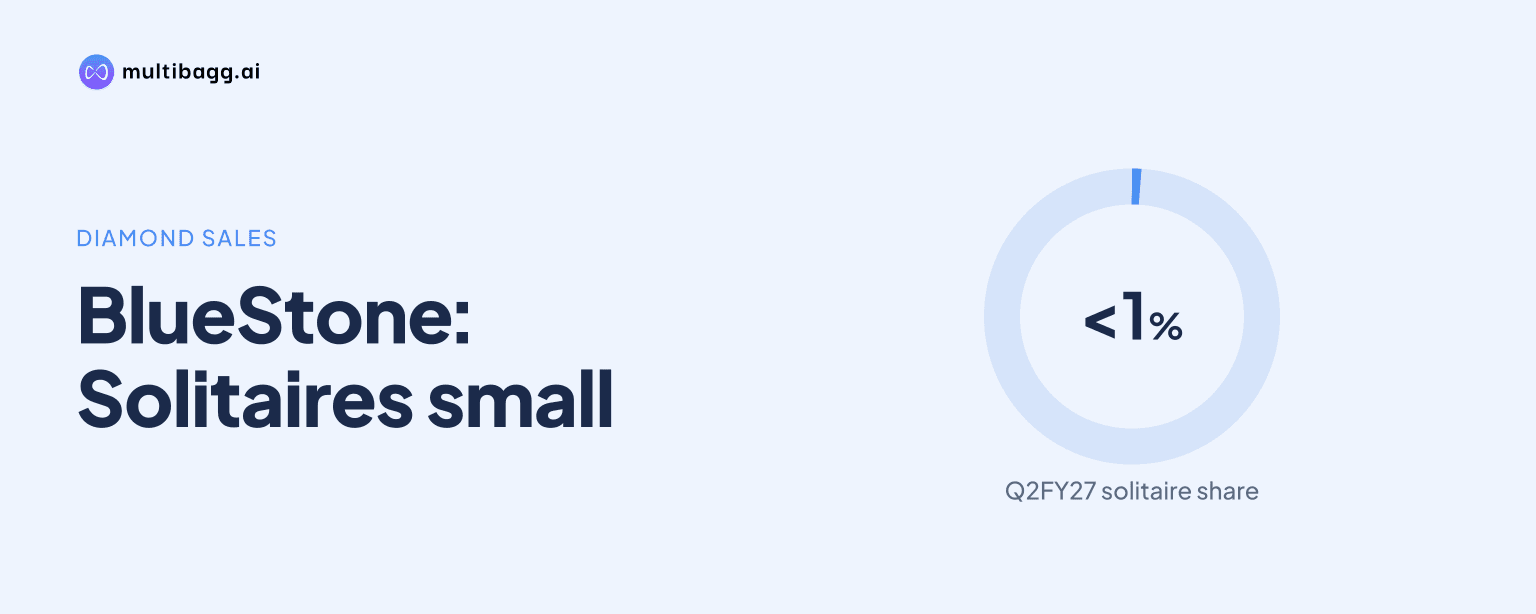
BlueStone says lab-grown diamonds are currently taking demand chiefly from large solitaire purchases rather than its design-led natural-diamond jewellery. In the second quarter of fiscal year 2027 (Q2FY27), management said solitaires accounted for less than 1% of BlueStone sales, while interest centred on larger diamonds priced at Rs 3 lakh, Rs 4 lakh and Rs 10 lakh.
Know Bluestone Jewellery & Lifestyle inside out
Results, valuation, peers and who's buying, in one view.
How exposed is BlueStone to lab-grown diamonds?
BlueStone’s disclosed exposure to the customer segment most open to lab-grown diamonds was less than 1% of sales in Q2FY27. Management said the relevant segment was solitaire jewellery, meaning diamonds of 1 carat and above, rather than BlueStone’s broader range of design-led pieces. This places current lab-grown traction in a category that management said was not material to BlueStone’s sales mix.
Management said BlueStone had not seen consumers in its stores asking for lab-grown diamonds. It added that its subsidiary, Ethera, operates in the lab-grown diamond category and provides data indicating that natural-diamond and lab-grown-diamond customers are currently “very distinct.” BlueStone said most consumers still prefer natural diamonds, while a defined group is choosing lab-grown stones.
The comparison is between two product pools, rather than between two diamond types across all BlueStone sales. Management said lab-grown diamonds are taking share “more from the solitaire space” and not from jewellery generally. BlueStone’s less-than-1% solitaire mix means the company did not disclose evidence in Q2FY27 of material demand shifting from its design-led assortment.
Why does BlueStone see solitaires as the main pressure point?
BlueStone sees solitaires as the main pressure point because buyers of large individual diamonds can substitute a lab-grown stone for a natural one more directly. Management identified purchases of bigger diamonds at Rs 3 lakh, Rs 4 lakh and Rs 10 lakh as customer cases opening up to lab-grown diamonds. These purchases differ from products selected primarily for their design, setting and cultural use case.
A solitaire, as BlueStone defined it in the Q2FY27 call, is a diamond of 1 carat or more. Management said large solitaire engagement rings are commonly sold in Western markets, including the United States and Europe, where engagement rings form a substantial part of jewellery demand. It contrasted this with India, where it said the large-solitaire engagement-ring category had never developed a high share of the jewellery market.
BlueStone attributed this difference to India’s design-led jewellery demand. Management cited earrings such as jhumkas and chandbalis and said Indian consumers can choose among some 200 to 300 jewellery types, reflecting cultural variation in design. The purchasing decision for these pieces can therefore extend beyond the choice of a single large diamond.
For a design-led item such as a jhumka or chandbali, management said gold represents a high share of the product’s value. BlueStone therefore said a lab-grown diamond cannot create substantial pricing disruption in that type of product, because changing the diamond component does not alter the full cost structure to the same extent as in a large-stone solitaire. This was management’s product-composition explanation, not a disclosed price calculation.
Got a follow-up? Ask IRIS
What does BlueStone’s subsidiary data indicate about customers?
BlueStone’s subsidiary data indicate that the two customer groups remained separate in Q2FY27, with lab-grown diamond demand showing traction mainly in solitaires. Ethera, BlueStone’s subsidiary in that category, is the source of the operating information management cited. Management did not disclose Ethera’s sales, order volumes, average order value or share of BlueStone’s business.
The absence of volume data limits conclusions about the pace of competitive change. BlueStone said it was seeing “some traction” in lab-grown diamonds, so its position was not that the category had no demand. Its narrower claim was that demand was occurring largely among buyers of big solitaire diamonds, rather than buyers of jewellery-led designs.
BlueStone also differentiated between store behaviour and the broader market. Management said consumers were not generally asking for lab-grown diamonds in BlueStone stores, while Ethera’s data showed that some customers specifically wanted lab-grown stones. These observations can coexist because BlueStone reported a below-1% solitaire mix while Ethera operates in the separate lab-grown segment.
The Q2FY27 discussion did not include a plan to introduce lab-grown diamonds into BlueStone’s core assortment, a forecast for lab-grown penetration or a target for natural-diamond sales. Management instead described the category as nuanced and tied its current impact to the relatively small solitaire segment. Product-level customer data, rather than a declared rollout, remains the disclosed basis for monitoring the issue.
What could change BlueStone’s lab-grown diamond assessment?
BlueStone’s assessment would face a different test if lab-grown demand extended beyond the 1-carat-and-above solitaire category into its design-led jewellery range. Management’s current position rests on three Q2FY27 observations: solitaires represented less than 1% of sales, Indian jewellery includes some 200 to 300 design types, and gold is a high-value component in products such as jhumkas and chandbalis.
A shift in any of those mechanisms would matter. Management’s view would need reassessment if consumers began asking for lab-grown diamonds more broadly in BlueStone stores, if Ethera’s data showed greater overlap between natural- and lab-grown-diamond buyers, or if lab-grown stones gained relevance in design-led products. BlueStone did not provide figures for these potential shifts in the call.
The distinction is between a reported competitive threat and a hypothetical one. BlueStone reported current lab-grown traction in larger-diamond purchases of Rs 3 lakh to Rs 10 lakh, but did not report a measurable loss of demand in its principal design-led natural-diamond range. Management’s comments describe its current market view, not an industry-wide market-share measurement.
Conclusion
BlueStone’s Q2FY27 comments portray lab-grown diamonds as a focused substitution issue in large solitaires, rather than a broad displacement of natural-diamond jewellery. The company’s less-than-1% solitaire sales mix, together with its description of 1-carat-and-above stones and India’s 200 to 300 jewellery designs, explains why management sees limited current overlap with its core assortment.
The unresolved matter is whether Ethera’s customer data show lab-grown demand moving from Rs 3 lakh to Rs 10 lakh solitaire purchases into design-led products, or whether enquiries become more common in BlueStone stores. BlueStone disclosed no lab-grown product rollout, penetration target or scheduled update in the Q2FY27 call.