










BlueStone keeps one retail playbook across Indian city tiers
Key highlights
- BlueStone opened 27 stores and entered 7 additional cities in Q2FY27, with openings across metros and Tier-1, Tier-2 and Tier-3 markets.
- BlueStone reported no material difference in jewellery price points or growth trends across city tiers and does not plan separate smaller-city assortments.
- BlueStone does not use below-the-line marketing, including apartment activations and outdoor advertising, relying largely on online customer acquisition.
- An analyst cited about 28% same-store sales growth in Q2FY27, while BlueStone said festive timing affected the quarter but could not quantify sales shifts into Q3FY27.
powered by IRIS
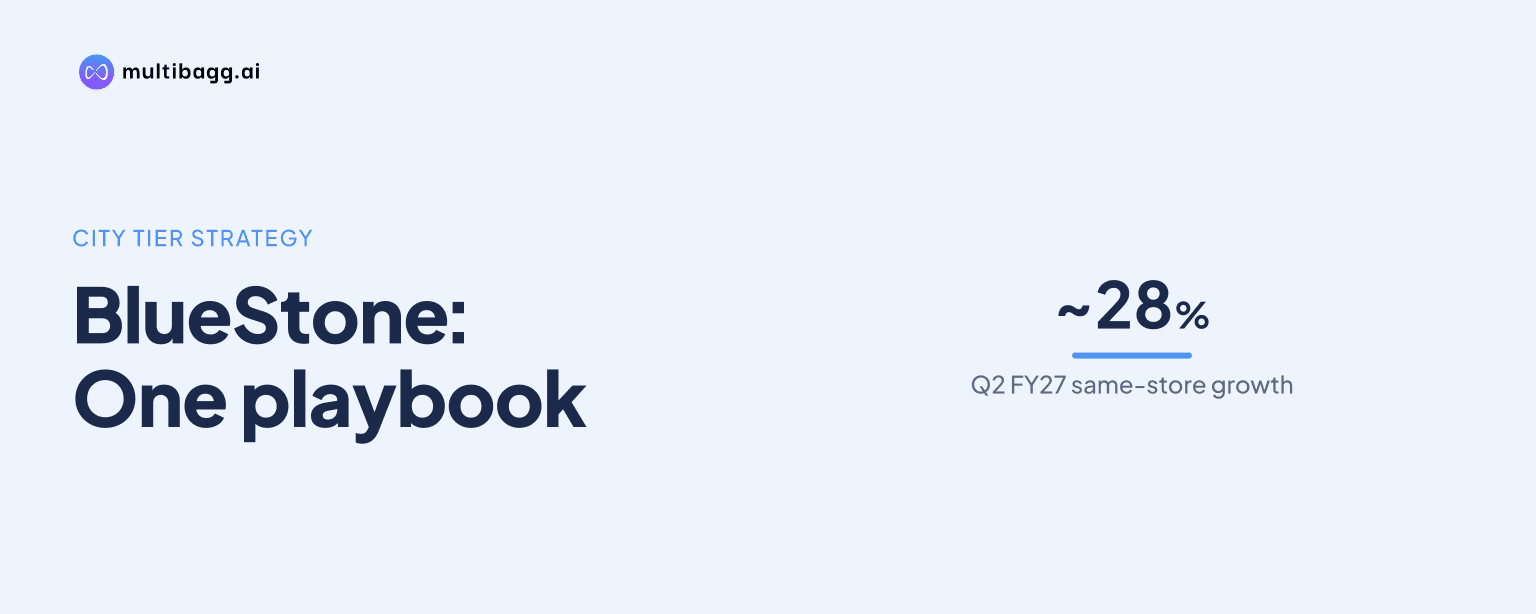
BlueStone said it will not create cheaper assortments or use local below-the-line marketing for Tier-2 and Tier-3 stores because it sees similar digital research and jewellery-buying behaviour across city tiers. In Q2FY27, BlueStone opened 27 stores while entering seven additional cities, with openings spread across metros and Tier-1, Tier-2 and Tier-3 markets.
Know Bluestone Jewellery & Lifestyle inside out
Results, valuation, peers and who's buying, in one view.
Does BlueStone use a separate strategy for Tier-2 and Tier-3 stores?
No. BlueStone said new-city expansion will largely take it into Tier-2 and Tier-3 markets, but store expansion is occurring across metros, Tier-1, Tier-2 and Tier-3 locations. Management said it entered seven more cities while opening 27 stores, indicating that many openings were in cities where BlueStone was already present.
BlueStone distinguishes city expansion from store expansion. New-city additions are expected to be weighted toward smaller cities, while the total store-opening programme also includes more outlets in established markets. Management did not disclose the 27-store split by tier, but said the network is expanding across all city groups rather than through a separate smaller-city format.
Will BlueStone sell cheaper jewellery in smaller cities?
No. BlueStone said it does not see a material price-point difference between Tier-1 and Tier-2 or Tier-3 jewellery markets. Management said jewellery is already well penetrated in smaller cities and that customers there can spend significant amounts on the category.
BlueStone added that many Tier-1 stores were also launched with lower price points, so entry-level products are not a Tier-2 or Tier-3-specific response. Management attributed initial ticket size more to a buyer's lifecycle, citing customers aged 28, 30 and 35 as relatively younger acquisition cohorts whose initial purchases may be lower than those of customers aged 40 or 45.
The company said customers generally raise spending as disposable income increases and as they make repeat purchases. Its range is intended to cover studded and non-studded jewellery, multiple price points, occasions and use cases. BlueStone did not disclose a tier-specific inventory allocation or a target mix for either product category.
How does BlueStone market stores in smaller cities?
BlueStone said it does not use below-the-line, or BTL, marketing in Tier-2 and Tier-3 cities or elsewhere in its network. Management specifically said it does not use apartment activations or outdoor advertising, and instead relies largely on online channels within a top-down marketing approach.
The operating model is designed to bring customers to BlueStone's website before a store visit. Management said consumers can research designs online and then use website store messaging to visit an outlet. It argued that shoppers cannot practically inspect 10,000 jewellery designs in a conventional store, making digital browsing the more suitable discovery mechanism.
BlueStone said this research pattern is relevant to jewellery, cars and houses and does not materially differ among metro, Tier-1, Tier-2 and Tier-3 customers. Management said consumers across these locations use the internet and aspire to similar products, and it intends to double down on the online-led channels that it said work for the business.
Got a follow-up? Ask IRIS
Are BlueStone's growth trends different across city tiers?
No material difference was reported. BlueStone said growth patterns are broadly similar when it examines stores by city tier or by store age, and it said its merchandise is not regional. Management therefore described performance as broad-based rather than driven by a particular city type or locally tailored assortment.
An analyst referred to about 28% same-store sales growth, or SSSG, in Q2FY27. Management said festive timing had a reasonable effect on the quarter but could not quantify the sales that may have shifted into Q3FY27 because consumer demand and operating conditions differed from the previous year.
BlueStone said its expansion hypothesis rests on three trends: more online research before purchase, greater demand for lightweight jewellery, and a shift from unorganised to organised jewellery retail. Management said these trends are visible across cohorts and cities, but it did not provide separate revenue, SSSG, traffic or conversion figures for Tier-2 and Tier-3 stores.
Why does BlueStone prioritise online discovery before a store visit?
BlueStone prioritises online discovery because management believes customers need access to a wide design range before visiting a jewellery store. Website engagement allows shoppers to examine products and designs before making a physical-store visit, according to management's description of its customer-acquisition model.
Management contrasted jewellery with apparel and footwear, where shoppers can browse a retailer for two hours or repeatedly visit stores such as Shoppers Stop or Zara. Its view is that a physical jewellery store cannot replicate that browsing experience across 10,000 designs, so online research is a category mechanism rather than only a marketing choice.
The approach also supports BlueStone's entry-price initiative. Management said average order value, or AOV, declined sequentially as entry-level price points performed better, calling this a deliberate result of its affordability effort. It said online messaging takes time to reach customers and that further gains could come from those price points.
Management also said that, even when gold prices are flat, ticket or AOV growth of 10% to 15% has historically occurred as customers mature and make higher-value repeat purchases. For Q3FY27, it had seen only 10 to 11 days of Navratri because the festival began late, with Karwa Chauth and Dhanteras still ahead.
Conclusion
BlueStone's stated expansion model treats online discovery, product breadth and customer behaviour as common across Indian city tiers. The seven-city and 27-store additions in Q2FY27 show that new-city growth can move toward Tier-2 and Tier-3 markets without requiring a separate assortment, local BTL campaign or different store proposition.
The next indicator is Q3FY27 festive trading after Karwa Chauth and Dhanteras, which had not occurred when management commented after 10 to 11 Navratri days. BlueStone also plans to continue its online-led acquisition model and expects further benefit as customers become more aware of its entry-level price points.