










BlueStone ties mature-store inventory to 1.8-2x turn levels
Key highlights
- BlueStone will add inventory to older stores only after they reach roughly 1.8-2 turns while sustaining growth and capital productivity.
- BlueStone has no fixed inventory target for mature stores, including no automatic increase after 2 or 5 years of operation.
- BlueStone’s oldest store cohorts are 5-7 years old and provide historical benchmarks across regions, store sizes, revenue levels and product mixes.
- Gold-price increases of 50%-70% shifted BlueStone’s entry price points from Rs 20,000-Rs 30,000 to about Rs 50,000, prompting a product-range redesign.
powered by IRIS
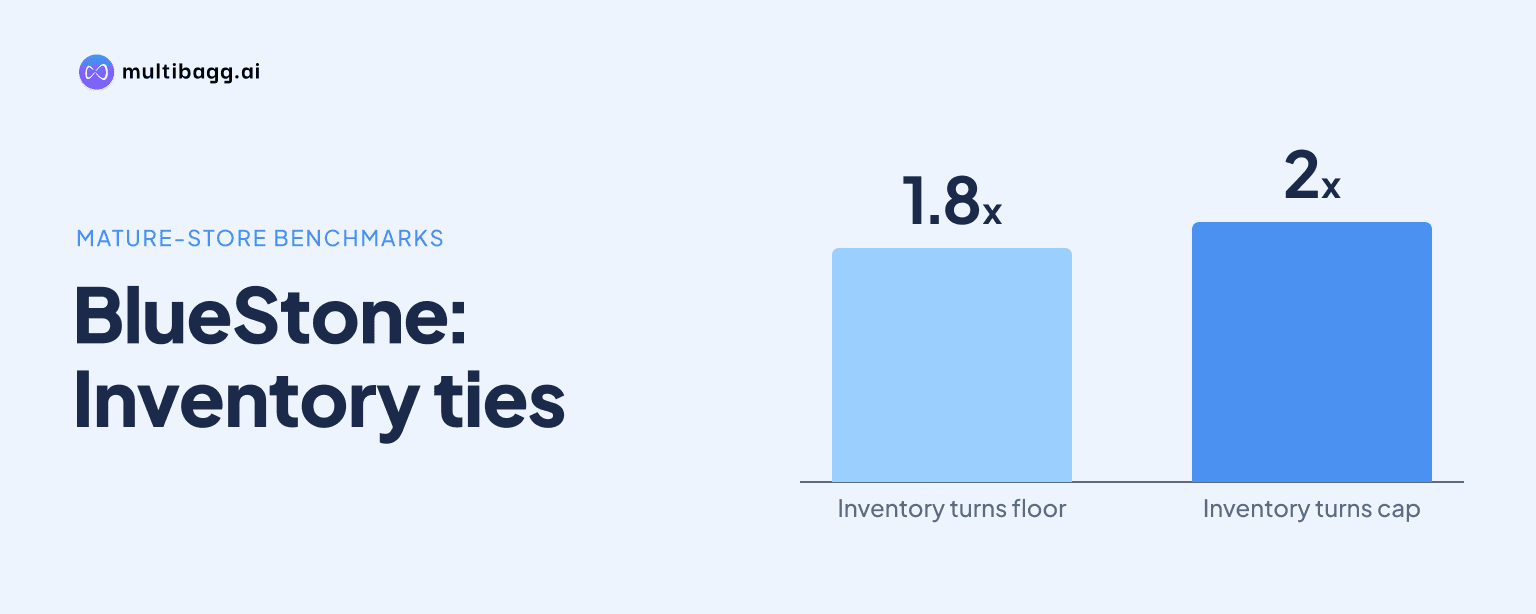
BlueStone Jewellery & Lifestyle Limited said older stores will receive additional inventory only after reaching roughly 1.8-2 turns while sustaining growth and capital productivity. BlueStone disclosed in its Q2FY27 earnings call that there is no fixed inventory target by store age; outlets must earn more stock through demonstrated performance.
Know Bluestone Jewellery & Lifestyle inside out
Results, valuation, peers and who's buying, in one view.
How will BlueStone allocate more inventory to older stores?
BlueStone will allocate more inventory to older stores when they show continuing growth and capital productivity, rather than when they reach a specified age. Management said stores with a large repeat-customer base can receive additional capital if their operating results support it, making the decision dependent on each outlet or cohort rather than a uniform store-expansion formula.
Management said an older store has no entitlement to a predetermined inventory increase after two years or five years. In response to a question on long-term per-store inventory for FY29 and FY30, it said there was “no target per se” for older cohorts. Stores must instead “win inventory” through the performance they demonstrate.
An analyst referred to current inventory of about Rs 7 crore per store when asking how per-store inventory could develop over the longer term. BlueStone did not validate a future per-store amount or provide a growth-rate target. It said capital allocation would move in tandem with the growth and productivity shown by individual store cohorts.
What does BlueStone's 1.8-2x turn level mean for inventory?
BlueStone said older cohorts can receive more inventory once they reach roughly 1.8-2 turns and management continues to see underlying growth. The company did not specify the period used for that turn measure, and it did not present the level as an automatic trigger for all outlets. The stated test also includes capital productivity.
Management said it considers inventory turns alongside revenue productivity, return on invested capital, or ROIC, and gross margin return on inventory, or GMROI. A store that reaches the turn level but does not show the required capital productivity will not receive more stock, according to management. This puts the 1.8-2x level within a broader store-level returns assessment.
BlueStone said its oldest store cohorts are five to seven years old and provide a reference for this assessment. Management said it has a grid of historical results across tiers, regions, store sizes, revenue levels, product baskets and product mix. It uses those earlier outcomes to judge whether a developing cohort is following an operating pattern that merits additional inventory.
Why does BlueStone focus on old cohorts instead of reported GMROI?
BlueStone said reported GMROI blends inventory turns from stores at different stages of maturity and therefore does not fully show older-store economics. An analyst said broad GMROI was around 26% in H1 and below the FY25 and FY26 figures. Management responded that the aggregate measure includes many locations opened during the last two to three years.
Management said a jewellery store builds toward full productivity through customer recruitment, repeat purchasing and average order value, or AOV. As a store gains vintage, its larger customer base can generate repeat purchases and higher AOV. BlueStone said the full effect on inventory productivity and GMROI is visible only after a store has achieved a certain vintage.
The comparison is therefore between a reported portfolio metric that includes young stores and historical cohort data from more established stores. BlueStone said investors should examine its older-cohort inventory turns, margins and productivity to understand the underlying model. It did not disclose cohort-level GMROI, ROIC or inventory-turn figures during the Q2FY27 call.
Got a follow-up? Ask IRIS
How do new and older BlueStone stores use inventory differently?
BlueStone said cash outflow for store inventory should be slightly lower as the network scales, but new stores can also begin with better inventory than earlier openings. Management cited a broader design range, a stronger brand and a stronger store network as reasons that inventory in new outlets can produce greater revenue productivity. It did not disclose inventory in kilograms, calling that information competitive.
Older stores have a different claim on incremental capital because they may have built a larger repeat-customer base. BlueStone said such outlets can require more articles and inventory as they continue to grow, but only after meeting its productivity tests. New locations are building recruitment, repeat and AOV, while established outlets are assessed against prior cohort evidence.
Product mix can also affect inventory requirements. BlueStone said its Park Street, Kolkata flagship is an experiment intended to expand product lines and serve more use cases beyond casted jewellery, including handmade and Kundan techniques. Management said it may test one or two more such stores, but it has not decided how far to expand the format.
Management also linked store productivity to changes in customer acquisition. It said gold-price moves of 50%-70% last year shifted entry price points from Rs 20,000-Rs 30,000 to about Rs 50,000, creating a product gap for new customers. BlueStone said it began redesigning and repopulating those price points in Q3 of last year and has seen improvement in new-customer growth over the last three quarters.
Conclusion
BlueStone's approach makes mature-store inventory a performance-based allocation decision rather than an age-based entitlement. The company will support older outlets with more inventory when they reach roughly 1.8-2 turns, retain growth momentum and deliver the store-level capital productivity management seeks. This separates investment in proven cohorts from a fixed per-store inventory target.
The next issue to watch is whether more recent cohorts develop the vintage that management says is needed to show their full GMROI and ROIC. BlueStone plans to apply its historical playbook from five-to-seven-year-old stores across regions, tiers, sizes and product mixes, while the Park Street flagship remains under evaluation pending more data and learnings.