










Bodhi Tree secures Assam platform mandate, Tripura MoU
Key highlights
- Bodhi Tree secured Assam’s official digital-platform mandate on 24 June 2026.
- BTML says Assam’s technology architecture is substantially complete, with branding and content onboarding next.
- BTML signed a Tripura media-technology MoU on 14 July 2026.
- BTML targets Rs 250 crore revenue and Rs 25 crore profit after tax in about three years.
powered by IRIS
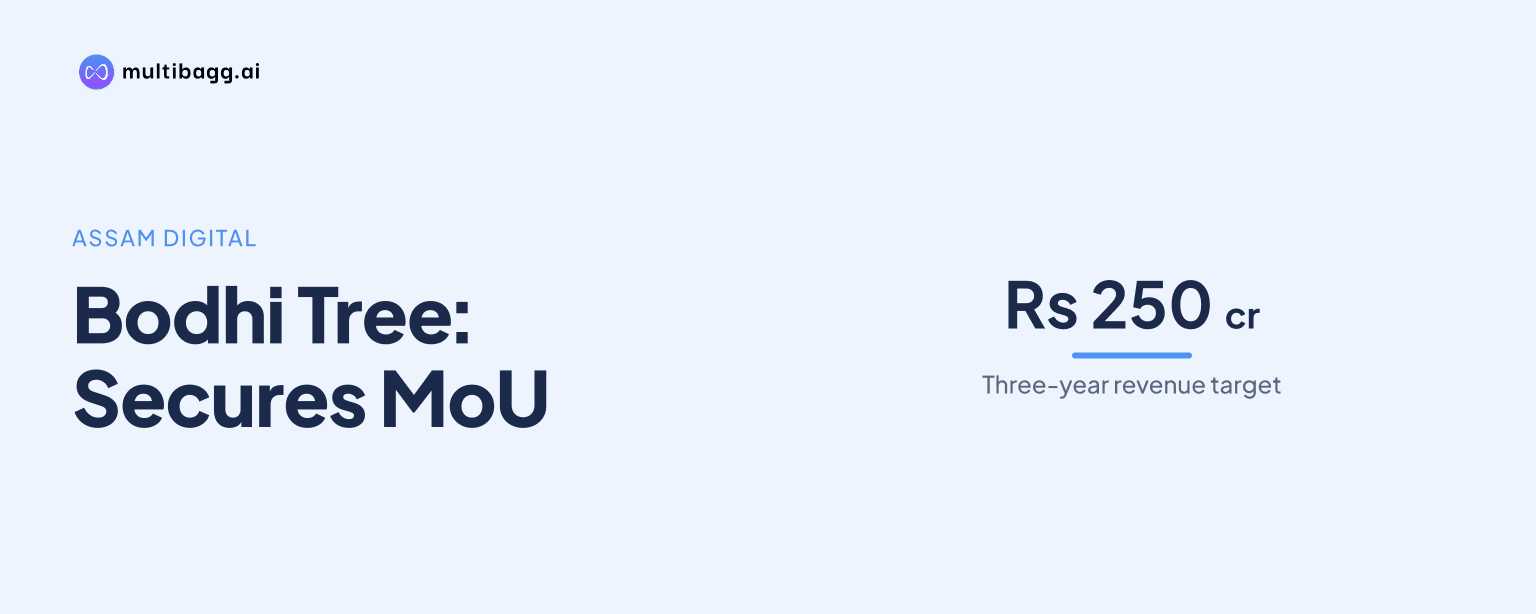
Bodhi Tree secured a 24 June 2026 mandate to develop, launch and manage Assam’s official digital content platform, with its technology architecture substantially complete, and signed a Tripura media-technology memorandum of understanding on 14 July 2026. The Assam project is BTML’s first stated move into platform ownership and recurring subscription revenue.
Know Bodhi Tree Multimedia inside out
Results, valuation, peers and who's buying, in one view.
What does the Assam platform mandate require from BTML?
BTML is required to develop, launch and manage Assam’s official digital content platform under the mandate secured on 24 June 2026. The platform is intended to carry regional entertainment, heritage content, live events, films, music and creator storytelling across mobile, web and connected television.
The platform is to be built with Mogi OTT on Google Cloud and Kubernetes auto-scaling. BTML presents the assignment as a move beyond producing commissioned content, because it gives the company responsibility for a state-level digital platform rather than a single programme or content property.
BTML says the Assam project marks its first move into platform ownership and recurring subscription revenue. The presentation does not disclose the mandate’s value, duration, subscription pricing, revenue-sharing terms, launch date or expected subscriber base, so the amount and timing of any platform income cannot be determined.
How advanced is BTML’s Assam platform project?
BTML says the Assam platform’s technology architecture is substantially complete and the project has moved to branding and content onboarding. This indicates progress beyond technical design, but the presentation does not say that the service has launched or begun generating subscription revenue.
Branding and content onboarding are the next disclosed activities before the platform can offer its planned mix of regional entertainment, heritage programming, live events, films, music and creator content. BTML does not provide a timetable for these activities or identify content partners, launch markets within Assam, or the initial catalogue size.
The two arrangements are therefore at different stages. Assam has a defined mandate, named technology components and a progress update, whereas Tripura remains at the memorandum stage after being signed 20 days later.
What does BTML’s Tripura MoU cover?
BTML’s 14 July 2026 Tripura memorandum of understanding covers media technology, creator ecosystem initiatives, artificial-intelligence-enabled infrastructure, digital marketing and media intelligence solutions. The stated purpose is to strengthen Tripura’s digital economy through digital media platforms and related creator and technology activity.
The presentation positions the MoU as a long-term strategic partnership, not as a completed platform deployment. Its stated scope includes digital media platforms, creator ecosystem initiatives, digital marketing and media intelligence, but it does not specify individual products, implementation milestones or a consumer-service launch date.
BTML says an implementation roadmap will follow the MoU. No commercial consideration, project budget, revenue model, delivery schedule or contract duration is disclosed, leaving the operational and financial structure of the Tripura arrangement unresolved.
Got a follow-up? Ask IRIS
How do these partnerships fit BTML’s stated strategy?
BTML says the Assam and Tripura arrangements support a transition from content producer to digital infrastructure platform owner. The company identifies platform and technology-enabled recurring streams as a way to diversify revenue beyond traditional content commissioning.
This platform strategy sits alongside BTML’s content operations through more than five creator-led studios delivering television, OTT, digital and free ad-supported streaming television content. Its wider model also includes co-created and owned intellectual property, with Bodhi Tree Ventures supporting syndication and digital sales across more than 100 countries.
The company’s stated objectives are Rs 250 crore of revenue and Rs 25 crore of profit after tax in about three years, alongside a long-term intellectual-property mix above 50%. These are BTML targets rather than forecasts for the Assam or Tripura projects, and the presentation does not allocate any part of either financial target to the state partnerships.
BTML also identifies Bodhi AI as a mechanism to improve production speed, localisation and workflows. The government projects add a public-sector platform and media-technology dimension to a strategy that otherwise includes franchise development, regional content, syndication, FAST channels and YouTube monetisation.
Could the state agreements change BTML’s revenue mix?
BTML says the Assam mandate can add platform and technology-enabled recurring streams to a revenue base previously centred on content commissioning and intellectual-property monetisation. The disclosed mechanism is an official digital platform available on mobile, web and connected television, with recurring subscription revenue specifically cited by the company.
The company’s existing monetisation plan includes OTT, television and FAST distribution, cross-language remakes, brand integrations, global syndication and digital sales. The Assam mandate introduces platform operation as an additional activity, while the Tripura MoU creates a framework spanning platforms, creator initiatives, marketing and media intelligence.
BTML describes the Tripura arrangement as a scalable framework for future state partnerships and says the Assam mandate validates it as a state-level digital infrastructure partner. These are management’s strategic positions, not evidence of additional mandates: the presentation identifies only Assam and Tripura among government partnerships.
The financial outcome will depend on execution because neither project has disclosed contract economics or project-specific targets. Assam still requires branding and content onboarding despite its substantially complete architecture, while Tripura requires the implementation roadmap promised after the July 2026 MoU.
Conclusion
The Assam mandate is the more developed of BTML’s two disclosed government partnerships, combining a defined responsibility to develop, launch and manage an official platform with named Mogi OTT, Google Cloud and Kubernetes components. Tripura broadens the company’s stated role into media technology, creator ecosystems, digital marketing and media intelligence, but remains a framework rather than an announced deployment.
The next disclosed milestones are Assam’s branding and content onboarding and Tripura’s implementation roadmap. BTML’s target of Rs 250 crore revenue and Rs 25 crore profit after tax in about three years gives broader strategic context, but the presentation does not show how much either state partnership may contribute or when platform revenue may begin.