










Bodhi Tree shifts to co-owned IP for repeat monetisation
Key highlights
- The Little Adda Company reached 728K+ subscribers and 100M+ views in four months.
- Khaane Mein Kya Hai recorded 625K+ subscribers, 150M+ views and 7M+ watch hours over four years.
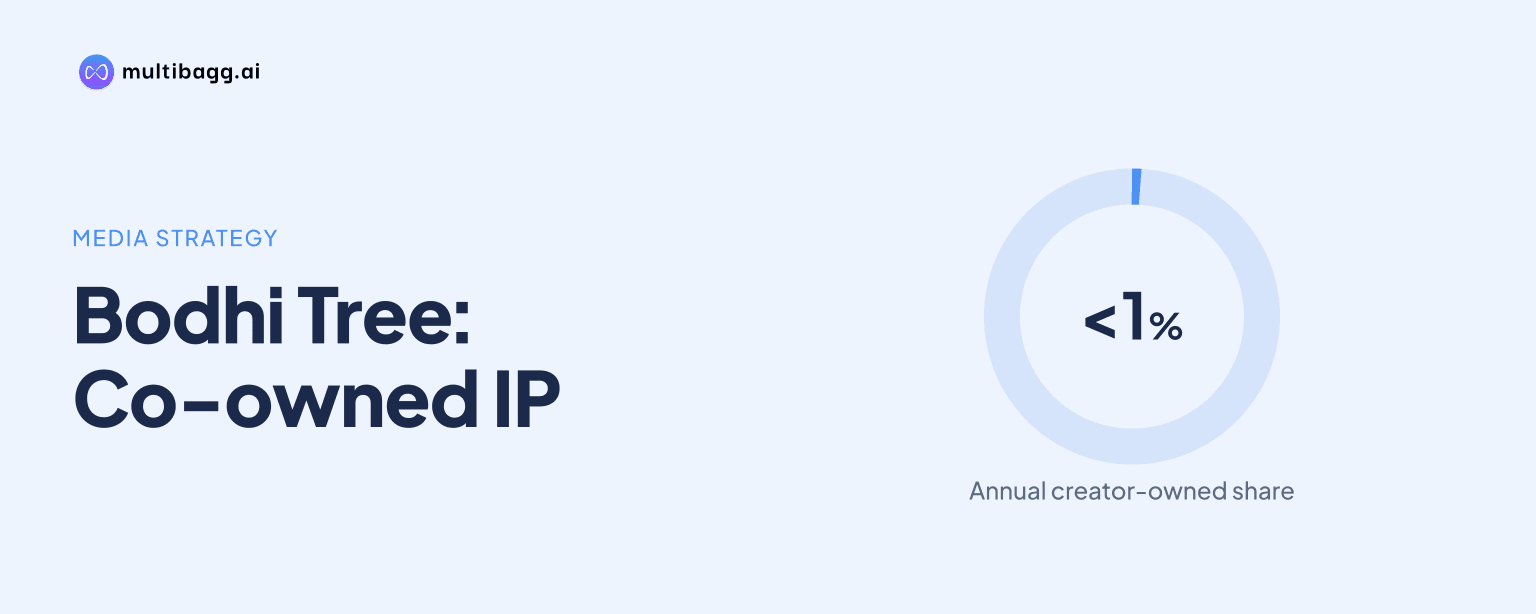
- Bodhi Tree says more than 50,000 hours of content are created annually in India, while creators own less than 1%.
- The Assam digital-platform mandate was secured on 24 June 2026, while the Tripura MoU was signed on 14 July 2026.
powered by IRIS
BodhiTree Multimedia Ltd is shifting from commissioned production toward co-created, selectively owned intellectual property (IP) intended for repeat monetisation, supported by The Little Adda Company’s 728K+ subscribers and 100M+ views in four months. Bodhi Tree says retained rights can support distribution, adaptation and extensions after an initial release.
Know Bodhi Tree Multimedia inside out
Results, valuation, peers and who's buying, in one view.
How is Bodhi Tree changing its content-production model?
Bodhi Tree is replacing a model centred on fixed production fees with selective co-creation and IP ownership intended to create recurring revenue streams. Under the legacy model described in the presentation, a platform commissions content, pays a production fee and controls much of the long-term upside, leaving Bodhi Tree dependent on platform renewal cycles. The proposed model retains rights in selected properties and seeks value across over-the-top (OTT), television, YouTube and digital-first distribution.
The practical distinction is ownership after delivery. Bodhi Tree says its operating sequence is to co-create, retain IP rights, control distribution and extend a title’s lifecycle. The presentation identifies syndication, licensing, re-formatting, language adaptations, podcasts, live formats, branded content, merchandise and free ad-supported streaming television (FAST) channels as potential further monetisation routes. These extensions depend on a property proving successful rather than representing automatic outcomes for every production.
Why does co-owned IP offer different economics from commissioned work?
Co-owned IP can provide multiple potential revenue cycles, while a commissioned production is presented as producing a one-time fee with limited backend participation. Bodhi Tree describes the intended progression as launch, scale, syndicate, adapt, extend and re-monetise. In that model, domestic and international licensing could continue after the first release, while adaptations can move an established format into new languages, geographies or media.
Bodhi Tree links the model to reinvestment, saying recurring cash flows from successful properties are intended to fund new IP creation. The presentation cites an ownership gap in India, where more than 50,000 hours of content are created annually but less than 1% is owned by creators. That figure supports the company’s view that long-term value often remains outside production companies, although the presentation does not quantify Bodhi Tree’s current owned-IP revenue or ownership share.
Got a follow-up? Ask IRIS
What evidence does Bodhi Tree provide for its IP strategy?
Bodhi Tree presents The Little Adda Company as its clearest early digital proof point, reporting 728K+ subscribers, 100M+ views and 6M+ watch hours within four months. The creator-driven channel focuses on podcasts and conversational formats. A podcast featuring Elvish Yadav crossed 8M+ views per episode, and Bodhi Tree says it is being developed into a multi-franchise property with potential OTT and live extensions.
Khaane Mein Kya Hai provides a second, longer-running example. The food-based property had built 625K+ subscribers over four years, with 150M+ views and 7M+ watch hours, according to the presentation. Bodhi Tree markets the format as a mix of food and conversation and says it is growing into digital and live formats with brand-integration potential. Compared with The Little Adda Company, it has more cumulative views, while The Little Adda Company reached a larger subscriber base over a much shorter four-month period.
Bodhi Tree also cites Class, a Netflix series that reached Netflix’s Global Top 10, as evidence of its storytelling reach. However, the presentation separately describes commissioned and syndicated projects as a continuing income base that supports reinvestment into original IPs. That distinction matters because Class demonstrates distribution visibility, but the supplied material does not state that Bodhi Tree owns Class or its associated rights.
How could Bodhi Tree extend content beyond an initial release?
Bodhi Tree intends to build properties for several media formats from the outset, including reality shows for YouTube, OTT releases, television and digital-first platforms. Its presentation describes the first stage as identifying scalable concepts and partnering with creators across genres and formats. It also plans Indian adaptations of globally successful content and formats, a route that could use existing audience recognition while tailoring a concept to domestic viewers.
After platform distribution, Bodhi Tree’s proposed extensions include domestic and international syndication, format rights, new-language versions, FAST channels, podcasts, live formats, branded content and merchandise. The company uses Korean drama, Turkish series and La Casa de Papel as industry parallels for its view that ownership combined with franchise building can lengthen a title’s commercial life. Those examples are not forecasts or disclosed financial outcomes for Bodhi Tree.
The structure supporting this approach includes Studio Bodhi as the production studio unit and Bodhi Ventures as the sales monetisation unit. The group also lists subsidiaries in digital-first and unscripted IP, premium OTT and film IP, and mass-market television. Moving Images is positioned for FAST monetisation, while Gurudev Bhalla Films is described as generating 50% of revenue from licensing. The presentation does not disclose revenue, profit or ownership economics by unit.
Conclusion
Bodhi Tree’s stated transition is from earning mainly at delivery to retaining selected rights that may produce revenue through syndication, adaptations and multi-format extensions. The Little Adda Company’s 728K+ subscribers and 100M+ views in four months, alongside Khaane Mein Kya Hai’s 150M+ views over four years, provide audience indicators for digital formats that management aims to develop into longer-lived properties. The continuing commissioned portfolio is presented as the funding base for this IP-building effort rather than as a discontinued business.
The next disclosed execution markers are the company’s platform and partnership plans. Bodhi Tree said the Government of Assam platform mandate, secured on 24 June 2026, had a substantially complete technology architecture and had moved to branding and content onboarding. Its 14 July 2026 memorandum of understanding with the Government of Tripura remained at the memorandum stage, with an implementation roadmap still to follow; the presentation does not disclose recurring revenue from either initiative.