










Bondada sees debt at Rs 1,300-1,500 crore by March
Key highlights
- Bondada expects total debt of Rs 1,300 crore to Rs 1,500 crore by March 31, 2027.
- Management expects Rs 750 crore to Rs 800 crore of Onix and BESS term-loan utilisation by end-March 2027.
- Bondada reported Rs 480 crore of existing working-capital debt during the Q2 FY27 call.
- Bondada said its existing capital requirements are tied up and no near-term equity raise is needed.
powered by IRIS
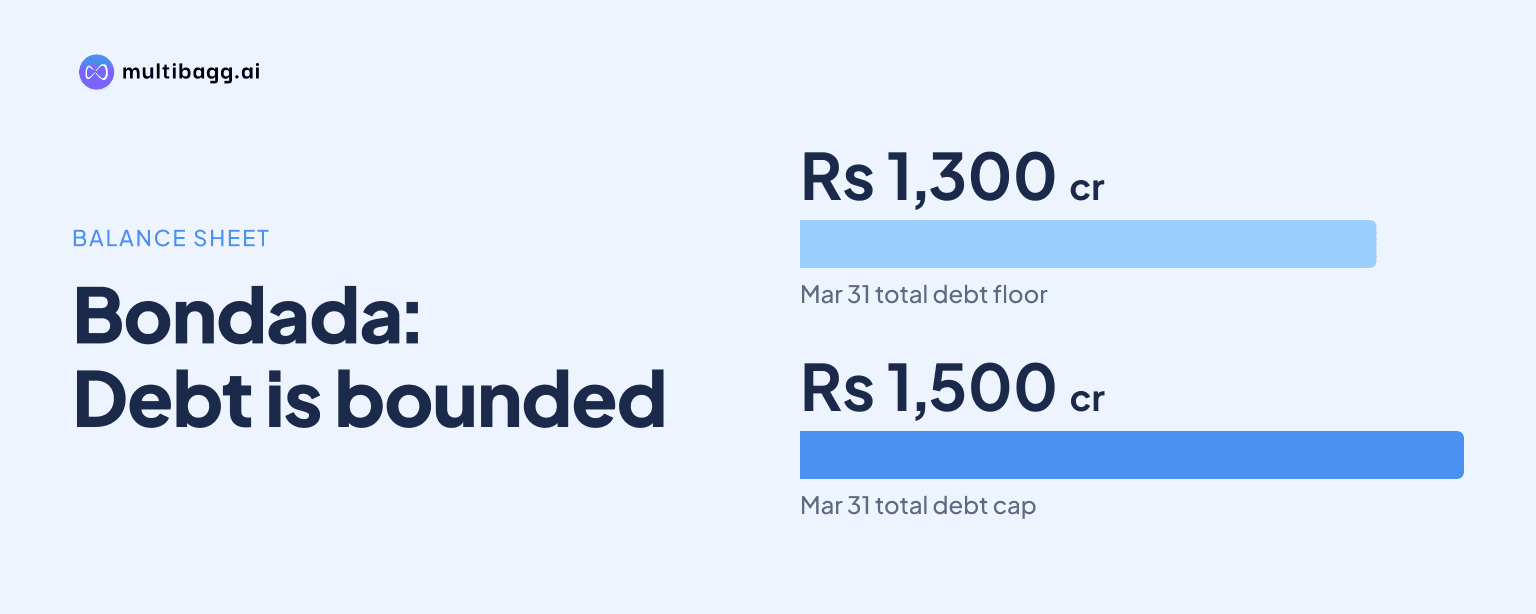
Bondada expects total balance-sheet debt of Rs 1,300 crore to Rs 1,500 crore by March 31, 2027, after drawing Rs 750 crore to Rs 800 crore in term loans for Onix and battery energy storage system projects, alongside Rs 480 crore of existing working-capital debt. Management said this would equal about 1.5 times equity.
Know Bondada Engineering inside out
Results, valuation, peers and who's buying, in one view.
How will Bondada's debt change by March 2027?
Bondada expects debt to rise from the roughly Rs 360 crore net-debt level cited by an analyst for the September 2026 quarter to Rs 1,300 crore to Rs 1,500 crore by March 31, 2027. Chief Financial Officer Satyanarayana Baratam said current net debt was entirely working-capital debt, apart from Rs 70 crore to Rs 80 crore received from banks under an emergency credit line.
The expected increase is linked mainly to project financing that has yet to be drawn. Management expects Rs 750 crore to Rs 800 crore of term-loan utilisation by the end of March after execution of the Onix and BESS projects, while existing working-capital borrowing stands at Rs 480 crore. The stated total debt range is higher than the simple sum of those components, and management did not provide a further item-by-item bridge.
What will fund Bondada's higher borrowing?
Bondada said the additional term borrowing will support Onix and BESS projects. The company acquired a 60% controlling stake in Onix IPP Private Limited, which owns a 225-megawatt alternating-current solar project in Maharashtra. The independent power producer project has a 25-year power purchase agreement with MSEDCL and is expected by management to generate about Rs 150 crore of annual revenue.
For BESS, management said it has banking facilities with Canara Bank and would draw them alongside the Onix term loan. Bondada reported a BESS order book of about 1,250 megawatt-hours, including 850 megawatt-hours of annuity-based orders expected to be realised over 12 years. Management said bank finance for those 850 megawatt-hours was closed and the projects were under execution, with an internal rate of return of 14% to 14.5%.
The BESS pipeline includes a 100-megawatt-hour vanadium redox flow battery project at Khavda, Gujarat, and a 120-megawatt-hour project for Gujarat Industries Power Company Limited at Vadodara. Management described vanadium redox flow batteries as an alternative to lithium-ion technology. It also said around 350 megawatt-hours of its BESS orders are engineering, procurement and construction, or EPC, projects carrying EBITDA margins of about 12% to 13%.
Does Bondada need to raise equity soon?
Bondada does not expect an equity raise in the near future because management said capital for its existing order book and current requirements is already tied up. Baratam said the company has avenues to raise equity depending on capital requirements and expansion, but added that it does not need further funding at this point for the existing order book.
Management identified two circumstances that could alter that position: a large EPC contract requiring additional working capital, or a large independent power producer project requiring a term loan. The company also has a proposed 2-gigawatt project, but management said it was not seeking funding for it in the current financial year. It said 50% of the land had been acquired and that it might develop 200 megawatts, 300 megawatts, or at most 500 megawatts at one time rather than build the full capacity at once.
Bondada expects clarity on funding for the 2-gigawatt project by the end of the financial year, based on the capacity eventually taken up. Management said it was working on two contracts using the land already acquired and could declare them in the next quarter, while power purchase agreements and contracts could be concluded in the next half year. Those statements describe management's plan rather than committed financing.
Got a follow-up? Ask IRIS
How does higher debt fit Bondada's balance sheet and order book?
Bondada reported cash deposits of about Rs 335.3 crore as of September 30, 2026, net worth of Rs 840 crore, and a consolidated balance-sheet size of about Rs 2,500 crore. Net worth had increased from Rs 730 crore at March 31, 2026, a rise of Rs 110 crore over six months. Management's projected Rs 1,300 crore to Rs 1,500 crore debt range equates to roughly 1.5 times equity, as it stated on the call.
The planned funding coincides with a larger project workload. Bondada's consolidated order book was about Rs 10,445.8 crore at October 31, 2026, spanning renewable energy, BESS, telecom infrastructure and other infrastructure. Of that order book, management said about Rs 2,000 crore comprised operations and maintenance orders running for three to five years, while Rs 1,400 crore of annuity orders extended for 12 years.
After excluding those longer-duration operations and maintenance and annuity orders, management estimated that about Rs 7,000 crore needed to be executed over the next 24 months. That compares with H1 FY27 revenue of Rs 1,415.3 crore, up 16% year on year, and EBITDA of Rs 162.2 crore, up 12%. The debt increase is associated with execution and asset-owning projects, while the order book still contains a substantial EPC component to be delivered within two years.
What does Bondada expect from its business mix?
Bondada said solar EPC and telecom EPC currently contribute about 90% of revenue, with newer businesses contributing the remaining 10%. Management wants EPC's share to fall to 70% by 2030 and for newer technologies, including data centres and defence, to account for 30%. It said defence and data-centre initiatives are recent and may not generate considerable revenue in the current financial year.
Management also expects annuity revenue and new technologies to contribute 30% to 35% over the next three years, compared with EPC's current 90% to 92% contribution. Baratam said annuity-based business has somewhat higher EBITDA margins than EPC and guided that overall margins would at least be maintained or improve. This remains management guidance, contingent on execution, financing and development of the planned asset-based projects.
Conclusion
Bondada's projected Rs 1,300 crore to Rs 1,500 crore debt level by March 31, 2027 marks a shift from predominantly working-capital borrowing toward term-funded asset projects. The Onix solar asset and BESS facilities are the disclosed reasons for the change, while management says existing capital needs are funded and an equity issue is not imminent.
The next items to watch are actual drawdown of the Rs 750 crore to Rs 800 crore of project term loans, progress on Onix and BESS execution, and management's funding clarity for the proposed 2-gigawatt project by the end of FY27. The company also said it may disclose two contracts for that project in the next quarter and target power purchase agreements in the following half year.