










Bondada Guides 55%-60% FY27 Revenue Growth on H2 Execution
Key highlights
- Bondada guided for FY27 revenue growth of 55% to 60% over the prior year.
- Management expects 65% of FY27 targeted revenue in H2, compared with 35% in H1.
- Bondada disclosed an order book of approximately Rs 10,500 crore, with its top five customers representing 70%.
- Management expects total debt of Rs 1,300 crore to Rs 1,500 crore by March 31, 2027.
powered by IRIS
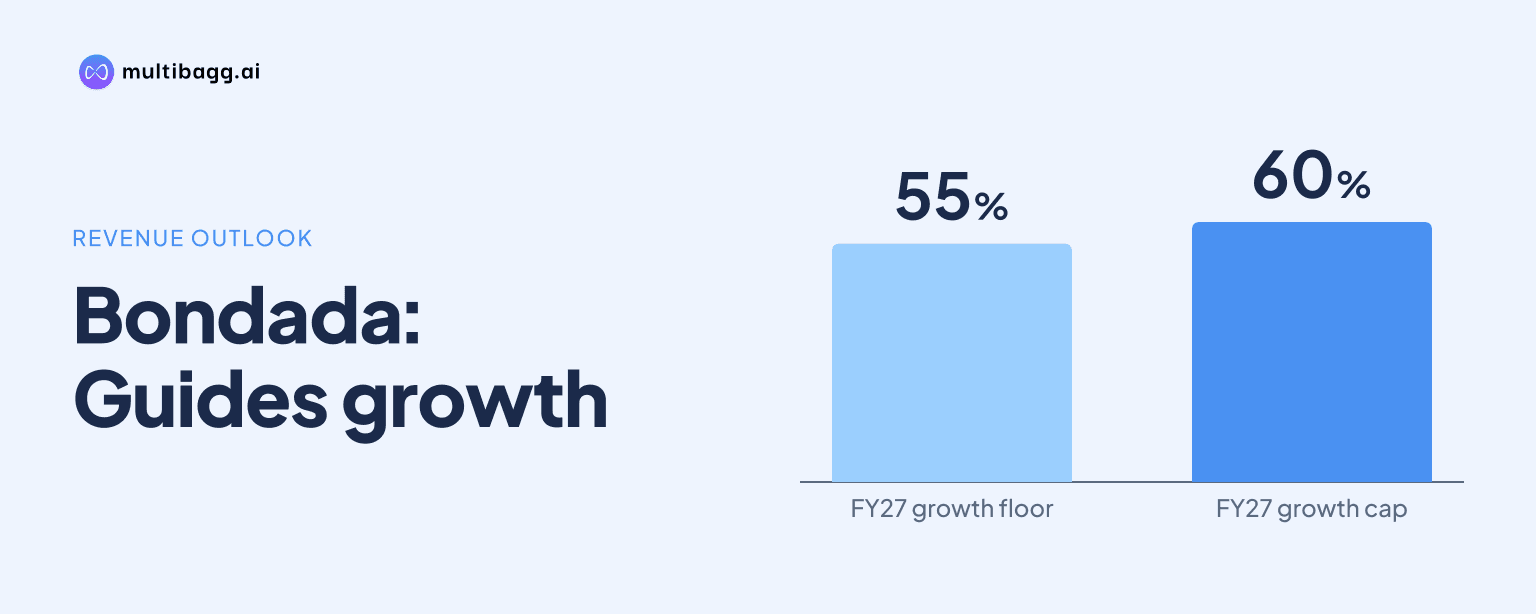
Bondada Engineering Limited guided for 55% to 60% revenue growth in FY27 over the prior year, based on management's expectation that about 65% of targeted annual revenue will be delivered in the second half, or H2. The outlook follows 10% to 15% first-half, or H1, top-line growth cited by an analyst and depends on manpower and funding.
Know Bondada Engineering inside out
Results, valuation, peers and who's buying, in one view.
Why does Bondada guide for 55%-60% FY27 revenue growth?
Bondada guides for 55% to 60% FY27 revenue growth because management expects its customary H2-heavy execution pattern to continue. Raghavendra Bondada said H1 generally contributes about 35% of the financial year's targeted revenue, with H2 accounting for the remaining 65%, except in the last financial year.
The 55% to 60% figure is management guidance, not a reported FY27 outcome. An analyst described H1 top-line growth of around 10% to 15% during the call, while Bondada did not disclose H1 revenue in rupees or provide a specific full-year revenue target in rupees. The guidance therefore requires considerably faster revenue conversion during H2 than the pace indicated by the H1 comparison.
Management linked the outlook to contractually binding work that it says must be delivered. Bondada said it needed to increase execution capacity through additional manpower and arrange financial resources on time; management said it saw no limitation in either requirement at the time of the call.
How much of Bondada's FY27 revenue is expected in H2?
Bondada expects about 65% of FY27 targeted revenue in H2, compared with about 35% in H1. This means H2 is expected to account for nearly twice H1's share of the annual target, making the timing of project execution central to the 55% to 60% full-year growth guidance.
The company did not provide quarterly revenue targets, H1 revenue in rupees, or a schedule of which projects will be billed in H2. It did say that its normal revenue split had applied in years other than the preceding financial year, when that pattern was an exception.
Bondada disclosed a total order book of approximately Rs 10,500 crore, including around Rs 2,000 crore in telecom, about Rs 1,500 crore related to Adani, around Rs 2,800 crore related to NTPC and approximately Rs 1,500 crore of pending NHPC orders. These disclosures indicate the pool of work available for execution, but management did not identify the H2 FY27 portion of each category.
The top five customers represented 70% of the order book, according to management. Bondada said it was also participating in tenders worth about Rs 26,000 crore across public-sector companies including NHPC, SJVN and Coal India, as well as private customers, although tender participation is not awarded work or recognised revenue.
What conditions must Bondada meet to deliver FY27 guidance?
Bondada said expanding manpower and pooling funds on time are the two conditions for delivering the revenue plan. Management said it must raise execution capability through personnel additions, while financial resources must be available as projects move from order book to construction and billing.
Funding matters because Bondada is executing engineering, procurement and construction, or EPC, projects while developing asset-based energy projects. Management said EPC currently accounts for around 90% to 92% of business, but annuity revenue and newer technologies are intended to contribute about 30% to 35% over the next three years.
Receivables are also tied to project execution. Bondada said private customers typically have two or three payment milestones, while government customers have five or six milestones. Management reported procedural delays with one or two customers in the prior quarter and said those collections could be recovered during Q3, while stating that it saw no broader collection difficulty.
Product subsidiaries contributed close to 10% of consolidated revenue in H1 FY27, and management expected a similar contribution in H2 FY27. That expectation suggests subsidiaries are not projected to be the primary source of the near-term acceleration implied by the 55% to 60% FY27 growth outlook.
Got a follow-up? Ask IRIS
How do Bondada's debt and project plans affect execution?
Bondada said existing capital was tied up for the current order book and capital requirements, and that it did not need additional funding at present. Management said equity funding could be considered for future expansion, but not in the near term, unless a large EPC contract requires working capital or a large independent power producer, or IPP, project requires term debt.
Management described around Rs 360 crore of net debt at the quarter end as working-capital debt, apart from roughly Rs 70 crore to Rs 80 crore of bank emergency-credit-line term debt. By March 31, 2027, Bondada expects total balance-sheet debt of Rs 1,300 crore to Rs 1,500 crore, including term-loan utilisation of around Rs 750 crore to Rs 800 crore and existing working capital of Rs 480 crore.
Bondada also said it was not seeking funding for its 2-gigawatt IPP project in the current financial year. Management said 50% of the project's land had been acquired, while land pooling was delayed, and that future phases could be 200 megawatts, 300 megawatts or a maximum 500 megawatts rather than the full 2 gigawatts at once.
How could Bondada's changing mix affect FY27 execution?
Bondada aims to shift from an EPC contribution of roughly 90% to 92% today to a 70:30 mix over the next three years, with annuity revenue and new technologies forming the balance. Management said annuity-based activity has somewhat higher earnings before interest, tax, depreciation and amortisation, or EBITDA, margins than EPC work and guided for margins to be maintained or improved over time.
Battery energy storage systems, or BESS, are part of that planned mix change. Bondada reported an order book of around 1,250 megawatt-hours, including 850 megawatt-hours of annuity-based projects that management said carry internal rates of return of 14% to 14.5% over 12 years.
The remaining BESS EPC work was around 350 megawatt-hours, with management citing EBITDA margins of about 12% to 13%. Bondada said BESS order inflow had slowed during the previous six to seven months, or around two quarters, because of volatility in battery-cell and imported-battery prices, but management expected activity to pick up as cell availability stabilised.
Conclusion
Bondada's FY27 revenue guidance depends on an unusually concentrated H2 delivery period rather than the H1 growth pace cited during the call. Its Rs 10,500 crore order book, continued EPC execution and expanding energy-storage activities provide the work base management referenced, but staffing, funding and milestone-based collections remain necessary to convert that work into revenue.
The next disclosed milestones are two potential contracts for the 2-gigawatt IPP project that management said may be announced in the next quarter, followed by possible power purchase agreements and contracts in the next half year. Bondada said the project's funding requirement should become clearer by the end of the current financial year as it determines the size of the first 200-megawatt to 500-megawatt phase.