










Brookfield India REIT Has 83% of Debt Maturing From FY31+
Key highlights
- Brookfield India REIT reported that 83% of gross-debt repayments fall in FY31+ as of September 30, 2026.
- Brookfield India REIT's debt mix was 87% floating rate and 13% fixed rate, with a 7.3% average interest rate.
- Portfolio Assets had Rs 14,550 crore of gross debt and a nine-year average maturity.
- Brookfield India REIT reported LTV of 26.7% excluding shareholder instruments and 28.7% on a consolidated basis.
powered by IRIS
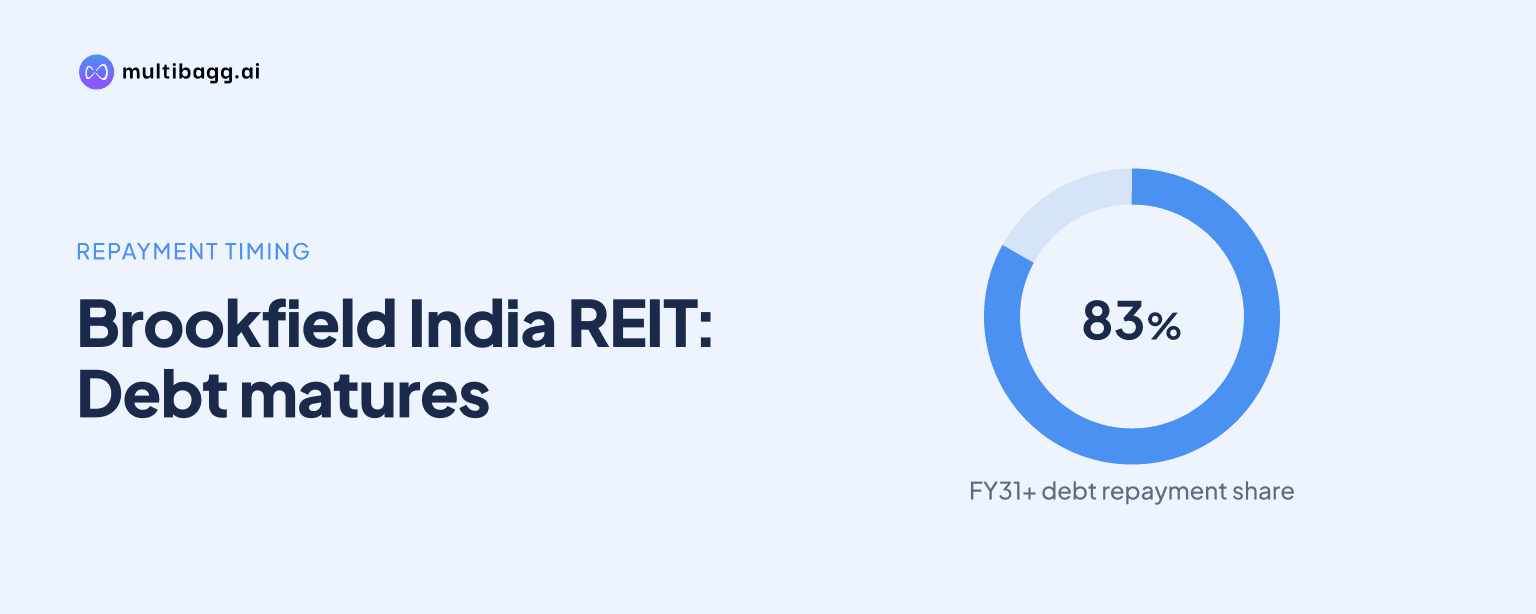
Brookfield India REIT had 83% of gross-debt repayments scheduled in FY31+ as of September 30, 2026, while 87% of its debt book was floating rate and management said a 25-basis-point repo-rate increase would affect it after Q2 FY2027. The remaining stated repayment share through FY30 was 17%.
Know Brookfield India Real Estate Trust inside out
Results, valuation, peers and who's buying, in one view.
When does Brookfield India REIT's gross debt mature?
Brookfield India REIT reported that 83% of its gross-debt repayment profile falls in FY31+, compared with 2% in FY27, 3% in FY28, 6% in FY29 and 6% in FY30. The presentation separates the schedule between Portfolio Assets and North Commercial Portfolio Assets, with the maturity profile stated as of September 30, 2026.
Portfolio Assets had reported gross debt of Rs 14,550 crore and an average maturity of nine years. Brookfield India REIT defines this figure as bank borrowings, including accrued interest, and non-convertible debentures, or NCDs, adjusted for Rs 60 crore of processing fees. This is a gross-debt measure and is not presented as the same measure as balance-sheet borrowings.
The North Commercial Portfolio had Rs 3,000 crore of gross debt with a 13-year average maturity. Its schedule has no repayment in FY27, followed by Rs 40 crore in FY28, Rs 50 crore in FY29, Rs 130 crore in FY30 and Rs 2,780 crore in FY31+. The 13-year average maturity is four years longer than the nine-year average disclosed for Portfolio Assets.
How exposed is Brookfield India REIT to interest-rate changes?
Brookfield India REIT's gross debt was 87% floating rate and 13% fixed rate as of September 30, 2026. The maturity schedule indicates when repayments are due, while the floating-rate proportion identifies the debt whose borrowing cost can change with applicable benchmark rates before those maturity dates.
The average interest rate was 7.3%, and management stated that the impact of a 25-basis-point increase in the repo rate was expected after Q2 FY2027. The presentation does not quantify the rupee effect on interest expense, net distributable cash flow or distributions per unit. It therefore specifies the expected timing of the stated rate effect without providing a sensitivity amount.
Interest on external debt at the special purpose vehicle level was Rs 432.5 crore in H1 FY2027, comprising Rs 220.5 crore in Q1 and Rs 212 crore in Q2. At the REIT level, external-debt interest was Rs 90.4 crore in H1 FY2027, including Rs 49.4 crore in Q1 and Rs 40.9 crore in Q2. These are separate items in the net distributable cash flow walkdown and are not a stated calculation of repo-rate sensitivity.
Got a follow-up? Ask IRIS
What leverage and cash figures did Brookfield India REIT report?
Brookfield India REIT reported loan-to-value, or LTV, of 26.7% excluding shareholder instruments, based on gross asset value, or GAV, at September 30, 2026. Its calculation uses GAV for Portfolio Assets and 50% of the GAV for the North Commercial Portfolio.
Including the liability component of partners' shares of NCDs and compulsorily convertible debentures, or CCDs, and shareholder debt from the REIT to the sponsor, consolidated LTV was 28.7%. The 2-percentage-point difference reflects the additional instruments included in the consolidated calculation. The presentation also reported ICRA AAA stable and CRISIL AAA stable ratings.
The summary balance sheet listed Rs 15,579.6 crore of borrowings within Rs 20,542 crore of total liabilities at September 30, 2026. Total equity was Rs 21,836.7 crore, including Rs 18,399.7 crore of equity and Rs 3,437 crore of non-controlling interest. Brookfield India REIT does not provide a direct reconciliation between this balance-sheet borrowing figure and the separate Rs 14,550 crore gross-debt measure for Portfolio Assets.
Cash and cash equivalents were Rs 1,512.7 crore, while investment property was Rs 37,735.2 crore and investment property under development was Rs 506.7 crore. Investments accounted for using the equity method were Rs 828 crore because the North Commercial Portfolio is equity accounted in the financial statements. The presentation does not disclose a separate undrawn-facility amount or a minimum cash requirement.
How do debt costs connect to Brookfield India REIT's distributions?
Brookfield India REIT generated net distributable cash flow, or NDCF, of Rs 899 crore at the REIT level in H1 FY2027. This followed Rs 972.8 crore of NDCF distributed to the REIT from underlying entities, Rs 90.4 crore of REIT-level external-debt interest and Rs 16.6 crore of treasury income net of REIT expenses.
Brookfield India REIT used Rs 38.8 crore of available cash, resulting in Rs 937.8 crore of NDCF distributable at the REIT level in H1 FY2027. NDCF per unit and distribution per unit were both Rs 11.30, comprising Rs 5.60 in Q1 and Rs 5.70 in Q2. The equal per-unit figures are reported results for the half year rather than management guidance.
At the property-owning entity level, cash flow from operations was Rs 1,483.3 crore in H1 FY2027, before Rs 432.5 crore of external-debt interest, resulting in Rs 1,077.5 crore of NDCF at the special purpose vehicle level. Cash taxes were Rs 23.6 crore in the same period. North Commercial Portfolio cash flow is separately reflected because that portfolio is accounted for as an equity-accounted investment.
Property income also increased in H1 FY2027. Net operating income rose 51.2% year on year to Rs 1,523.8 crore from Rs 1,008 crore in H1 FY2026, with Rs 435.3 crore of the increase attributed to Ecoworld and GBKC Floors' special purpose vehicle and Rs 80.5 crore primarily linked to higher operating lease rentals and common-area maintenance margin. The presentation does not state that this income increase offsets a specified future repo-rate effect.
Conclusion
Brookfield India REIT's September 2026 disclosures show that repayments are concentrated in FY31+, which accounts for 83% of the gross-debt maturity profile, while only 17% is scheduled from FY27 through FY30. The nine-year average maturity for Portfolio Assets and 13-year average for the North Commercial Portfolio contrast with a debt mix in which 87% is floating rate.
The disclosed item to watch is management's expected post-Q2 FY2027 effect from a 25-basis-point repo-rate increase, because no rupee sensitivity was provided. Changes in the 7.3% average interest rate, the Rs 937.8 crore of H1 FY2027 NDCF distributable and the 26.7% LTV excluding shareholder instruments would show how borrowing costs and capital structure are developing.