










Campus broadens portfolio with apparel and performance shoes
Key highlights
- Campus says apparel is live in 105 exclusive brand outlets and on its own website.
- Campus lists women’s and kids’ footwear, Elan and performance footwear in its FY27 portfolio.
- Campus reported more than 160 new product launches in H1FY27.
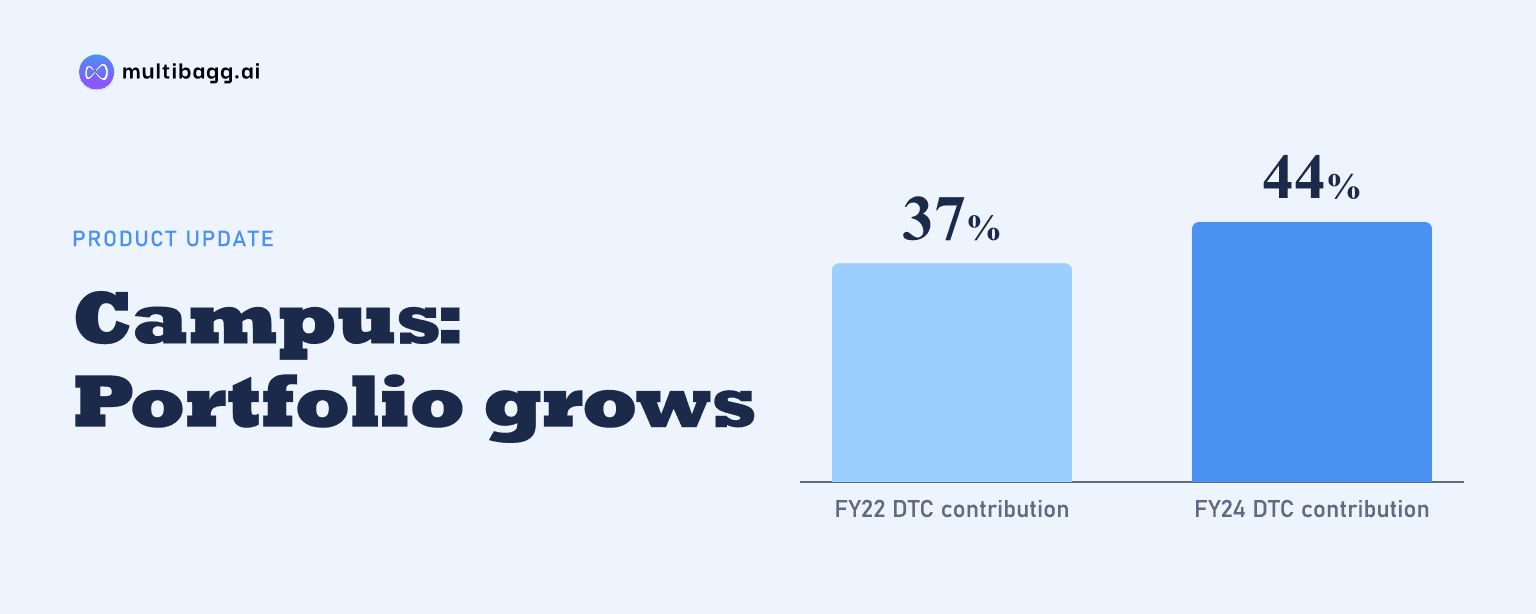
- Campus says direct-to-consumer revenue contribution crossed 44% in FY24, versus 37% in FY22.
powered by IRIS
Campus Activewear has broadened its FY27 portfolio beyond its FY21 men’s sports-shoe focus, with apparel available in 105 exclusive brand outlets and on its own website, alongside women’s and kids’ footwear, Elan premium neo-casual footwear and performance footwear. The presentation does not disclose sales or profit from the new categories.
Know Campus Activewear inside out
Results, valuation, peers and who's buying, in one view.
How is Campus changing its consumer strategy?
Campus is moving from a men’s-focused sports-shoe brand in FY21 towards what it calls a lifestyle brand for every Indian in FY27. Its FY21 range centred on men’s sports footwear, one consumer segment and a narrow category set, with primarily value-led mass-market positioning. The FY27 proposition adds women, children and different footwear occasions to that earlier focus.
Campus describes the broader shift as moving from “share of wallet” to “share of life.” Its stated future is a house of brands serving new consumer sets across price points and occasions, with deeper geographic reach and adjacent categories such as apparel and accessories. This is a stated direction rather than a quantified forecast, as the presentation gives no revenue target or timetable for the future house-of-brands model.
The transition follows growth in the direct-to-consumer channel. Campus said direct-to-consumer revenue contribution crossed 37% in FY22 and exceeded 44% in FY24, showing a higher contribution two years later. The presentation does not provide exact channel percentages, nor does it separate sales from exclusive brand outlets, the website and other direct routes.
Which categories has Campus added to its range?
Campus has added apparel, women’s footwear, kids’ footwear, Elan premium neo-casual footwear and performance footwear to the FY27 range described in the presentation. Apparel entered the portfolio in FY26 and is now live in 105 exclusive brand outlets, or EBOs, as well as Campus’s own website. The source does not disclose apparel sales, product count, margins or inventory levels.
Campus says women’s and kids’ footwear are scaling fast, but provides no separate revenue, volume or growth data for either segment. These categories extend the target customer set beyond the FY21 men’s sports-footwear customer. Elan, added in FY27, is identified as a premium neo-casual category, adding a different price positioning and footwear occasion to the earlier value-led mass-market framework.
Campus also records its entry into performance footwear in FY27. The presentation supports the category entry but does not state a launch date, sales target or market-share objective. Its product material identifies Campus Nitro Fly, Campus Nitro Boost, Campus Tyre Tech and Campus Air Capsule Pro as visible technologies for uses including running and walking.
How is Campus making apparel available to customers?
Campus is selling apparel through 105 EBOs and its own website. That distribution figure applies specifically to apparel and should not be read as Campus’s total EBO network. The company said its EBO count crossed 100 in FY22 and crossed 250 in FY23, but the presentation does not give a current total store count.
Campus’s direct channel had expanded before apparel entered in FY26. Direct-to-consumer revenue contribution crossed 37% in FY22 and 44% in FY24, while apparel now has both store-based and owned-online availability. The presentation does not disclose what share of apparel sales comes from the 105 EBOs versus the website.
Campus identifies omnichannel reach as one of six capabilities behind its strategy. The other five are design agility, integrated operations, culture-led brand building, a financial base and a people-powered organisation. These are company-stated operating themes; the presentation does not link them to a specific sales or profit target for apparel, Elan or performance footwear.
Got a follow-up? Ask IRIS
What product capability supports Campus’s wider portfolio?
Campus reported more than 160 new product launches in H1FY27, showing continued refresh across its footwear portfolio while it adds new categories. The source does not allocate those launches among men’s, women’s, kids’, Elan or performance footwear. Therefore, the figure measures total launch activity rather than the commercial scale of any one new segment.
Campus says it has more than 50 experienced in-house designers, supported by global design consultancy and design tie-ups that adapt international trends for Indian consumers. This design capability is presented alongside its performance technologies, including Nitro Fly and Air Capsule Pro. The source does not disclose research and development spending, patents or the proportion of products designed internally.
Integrated operations are another capability cited by Campus. It began a backward-integration initiative for an upper-manufacturing facility at Haridwar in FY20 and for a sole-manufacturing facility at Ghanaur in FY21. The presentation does not specify which facilities produce Elan, performance footwear or apparel.
How has Campus expanded production before the new categories?
Campus listed a Ghanaur capacity expansion and a Haridwar II upper plant for sneakers as FY25 milestones. In FY26, production commenced at upper facilities in Paonta and Pant Nagar, the same fiscal year in which Campus entered apparel. No production capacity, utilisation level, capital expenditure or category allocation is disclosed for these facilities.
The product expansion in FY26 and FY27 also coincided with a brand refresh. Campus launched a new logo in FY27, when it added Elan and entered performance footwear. Together with the two FY26 upper-facility commencements, the timeline indicates that brand, portfolio and operating changes have occurred in close succession, although the source does not quantify their financial contribution.
Campus’s earlier timeline also includes a Ghanaur sole-manufacturing initiative in FY21 and a Haridwar upper-manufacturing initiative in FY20. These preceded the FY25 capacity expansion and the FY26 facility commencements. The presentation does not establish whether the newer plants are dedicated to the expanded consumer categories or serve the wider footwear range.
Conclusion
Campus’s transformation is defined by the move from its FY21 men’s sports-shoe model to a FY27 range covering women’s and kids’ footwear, Elan premium neo-casual footwear, performance footwear and apparel available in 105 EBOs and online. More than 160 launches in H1FY27 and more than 50 in-house designers provide evidence of continued product-development activity alongside the wider consumer strategy.
The next issue to watch is execution of Campus’s stated plan to build a house of brands spanning price points and occasions while strengthening apparel, accessories and other adjacent categories. The presentation leaves unresolved the sales mix, profitability and growth rates of apparel, Elan and performance footwear, as well as the capacity assigned to the Paonta, Pant Nagar, Haridwar and Ghanaur facilities.