










Campus cuts shoe manufacturing lead times to 60-90 days
Key highlights
- Campus reports 60-90 day manufacturing lead times versus an industry average of 90-120 days.
- Campus completed 94% of shoe assembly in-house in H1FY27.
- Campus had annual assembly capacity of 31.9 million pairs as of 30 September 2026.
- Campus sourced 90% of raw materials domestically and made 40% of shoe soles in-house in H1FY27.
powered by IRIS
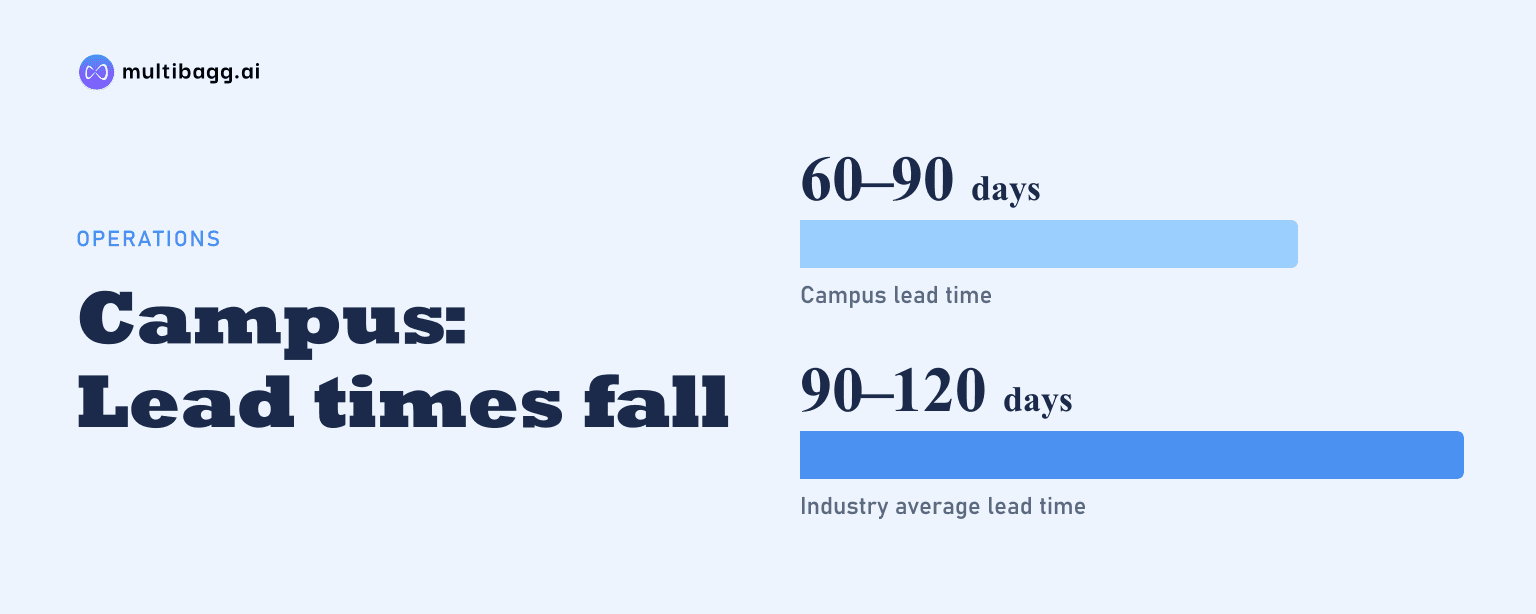
Campus reported manufacturing lead times of 60-90 days in the first half of fiscal year 2027 (H1FY27), versus an industry average of 90-120 days, with 94% of shoe assembly completed in-house. Its annual assembly capacity was 31.9 million pairs as of 30 September 2026, according to the presentation.
Know Campus Activewear inside out
Results, valuation, peers and who's buying, in one view.
How does Campus achieve 60-90 day shoe lead times?
Campus attributes its 60-90 day manufacturing lead times to an integrated ecosystem covering uppers, shoe soles and final shoe assembly. The company compares this range with an industry average of 90-120 days, so both ends of Campus’s stated range are 30 days lower than the cited industry range.
The H1FY27 production and purchase mix shows that Campus does not make every component internally, but it retains control over most final assembly. Management lists faster production responsiveness, improved execution visibility, better quality consistency and stronger supply-chain coordination as operational advantages of this structure. The presentation does not quantify the individual contribution of any one factory, supplier network or production stage to the lead-time range.
The disclosure refers specifically to manufacturing lead times rather than the full time from design to a product reaching a retail store. Campus does not define whether the 60-90 day range includes raw-material procurement, product design, warehousing or distribution. The company states that the production split is based on actual production and purchase volumes in H1FY27.
What share of Campus footwear production is in-house?
Campus completed 94% of shoe assembly in-house in H1FY27, while 6% was outsourced, making assembly its most internally controlled disclosed production stage. The company reported annual assembly capacity of 31.9 million pairs as of 30 September 2026.
Internal production is lower for components than for final assembly. Campus made 50% of uppers in-house and outsourced the other 50%, while it made 40% of shoe soles in-house and outsourced 60%. This means its model combines external component sourcing with predominantly internal assembly of finished shoes.
Campus says the outsourced portion comprises Elan, a portion of open footwear, apparel and retail accessories. The presentation does not provide separate volumes, revenues or capacity use for those outsourced categories. It also does not state whether the 31.9 million-pair annual capacity figure includes outsourced production.
Where are Campus manufacturing operations located?
Campus identifies eight manufacturing locations across uppers, shoe soles and shoe assembly, with four upper facilities, one sole facility and three assembly facilities. These operations support the company’s disclosed 31.9 million-pair annual assembly capacity as of 30 September 2026.
Upper manufacturing is located at Haridwar I, Haridwar II, Paonta and Pant Nagar. Campus says 90% of its raw materials are sourced domestically and refers to an exclusive ancillary supplier network. The source does not disclose the raw-material value, volume, supplier count or sourcing locations for the remaining 10%.
Shoe sole manufacturing is located at Ganaur, where Campus says in-house capability supports faster turnaround and intellectual-property protection. With 40% of soles made in-house and 60% outsourced in H1FY27, Ganaur forms part of a mixed sourcing model supported by a sole ancillary supplier network in India.
Final shoe assembly is carried out at CAL Baddi I, CAL Baddi II and Dehradun. This stage’s 94% in-house share was materially higher than the 50% internal upper share and 40% internal sole share in H1FY27. Campus therefore relies more on external supply for footwear components than it does for bringing finished shoes together.
Got a follow-up? Ask IRIS
How does Campus link manufacturing to product launches?
Campus positions integrated operations as a support for responsiveness while reporting more than 160 new product launches in H1FY27. Its product-development capability included more than 50 experienced in-house designers, alongside global design consultancy and design tie-ups that adapt international trends for Indian consumers.
The presentation describes design agility as translating trends into faster consumer adoption and integrated operations as building control, consistency and responsiveness at scale. Campus presents these capabilities alongside its 60-90 day manufacturing lead-time disclosure, but does not give an average design-to-shelf timeline or connect a specific launch to a specific factory lead time.
Products disclosed during the period include the Campus Court Collection, described as its first sports line for five racquet sports, and the Freedom range for kids. Campus also lists Campus Nitro Fly, Campus Nitro Boost, Campus Tyre Tech and Campus Air Capsule Pro under visible technology. The presentation does not identify the manufacturing location or in-house content for these ranges.
Campus frames these launches within a shift from a men’s-focused sports shoe brand in FY21 to a lifestyle brand for every Indian by FY27. The company says women’s and kids’ footwear are scaling, Elan is its premium neo-casual footwear entry, apparel is live across 105 exclusive brand outlets and its own website, and it has entered performance footwear. No category-specific manufacturing lead times are disclosed.
How does Campus balance internal factories and suppliers?
Campus balances internal production and external supply by assembling 94% of shoes in-house while outsourcing 50% of uppers and 60% of soles in H1FY27. This structure gives Campus direct control over final assembly while retaining supplier participation in two major footwear components.
For uppers, Campus combines four internal locations with an exclusive ancillary supplier network and 90% domestic raw-material sourcing. For soles, it combines the Ganaur facility with a sole ancillary supplier network in India. The presentation does not disclose supplier concentration, contractual terms, inventory levels or the share of suppliers serving more than one production stage.
The company’s lead-time claim appears under the assembly section of its integrated manufacturing slide, while the stated operational benefits apply to the wider ecosystem. Campus does not quantify how much of the 60-90 day range results from internal assembly, domestic raw materials, in-house sole production or ancillary suppliers. The disclosed comparison remains a manufacturing lead-time range against the cited 90-120 day industry average.
Conclusion
Campus’s manufacturing model centres on internally controlled final assembly, with 94% completed in-house in H1FY27, while uppers and soles remain partly outsourced. The company’s main operating comparison is its reported 60-90 day manufacturing lead time versus the industry’s cited 90-120 day range, supported by 31.9 million pairs of annual assembly capacity as of 30 September 2026.
The next point to watch is how Campus manages manufacturing as it expands women’s, kids’, performance footwear, Elan and apparel. Management’s future plan is to build a house of brands spanning price points and occasions, but the presentation does not disclose a new capacity target, category-level lead-time target or timetable for additional manufacturing sites.