










Campus Activewear lifts working capital to 94 days in H1FY27
Key highlights
- Campus reported net working capital of Rs 482 crore, or 94 days, in H1FY27 versus Rs 339 crore, or 70 days, in FY26.
- Average inventory rose to Rs 563 crore and 109 days in H1FY27 from Rs 415 crore and 85 days in FY26.
- Campus used Rs 75 crore in operating activities at September 2026 as working-capital changes absorbed Rs 164 crore.
- H1FY27 revenue from operations rose 14.7% to Rs 837 crore and profit after tax increased 19.4% to Rs 50 crore.
powered by IRIS
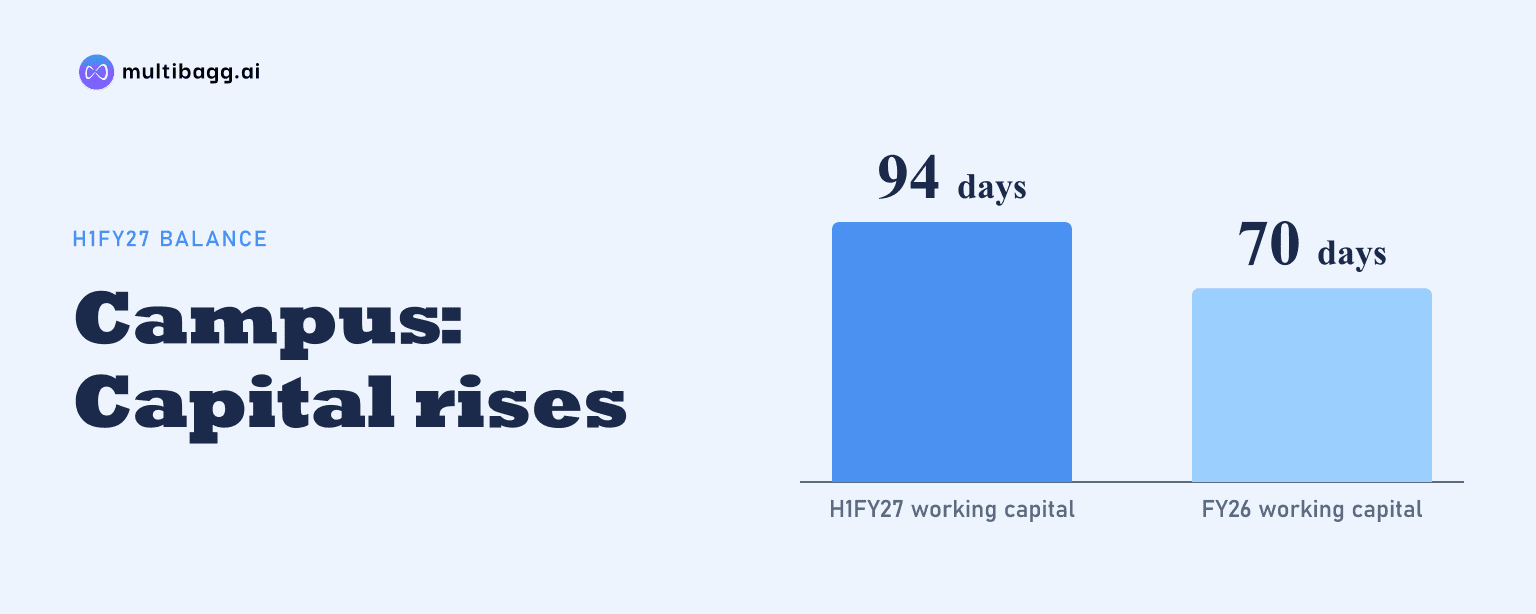
Campus Activewear raised net working capital to Rs 482 crore, or 94 days, in H1FY27 after building inventory for anticipated Q3 festive demand. Average inventory reached Rs 563 crore, or 109 days, while revenue from operations increased 14.7% year on year to Rs 837 crore in the first half.
Know Campus Activewear inside out
Results, valuation, peers and who's buying, in one view.
Why did Campus build inventory before the festive quarter?
Campus built inventory to cater to anticipated Q3 festive demand, which management identified as the reason working-capital days rose to 94 in H1FY27. The company said the festive season shifted to Q3 this year, while H1FY27 volume still grew 10.9% year on year to 121 lakh pairs.
Average inventory rose to Rs 563 crore and 109 days in H1FY27, from Rs 466 crore and 103 days in H1FY26. It was also above the FY26 average of Rs 415 crore and 85 days, an increase of Rs 148 crore and 24 days from the full-year level.
The September 2026 balance sheet also recorded higher stock. Inventories stood at Rs 628 crore, compared with Rs 449 crore at March 2026 and Rs 498 crore at September 2025; the Rs 179 crore increase from March accounted for more than the Rs 105 crore increase in current assets to Rs 984 crore.
How did Campus working capital change across periods?
Campus's net working capital rose to Rs 482 crore and 94 days in H1FY27, from Rs 339 crore and 70 days in FY26 and Rs 372 crore and 82 days in H1FY26. Campus defines working capital as average receivables plus average inventories minus average payables, excluding other current assets and liabilities.
Average receivables increased to Rs 178 crore from Rs 157 crore a year earlier, but receivable days fell to 34 from 35. The higher receivables balance accompanied H1FY27 revenue from operations of Rs 837 crore, compared with Rs 730 crore in H1FY26.
Average payables reached Rs 259 crore and 92 days in H1FY27, against Rs 251 crore and 107 days in H1FY26. Because payables reduce Campus's working-capital calculation, the 15-day decline in payable days versus H1FY26 provided a smaller offset to the higher inventory balance.
Got a follow-up? Ask IRIS
What was the cash-flow effect of Campus's inventory build?
Campus used Rs 75 crore in operating activities at September 2026, compared with Rs 26 crore used at September 2025. Changes in working capital absorbed Rs 164 crore, compared with Rs 107 crore a year earlier, exceeding operating profit before working-capital changes of Rs 116 crore.
Income tax paid was Rs 26 crore at September 2026, while operating profit before working-capital changes rose from Rs 105 crore at September 2025. The presentation separately reports Rs 104 crore generated from investing activities, including Rs 125 crore of net proceeds from maturity of bank deposits and Rs 23 crore of net purchase or sale of plant, property and equipment.
Cash and cash equivalents ended September 2026 at Rs 3 crore, versus Rs 4 crore at March 2026 and Rs 10 crore at September 2025. Current borrowings were Rs 78 crore at September 2026, up from Rs 36 crore in March but below Rs 165 crore a year earlier, while trade payables were Rs 255 crore versus Rs 225 crore in March.
Did Campus's sales growth precede the higher stock commitment?
Campus reported revenue from operations of Rs 837 crore in H1FY27, up 14.7% from Rs 730 crore in H1FY26, while volume increased 10.9% to 121 lakh pairs from 109 lakh pairs. In Q2FY27, revenue rose 16.9% year on year to Rs 452 crore and volume increased 10.2% to 63 lakh pairs.
Profit after tax increased 19.4% to Rs 50 crore in H1FY27 from Rs 42 crore in H1FY26. Earnings before interest, tax, depreciation and amortisation, or EBITDA, rose 12.9% to Rs 125 crore, although the EBITDA margin declined to 14.7% from 14.9%.
Campus's channel mix also changed in Q2FY27. Direct-to-consumer, or D2C, online revenue represented 36.5% of revenue from operations excluding other operating income, compared with 34.8% in Q2FY26, while trade distribution fell to 52.5% from 53.6%; the presentation does not quantify the allocation of festive inventory by channel.
Conclusion
Campus entered the anticipated Q3 festive period with average inventory of Rs 563 crore and net working capital of Rs 482 crore in H1FY27. The inventory-led build lifted working-capital days to 94 from 70 in FY26, absorbed Rs 164 crore through working-capital changes and coincided with 14.7% revenue growth and 19.4% profit-after-tax growth.
The next disclosed event to watch is Q3 festive demand, because management directly linked the inventory build to that quarter. Results after H1FY27 will show whether inventory days, net working-capital days and operating cash flow move from the September 2026 levels of 109 days, 94 days and Rs 75 crore used in operating activities.