










CAMPUS lifts D2C online revenue mix to 36.5% in Q2FY27
Key highlights
- CAMPUS's D2C Online share rose to 36.5% of Q2FY27 revenue from operations from 34.8% in Q2FY26.
- CAMPUS's own website represented 6.4% of D2C Online revenue in H1FY27, up from 3.5% a year earlier.
- CAMPUS's quick-commerce share of D2C Online revenue increased to 2.4% in H1FY27 from 1.0%.
- CAMPUS reported Q2FY27 revenue from operations of Rs 452 crore, up 16.9% year on year.
powered by IRIS
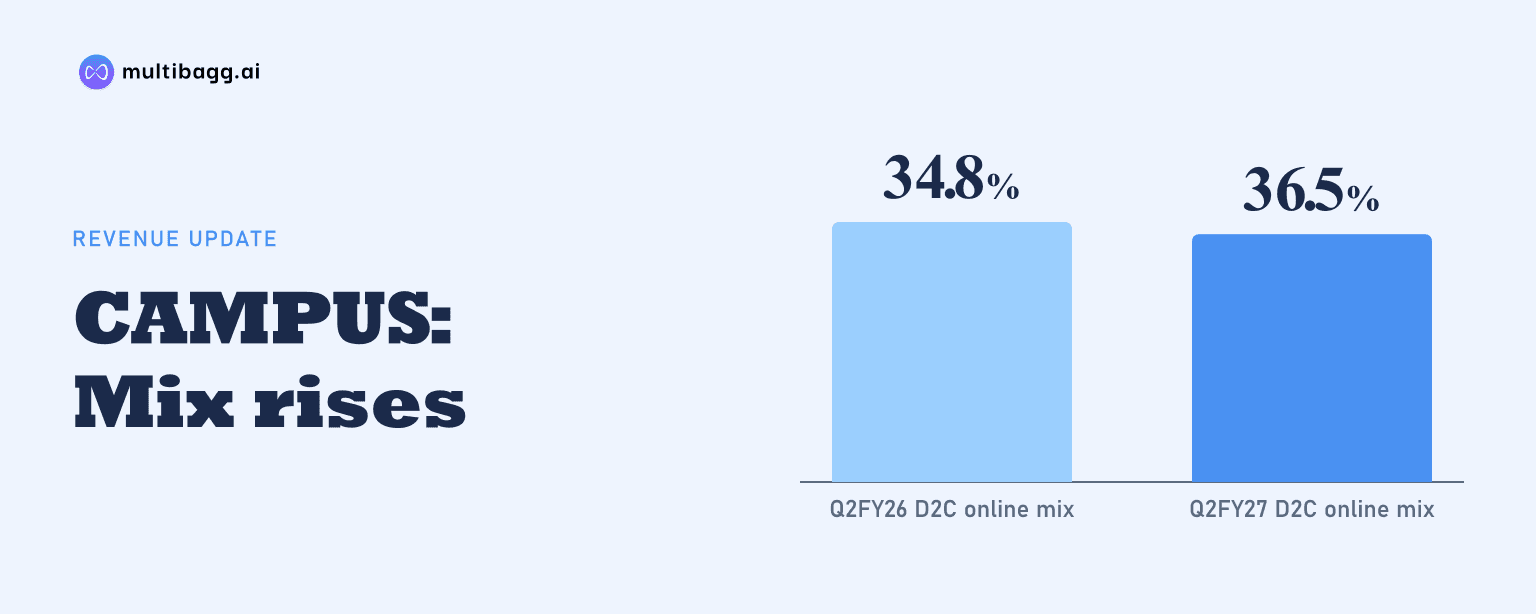
CAMPUS raised D2C Online to 36.5% of revenue from operations in Q2FY27, up 1.7 percentage points from Q2FY26, while its own website and quick commerce accounted for 6.4% and 2.4%, respectively, of D2C Online revenue in H1FY27.
Know Campus Activewear inside out
Results, valuation, peers and who's buying, in one view.
How did CAMPUS's channel mix change in Q2FY27?
CAMPUS increased D2C Online's share of revenue from operations to 36.5% in Q2FY27 from 34.8% in Q2FY26, a 1.7-percentage-point change. The company defines D2C Online as online marketplace, online SOR, quick commerce and its own website. This revenue-mix measure excludes other operating income, as specified in the channel disclosure.
Trade distribution remained CAMPUS's largest disclosed channel at 52.5% of Q2FY27 revenue from operations, compared with 53.6% in Q2FY26. D2C Offline represented 11.0%, down from 11.6%. Thus, the mix shift toward D2C Online occurred alongside a 1.1-percentage-point reduction in trade distribution and a 0.6-percentage-point reduction in D2C Offline.
CAMPUS reported 14.2% year-on-year growth alongside its Q2FY27 channel-performance disclosure. The mix data does not disclose revenue in rupees for each channel, so it does not establish the absolute revenue growth of D2C Online, trade distribution or D2C Offline individually. It does show that D2C Online took a larger proportion of operating revenue over the year.
How has CAMPUS diversified its D2C Online revenue?
CAMPUS more than doubled the own-website share within D2C Online revenue to 6.4% in H1FY27 from 3.5% in H1FY26. That is a 2.9-percentage-point increase within the D2C Online channel. The company separately reported quick commerce, or Q-com, at 2.4% of D2C Online revenue in H1FY27.
Quick commerce rose from 1.0% of CAMPUS's D2C Online revenue in H1FY26 to 2.4% in H1FY27, an increase of 1.4 percentage points. The presentation characterises both own website and Q-com as having doubled their shares. Together, the two identified channels represented 8.8% of D2C Online revenue in H1FY27, versus 4.5% a year earlier.
CAMPUS still includes online marketplaces and online SOR in D2C Online, but it does not give their separate shares for H1FY26 or H1FY27. Therefore, the disclosed data supports a greater role for own website and Q-com within online revenue, but it does not quantify the marketplace contribution or identify which remaining online component changed most.
Got a follow-up? Ask IRIS
How does CAMPUS's online mix fit its quarterly financial growth?
CAMPUS reported revenue from operations of Rs 452 crore in Q2FY27, up 16.9% from Rs 387 crore in Q2FY26 and 17.4% from Rs 385 crore in Q1FY27. Volume was 63 lakh units in Q2FY27, compared with 58 lakh units a year earlier and 57 lakh units in the preceding quarter. The higher D2C Online share was disclosed during a quarter of higher revenue and volume.
For H1FY27, CAMPUS reported revenue from operations of Rs 837 crore, 14.7% above Rs 730 crore in H1FY26, while volume increased 10.9% to 121 lakh units from 109 lakh units. The presentation's financial-highlight revenue measure includes other operating revenue, while its channel-mix percentages use revenue from operations excluding other operating income. These are related but not identical reporting bases.
CAMPUS's earnings measures also increased in absolute terms during H1FY27: earnings before interest, tax, depreciation and amortisation, or EBITDA, rose to Rs 125 crore from Rs 110 crore, and profit after tax, or PAT, rose to Rs 50 crore from Rs 42 crore. EBITDA margin was 14.7%, compared with 14.9% in H1FY26, while PAT margin increased to 5.9% from 5.7%. The source does not attribute these margin movements to any specific channel.
What does CAMPUS's offline network contribute to its channel strategy?
CAMPUS reported 317 stores in its FBO store-count disclosure for H1FY27, compared with 300 in FY26 and 297 in FY25. The count has increased from 202 in FY23 and 108 in FY22. D2C Offline, which CAMPUS defines as EBO and LFS, represented 11.0% of Q2FY27 revenue from operations.
The D2C Offline revenue share fell by 0.6 percentage points year on year, from 11.6% in Q2FY26 to 11.0% in Q2FY27, despite the store count rising by 17 from FY26 to H1FY27. The presentation does not provide store sales, comparable-store growth, or a split between EBO and LFS. As a result, store-count growth cannot be directly linked to offline revenue performance.
CAMPUS's working-capital disclosures also show inventory build-up ahead of the next seasonal period. Average inventory was Rs 563 crore or 109 days in H1FY27, compared with Rs 466 crore or 103 days in H1FY26. Management attributed the increase in working-capital days, which rose to 94 from 82, to strategic inventory build-up for anticipated festive demand in Q3.
Conclusion
CAMPUS's Q2FY27 channel data shows D2C Online becoming a larger part of operating revenue, reaching 36.5%, while trade distribution remained the largest channel at 52.5%. Within D2C Online, the own website and Q-com shares rose to 6.4% and 2.4% in H1FY27, indicating that the disclosed online mix was not confined to the company's other stated online formats.
The next disclosed period to watch is Q3, for which CAMPUS said it built strategic inventory to meet anticipated festive demand. The outcome will show whether the H1FY27 inventory level of Rs 563 crore and 109 inventory days is absorbed during that demand period, and whether D2C Online's 36.5% Q2FY27 mix is maintained or changes further.