










Capacit’e holds FY27 margin guidance as escalation catches up
Key highlights
- Capacit’e retained FY27 EBITDA margin guidance of 15.5% to 16.5%.
- The government-contract escalation gap narrowed to about 2% in Q2 from 5% to 6% in Q1.
- Capacit’e made no additional commodity provision in the current quarter.
- Formwork purchases were Rs 64.2 crore in H1, with Rs 135 crore to Rs 140 crore budgeted for the full year.
powered by IRIS
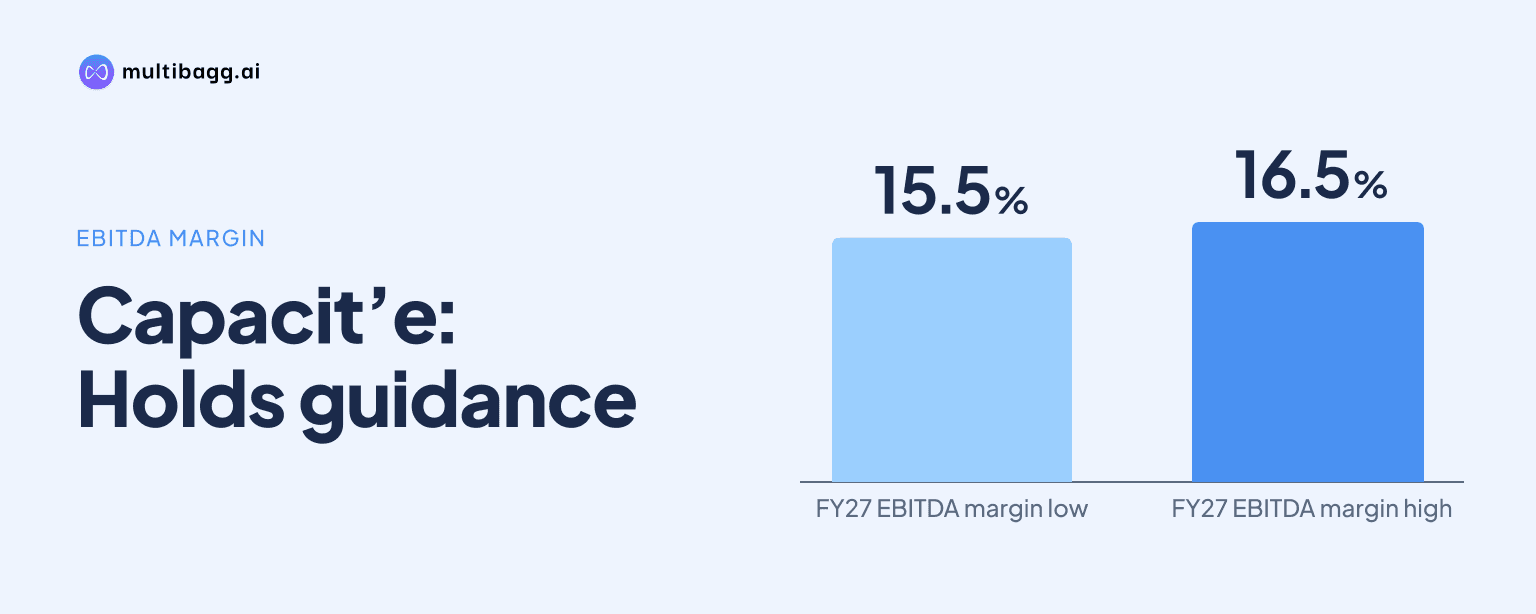
Capacit’e retained FY27 EBITDA margin guidance of 15.5% to 16.5% after the gap between commodity-cost inflation and government-contract escalation narrowed to about 2% in Q2 from 5% to 6% in Q1. Management said any reversal of earlier provisions depends on prices stabilising and contractual recovery matching actual costs.
Know Capacite Infraprojects inside out
Results, valuation, peers and who's buying, in one view.
Why is Capacit’e maintaining its FY27 margin guidance?
Capacit’e is maintaining FY27 EBITDA, or earnings before interest, tax, depreciation and amortisation, margin guidance of 15.5% to 16.5% and cash profit guidance of about 10.5% to 11.25%. Management said the guidance remains intact at present, while a review could be considered in Q4 if commodity prices and escalation recoveries improve further.
The key improvement was the reduction in the mismatch between actual procurement costs and price variation under government contracts. Management said this gap declined to around 2% in Q2 from 5% to 6% in Q1. It said government Wholesale Price Index, or WPI, and commodity-linked formulas can take six to nine months to reflect international market movements.
Capacit’e said Q2 profitability improved as the government escalation mechanism caught up more than it had in Q1. The company distinguished this from private-sector work, where management said commodity-cost increases receive full pass-through. Public contracts instead depend on price-variation clauses, leaving reported costs exposed until the relevant indices reflect movements in steel, electrical and finishing inputs.
What must happen before Capacit’e reverses its provisions?
Capacit’e will consider a provision reversal only if commodity prices stabilise and government-contract escalation matches the actual increase in costs. Management said it requires another quarter of evidence and could offer a firmer view at the Q3 earnings call, rather than predicting a Q4 reversal in advance.
An analyst referred to Rs 20 crore of provisions across Q1 and Q4 related to commodity volatility. Management said no additional provision was made in the current quarter. It cited sharp oil-price movements from Rs 115 to Rs 90 and then Rs 72 as an example of the volatility that prevents a reliable forecast, while dollar appreciation was also increasing procurement costs.
Steel and electrical items were the main inputs where management identified inflation above available escalation recovery. Steel was around Rs 62,000 per metric tonne at the time of the call, versus Rs 47,000 per metric tonne three months earlier. Electrical-item prices had corrected slightly, management said, but the public-project formula had not yet reflected the full previous increase in finishing and electrical costs.
Management described the Q2 improvement as an early indication rather than a settled outcome. It said commodity prices were then stable with some downward movement, while public-contract indices had caught up more during Q2. If that process continues in Q3, management said it would be better placed to discuss a possible Q4 reversal at the next earnings call.
Got a follow-up? Ask IRIS
How do aluminium formwork costs affect Capacit’e’s profits?
Higher aluminium formwork prices principally affect Capacit’e’s cash outflow rather than its current profitability, according to management. Aluminium formwork had risen to Rs 14,500 per square metre from Rs 10,500 per square metre, a 40% increase. Management expects future procurement costs to correct towards Rs 12,000 to Rs 12,500 per square metre.
Capacit’e said aluminium prices remained above pre-war levels despite their decline, and the stronger dollar added to the purchase cost. Management illustrated the cash effect with formwork that previously cost Rs 1 crore and now costs Rs 1.4 crore. The equipment is depreciated over several years, so management does not treat the upfront price increase as a direct current-period profitability impact.
Management corrected its H1 procurement figure, stating that formwork purchases were Rs 64.2 crore and plant and machinery purchases were Rs 10.57 crore. It expects the full-year procurement budget of Rs 135 crore to Rs 140 crore to be used in H2 because of the order pipeline. Capacit’e said capital expenditure is linked directly to order intake and the number of projects started each quarter.
Management also said aluminium formwork, which represents most procurement, is written off over seven years. It expects a consolidated fixed-asset revenue turnover ratio above 5 at its FY28 revenue target of Rs 4,000 crore, compared with 4.7 at the time discussed on the call. Its stated priority is positive operating cash flow after term-loan repayments.
What could affect Capacit’e’s execution and margin outlook?
National Green Tribunal, or NGT, restrictions in the National Capital Region, or NCR, remain an execution uncertainty for Capacit’e’s FY27 growth outlook. Management said a 15-day disruption should create no material issue, while a 20-day disruption could be managed through other projects. It could not quantify the outcome if a shutdown extended to 45 days.
Management said a complete ban from 5 November to 20 November would itself remove 15 working days. Last year, Capacit’e had assumed 15 to 20 shutdown days. It said complete work suspension had previously occurred at the fourth stage of the Graded Response Action Plan, whereas the situation discussed on the call involved suspension at earlier stages.
Project ramp-ups could support revenue if NCR disruption remains contained. CIDCO generated Rs 177 crore in the first six months, or close to Rs 30 crore a month, and management expects its run rate to increase by 35% to 40% in Q3 and Q4. For the next financial year, it expects CIDCO revenue of at least Rs 50 crore a month, equivalent to Rs 600 crore annually.
MHADA generated Rs 124 crore in the first six months, and management expects a 25% increase in the remainder of the financial year and growth of more than 40% from the current level next year. Of 34 rehabilitation towers, 25 had been handed over. Management said Capacit’e’s share of the joint venture is 35%, while the escalation condition still applies to its margin outlook.
Conclusion
Capacit’e’s unchanged FY27 margin guidance reflects a narrower gap between public-contract escalation and actual input costs, which fell to about 2% in Q2 from 5% to 6% in Q1. Management has not treated this improvement as sufficient to reverse provisions because steel prices, electrical inputs, oil and currency movements can still reopen the cost-recovery mismatch.
The next event to watch is the Q3 earnings call, when management said it may be able to provide a firmer view on a possible Q4 provision reversal. Investors will also watch whether WPI-linked escalation continues to catch up with commodity costs and whether NCR restrictions remain near 15 to 20 days rather than approaching 45 days.