










Capacit’e order book is 54% public and 62% high-rise
Key highlights
- Capacit’e reported a Rs 13,013 crore order book as on September 30, 2026.
- Public-sector projects accounted for 54% of Capacit’e’s order book, compared with 46% for private-sector projects.
- Projects above 40 floors represented 62% of the order book, versus 38% below 40 floors.
- Residential projects comprised 64% of the order book, while mixed-use and institutional projects comprised 29% and 7%.
powered by IRIS
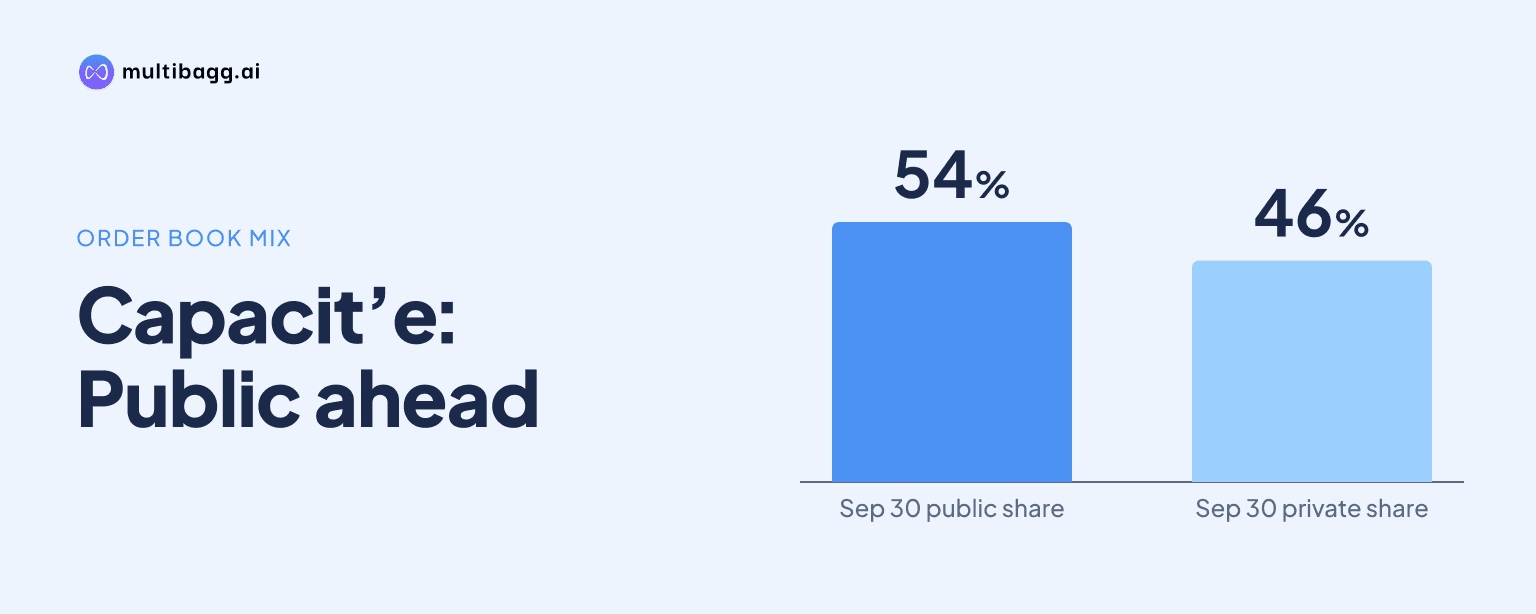
Capacit’e’s order book of Rs 13,013 crore as on September 30, 2026 was 54% public-sector and 62% in projects above 40 floors, making public-sector clients and high-rise construction the larger disclosed portions. Residential work represented 64%, compared with 29% mixed-use and 7% institutional.
Know Capacite Infraprojects inside out
Results, valuation, peers and who's buying, in one view.
How is Capacit’e’s Rs 13,013 crore order book divided?
Capacit’e divides its September 30, 2026 order book into 54% public-sector work and 46% private-sector work. Public-sector projects therefore exceed private-sector projects by 8 percentage points, although the presentation does not disclose the rupee value, project count or delivery schedule for either client segment.
Projects above 40 floors account for 62% of the order book, compared with 38% for projects below 40 floors. The 24-percentage-point difference makes above-40-floor construction the larger component of the height-based project split.
The category split shows residential projects at 64% of the order book, mixed-use projects at 29% and institutional projects at 7%. Residential work exceeds mixed-use work by 35 percentage points, and the three category shares total 100%.
The public-private, height and category data are separate classifications. Capacit’e does not state how much of the 54% public-sector work is residential, how much of the 62% above-40-floor work is private-sector, or how institutional projects are distributed by building height.
How have Capacit’e’s backlog and order inflow changed?
Capacit’e’s order backlog was Rs 13,013 crore in H1FY27, down Rs 485 crore from Rs 13,498 crore in FY26. It nevertheless remained Rs 2,468 crore above the Rs 10,545 crore recorded in FY25 and Rs 4,002 crore above the Rs 9,011 crore in FY24.
FY26 had the highest annual order inflow shown, at Rs 4,446 crore, versus Rs 2,823 crore in FY25 and Rs 2,009 crore in FY24. FY27 year-to-date order inflow was Rs 2,487 crore, while the presentation labels the backlog and order book-to-sales ratio period as H1FY27; it provides no comparable prior-year half-year inflow figure.
The order book-to-sales ratio was 4.7 in H1FY27, compared with 5.1 in FY26 and 4.5 in FY25. The presentation does not disclose the sales amount used for the H1FY27 ratio or specify the financial year in which the Rs 13,013 crore backlog is expected to be executed.
Got a follow-up? Ask IRIS
Which clients are listed in Capacit’e’s order-book mix?
Capacit’e lists 10 public-sector organisations: MHADA, CIDCO, Government of Maharashtra Public Works Department, Brihanmumbai Municipal Corporation, BSNL, IndianOil, GIFT, NHSRCL, NBCC and Indian Institute of Technology Bombay. The presentation does not assign a contract value, order-book balance or project location to any of these organisations.
The private-sector client list contains 18 names, including DLF, Lodha, Godrej Properties, Oberoi Realty, Prestige Group, The Phoenix Mills, Tata Trusts, K Raheja Corp, Raymond Realty, Brigade Group, M3M and Mahindra Lifespaces. It also names Signature Global, Brookfield, Piramal Realty, CIC, Saifee Burhani Upliftment Trust and Hubtown.
The named-client lists do not establish the exposure to an individual organisation within the 54% public-sector and 46% private-sector allocation. Capacit’e provides no order values, award dates, outstanding contract balances or regional split for the 28 listed organisations.
Capacit’e says it has delivered more than 75 million square feet across residential, commercial and institutional buildings in Mumbai Metropolitan Region, Pune Metropolitan Region, National Capital Region, Varanasi, Bengaluru, Chennai and Hyderabad. Its current category mix is led by residential projects at 64%, while mixed-use and institutional projects represent 29% and 7%, respectively.
What does Capacit’e say about converting backlog into revenue?
Capacit’e says revenue growth momentum is expected to accelerate in H2 FY27 and beyond, supported by the order book and improved workmen availability. This is management’s outlook, and the presentation does not provide an H2 FY27 revenue target, a quarterly execution target or a quantified measure of workmen availability.
Under Vision 2028, management plans to continue revenue growth of more than 20% compound annual growth rate, or CAGR, and surpass Rs 4,000 crore of revenue from operations in FY28. The target rate is above the 18% revenue CAGR Capacit’e reports for FY22 to FY26, although the presentation does not provide annual revenue figures for the FY26-to-FY28 path.
Management also targets an earnings before interest, tax, depreciation and amortisation, or EBITDA, margin of 16%-17% under Vision 2028. Its plan includes reducing working-capital requirements both in absolute terms and in days, and reducing net debt through lower working capital and monetisation of non-core assets.
Capacit’e reported net debt-to-equity of 0.10 times and gross debt-to-equity of 0.25 times as of March 31, 2026. It also reported FY22-FY26 CAGRs of 27% for earnings before interest and tax and 42% for profit after tax, while the September 2026 project mix places substantial disclosed weight on public-sector, high-rise and residential execution.
Conclusion
Capacit’e’s Rs 13,013 crore order book at September 30, 2026 combines a 54% public-sector allocation, a 62% share of projects above 40 floors and a 64% residential category share. The backlog was Rs 485 crore below FY26’s Rs 13,498 crore balance, while FY26 order inflow of Rs 4,446 crore was the highest annual inflow shown.
The next disclosed marker is management’s expectation of faster revenue growth in H2 FY27, supported by improved workmen availability. Further milestones are the FY28 revenue benchmark above Rs 4,000 crore, the 16%-17% EBITDA-margin target, lower working-capital requirements and planned net-debt reduction through operational changes and monetisation of non-core assets.