










Capacit’e net debt reaches Rs 350 crore as H1 cash falls
Key highlights
- Capacit’e’s net debt rose to Rs 350 crore at September 30, 2026 from Rs 204 crore at March 31, 2026.
- Capacit’e’s closing cash and cash equivalents were Rs 14 crore in H1 FY27, compared with Rs 91 crore at the period’s opening.
- Capacit’e’s working-capital changes used Rs 157 crore in H1 FY27, versus Rs 127 crore in H1 FY26.
- Capacit’e’s H1 FY27 revenue rose 13% to Rs 1,399.9 crore, while profit after tax fell 11% to Rs 87.4 crore.
powered by IRIS
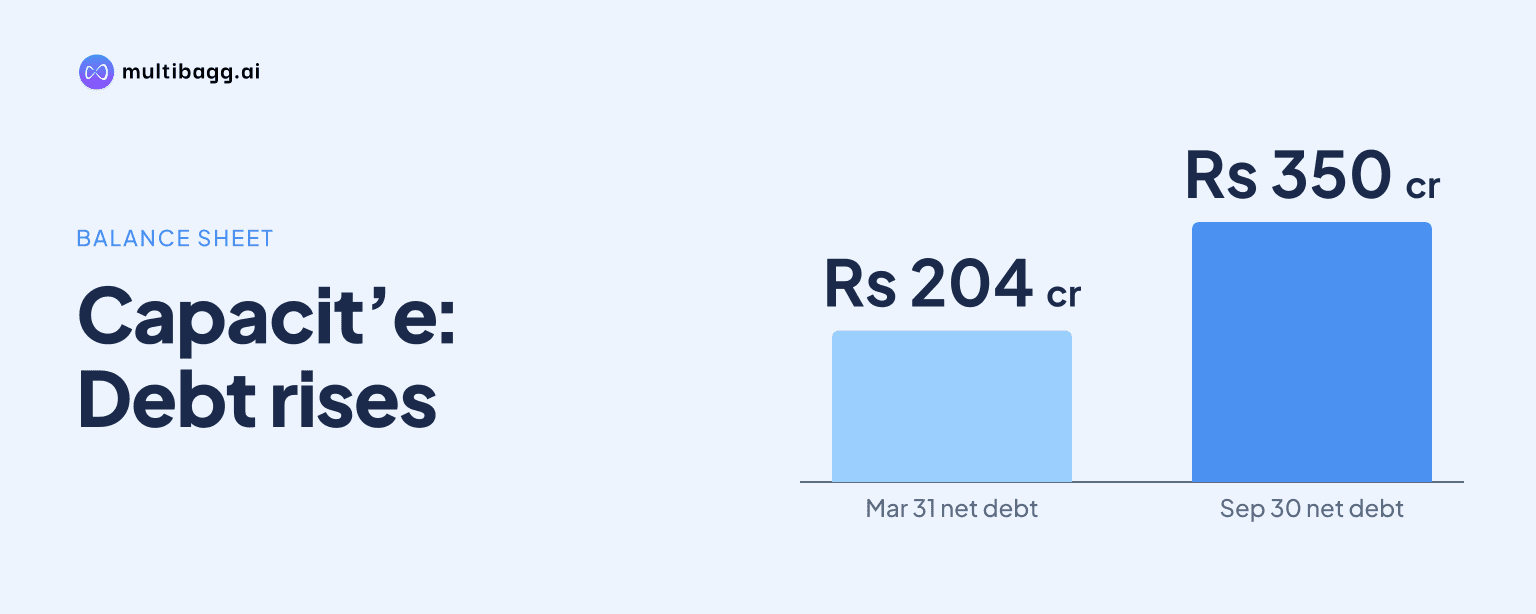
Capacit’e Infraprojects reported net debt of Rs 350 crore at September 30, 2026, after the first half (H1) of fiscal year (FY) 2027, up from Rs 204 crore at March 31, 2026, as closing cash and cash equivalents fell to Rs 14 crore from Rs 91 crore and working-capital changes used Rs 157 crore.
Know Capacite Infraprojects inside out
Results, valuation, peers and who's buying, in one view.
Why did Capacit’e’s net debt increase in H1 FY27?
Capacit’e’s reported net debt increased by Rs 146 crore in H1 FY27 because gross debt rose to Rs 540 crore at September 30, 2026 from Rs 472 crore at FY26 end, while reported cash and cash equivalents declined. The net debt-to-equity ratio consequently rose to 0.18x from 0.11x, while the gross debt-to-equity ratio increased to 0.27x from 0.25x.
The balance sheet shows that the rise in borrowings was concentrated in non-current borrowings, which increased to Rs 212 crore in September 2026 from Rs 129 crore in March 2026. Current borrowings moved in the other direction, declining to Rs 328 crore from Rs 343 crore. Total balance-sheet borrowings therefore increased by Rs 68 crore to Rs 540 crore, matching the gross-debt figure in the debt-position presentation.
Management described the 0.18x net debt-to-equity ratio as healthy at September 30, 2026. The presentation shows a higher level than in FY24, when net debt was Rs 69 crore and the net debt-to-equity ratio was 0.05x. Gross debt also rose from Rs 417 crore in FY25 and Rs 326 crore in FY24 to Rs 540 crore in H1 FY27.
What happened to Capacit’e’s cash and operating cash flow?
Capacit’e closed H1 FY27 with Rs 14 crore of cash and cash equivalents, compared with Rs 91 crore at the start of the period and Rs 42 crore at the end of H1 FY26. Its cash-flow statement reports a Rs 23 crore reduction in cash and cash equivalents during H1 FY27, alongside a Rs 54 crore adjustment from the initial application of Indian Accounting Standard (Ind AS) 109 amendment on April 1, 2026.
Net cash from operating activities declined to Rs 73 crore in H1 FY27 from Rs 98 crore in H1 FY26, although operating profit before working-capital changes increased to Rs 254 crore from Rs 244 crore. Changes in working capital used Rs 157 crore, compared with Rs 127 crore a year earlier. Direct taxes paid increased to Rs 24 crore from Rs 19 crore.
Investing activities used Rs 108 crore in H1 FY27, versus Rs 59 crore in H1 FY26, while financing activities provided Rs 12 crore after using Rs 61 crore a year earlier. On the balance sheet, property, plant and equipment increased to Rs 699 crore from Rs 640 crore, while capital work-in-progress was Rs 13 crore compared with Rs 32 crore. The presentation does not break down the Rs 108 crore investing outflow by asset or project.
Got a follow-up? Ask IRIS
How did working capital and earnings change at Capacit’e?
Capacit’e’s working-capital outflow widened to Rs 157 crore in H1 FY27 from Rs 127 crore in H1 FY26, despite management reporting an 11-day reduction in working capital against Q1 FY27. The balance sheet shows current contract assets of Rs 1,179 crore, compared with Rs 1,068 crore in March 2026, and current trade receivables of Rs 1,183 crore, compared with Rs 1,085 crore.
Inventory increased to Rs 179 crore from Rs 129 crore during the six months to September 2026. Current trade payables also increased to Rs 953 crore from Rs 910 crore, while current contract liabilities grew to Rs 357 crore from Rs 283 crore. These movements occurred alongside the working-capital cash outflow, but the presentation does not quantify each balance-sheet category’s contribution to that outflow.
Revenue from operations rose 13% year on year to Rs 1,399.9 crore in H1 FY27 from Rs 1,235.5 crore in H1 FY26. Earnings before interest, tax, depreciation and amortisation (EBITDA) rose 4% to Rs 217.8 crore, but its margin declined to 15.6% from 17.0%. Earnings before interest and tax (EBIT) declined 3% to Rs 169.2 crore, finance cost increased to Rs 54.7 crore from Rs 47 crore, and profit after tax fell 11% to Rs 87.4 crore.
Capacit’e recorded its highest-ever quarterly revenue in the second quarter (Q2) of FY27, with revenue from operations of Rs 770.9 crore against Rs 646.2 crore in Q2 FY26. Q2 EBIT was Rs 89.4 crore versus Rs 88.5 crore, while Q2 profit after tax declined to Rs 47.6 crore from Rs 51.1 crore. Management attributed the execution ramp-up to improved workforce availability after temporary labour shortages in Q1 FY27.
Conclusion
Capacit’e entered the second half of FY27 with reported net debt of Rs 350 crore, gross debt of Rs 540 crore and closing cash and cash equivalents of Rs 14 crore. Revenue increased to Rs 1,399.9 crore in H1 FY27, but a Rs 157 crore working-capital outflow, Rs 108 crore of investing outflows and lower operating cash generation accompanied the increase in net debt from Rs 204 crore at FY26 end.
The next disclosed operational marker is management’s FY27 order-inflow target of Rs 4,500 crore to Rs 5,000 crore, against Rs 2,487 crore booked so far in FY27 and an order book of Rs 13,013 crore at September 30, 2026. Investors can also monitor whether the reported 11-day working-capital reduction from Q1 FY27 continues, as the presentation does not disclose a debt-reduction target or define the components used to calculate net debt.