










Capri Global Capital Limited scraps short loans on spike
Key highlights
- Capri Global said short one-, two- and three-month gold-loan structures lifted Stage 2 assets by Rs 1,266 crore in Q2 FY27.
- Management expects gold-loan delinquencies to decline significantly by the end of the next quarter after discontinuing short-tenure structures.
- Capri Global reported a gold-loan portfolio LTV of about 70% and gold-loan yields of 19% in Q2 FY27.
- The company added 154 gold-loan branches in the latest quarter, reducing average AUM per branch to Rs 18.2 crore from Rs 19.2 crore.
powered by IRIS
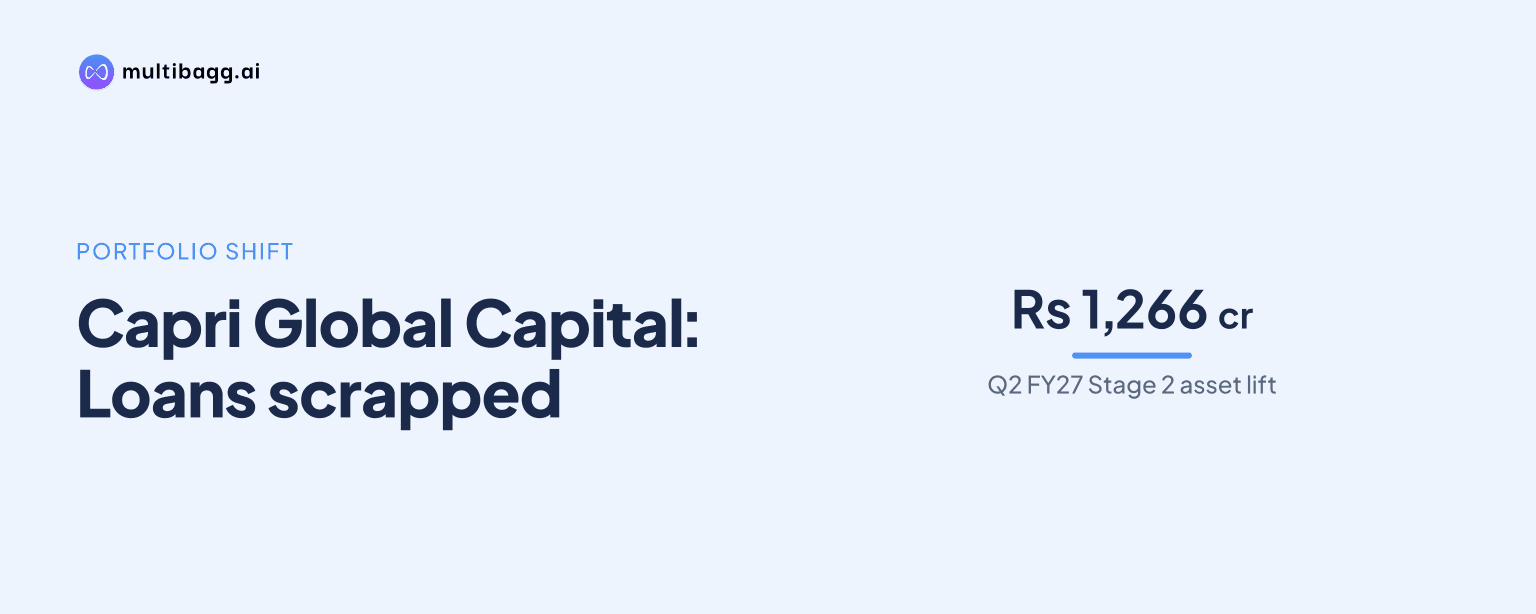
Capri Global said in Q2 FY27 that one-, two- and three-month gold-loan repayment structures increased Stage 2 assets by Rs 1,266 crore, prompting the discontinuation of those products. Management expects reported gold-loan delinquencies to fall significantly by the end of the following quarter, while portfolio loan-to-value, or LTV, remained about 70%.
Know Capri Global Capital inside out
Results, valuation, peers and who's buying, in one view.
Why did Capri Global's Stage 2 gold-loan assets rise?
Capri Global said the entire increase in reported slippages came from gold loans, rather than from its micro, small and medium enterprise, or MSME, housing or construction-finance businesses. Management attributed the Rs 1,266 crore increase in gold-loan Stage 2 assets in Q2 FY27 to short-tenure products introduced after new guidelines, with repayment or interest becoming due after one, two or three months.
The company described the effect as temporary operational behaviour rather than a matching deterioration in underlying credit quality. In response to an analyst question about sequential increases in gross and net non-performing assets, management said the short repayment windows had increased reported gold-loan delinquencies, while no comparable slippages had occurred in MSME, housing or construction finance.
What has Capri Global changed in its gold-loan products?
Capri Global has reduced and discontinued the shorter-tenure repayment structures that management identified as contributing to Q2 FY27 delinquencies. Management said the schemes carrying one-, two- and three-month interest or repayment obligations had been reduced, and it expected this action to result in a significant fall in gold-loan delinquency by the end of the next quarter.
The company is also maintaining its focus on loans below Rs 3 lakh rather than competing for gold loans above Rs 5 lakh, where management said net realisations are lower. Gold-loan yields reached 19% in Q2 FY27, helped by a focus on granular lending, smaller ticket sizes and higher interest rates applying when a customer defaults. Management said it did not intend to pursue growth at lower yields.
Capri Global's promotional Vyapar Mela activity did not mean every customer received the advertised starting rates, according to management. The campaign ran only on particular days to attract customers, while final pricing depended on customer and loan characteristics; management said it aimed to avoid materially lowering portfolio yield through low-rate lending.
Is the reported gold-loan stress linked to collateral coverage?
Capri Global said its gold-loan portfolio LTV was about 70%, leaving what management called a 30% cushion relative to collateral values. Management noted that the prescribed maximum LTV for small-ticket loans is 85%, while income-generating loans do not have that stated cap, and said a 5% to 7% fall in gold prices could be addressed through cash margins or additional pledged gold.
The company acknowledged initial signs of stress at gold-loan branches in semi-urban and rural areas affected by drought conditions. For MSME, housing and construction finance, management said it had practically seen no impact in the affected geographies. Where agricultural stress emerges, it plans to tighten credit screens, raise fixed-obligation-to-income ratio requirements for income-generating loans and reduce LTVs.
Portfolio construction also differs by branch maturity. Management said gold-loan branches older than 18 months have average assets under management, or AUM, of about Rs 20 crore per branch, while newer branches range between Rs 4 crore and Rs 7 crore. After adding 154 gold-loan branches in the last quarter, the overall average AUM per branch fell to Rs 18.2 crore from Rs 19.2 crore because new outlets had not reached mature volumes.
Got a follow-up? Ask IRIS
What other portfolio indicators did Capri Global disclose?
Capri Global said MSME gross non-performing assets had remained in a 3% to 3.1% range for the preceding three to four quarters. It disbursed close to Rs 560 crore in MSME loans during Q2 FY27 and said geopolitical conditions had not yet affected the segment's business or growth, contrasting with the gold-loan-specific movement in reported Stage 2 assets.
Gold-loan customer numbers increased despite a decline in live accounts per customer. Management said total customers rose from 6.59 lakh to 7.13 lakh in Q2 FY27, while separately citing live unique customers rising from 7 lakh to 7.13 lakh. It attributed lower live accounts to customers taking fewer loans across different loan account numbers, rather than to a lack of new customer additions.
The average gold-loan ticket size had reached about Rs 2.14 lakh, but management said it intends to remain within the below-Rs 3 lakh segment. This approach is intended to preserve the company's targeted yield profile while it expands in southern markets, where management said competitive intensity is higher and larger-ticket lending often carries lower realised rates.
What does Capri Global expect next for asset quality and growth?
Capri Global's stated near-term expectation is that gold-loan delinquencies will decline significantly by the end of the quarter following Q2 FY27, following the removal of the short-tenure structures. That is a management expectation, not a reported outcome, and it depends on the repayment behaviour of borrowers after the product changes and on conditions in rural and semi-urban gold-loan markets.
For FY27, management maintained its AUM guidance at about Rs 50,000 crore even though AUM had already reached about Rs 44,000 crore at the end of H1 FY27. It said the company could perform slightly better than that AUM target and expected profit after tax of about Rs 1,600 crore. The longer-term target is Rs 65,000 crore of AUM by FY28, with return on average equity of about 20% to 21% and return on average assets of 4.2% to 4.7%.
Capri Global plans to add about 500 gold-loan branches during the year under a board approval for 600 branches, alongside further MSME and affordable-housing additions. The branch programme can keep average AUM per branch below mature-branch levels in the near term, as shown by the 154 gold-loan outlets added in the latest quarter, but management is positioning the network for its FY28 AUM objective.
Conclusion
The Rs 1,266 crore increase in Stage 2 gold-loan assets was concentrated in a specific product design rather than disclosed across Capri Global's other principal lending segments. Management's explanation rests on the timing of one-, two- and three-month repayment obligations, while the portfolio's roughly 70% LTV provides the collateral-position context for its view that underlying credit quality has not deteriorated to the same extent as reported delinquency measures.
The next reported quarter is the test of management's expectation, because it has said gold-loan delinquencies should decline significantly after the short-tenure structures were discontinued. Other disclosed items to watch are the plan to add about 500 gold-loan branches in FY27, credit-screen tightening in drought-affected areas and progress toward the maintained Rs 50,000 crore FY27 AUM guidance.