










Care Health sees 1/n profit from October 2027, Ind AS PBT up 42%
Key highlights
- Care Health reported Rs 392 crore of Ind AS PBT in H1 FY27, up 42% from Rs 276 crore.
- Management expects Care Health's transitional 1/n profitability to turn positive from October 2027.
- Care Health's H1 FY27 combined operating ratio improved 70 basis points to 100.5%.
- Care Health reported 1.55 times solvency and planned a Rs 300 crore rights issue in November.
powered by IRIS
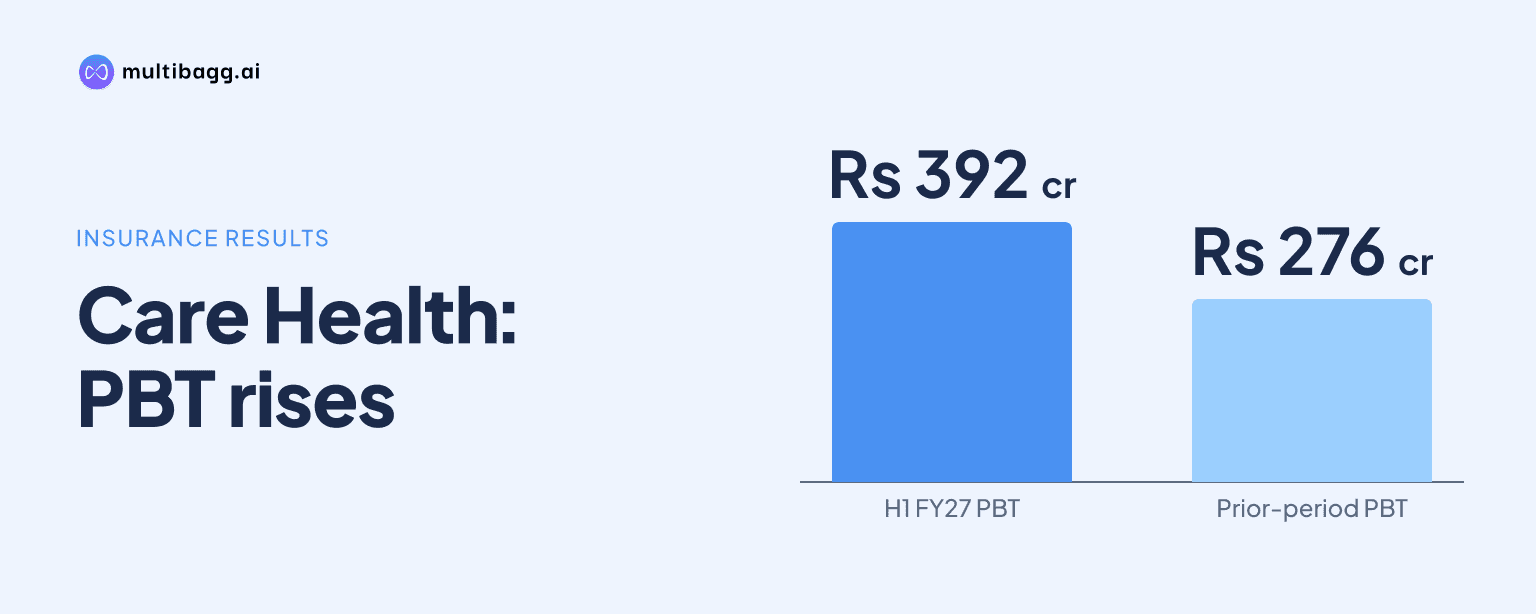
Care Health Insurance expects its reported 1/n profit to turn positive from October 2027 after posting Rs 392 crore of profit before tax under Indian Accounting Standards, or Ind AS, in H1 FY27, up 42% from Rs 276 crore a year earlier. Management attributed the 1/n loss to the accounting transition introduced in October 2024.
Know Religare Enterprises inside out
Results, valuation, peers and who's buying, in one view.
Why does Care Health report Ind AS profit but a 1/n loss?
Care Health says its 1/n loss reflects a transition in accounting rather than its underlying Ind AS result, which showed H1 FY27 profit before tax, or PBT, of Rs 392 crore. Chief Financial Officer Ambrish Jindal said 1/n was introduced by the regulator in October 2024, creating transition-year effects that make the reported 1/n figures difficult to compare with earlier periods.
Management said opening and closing reserves affect the 1/n presentation, while deferred business is also a factor. Care Health did not disclose the absolute 1/n loss during the call. It asked investors to assess profitability and loss ratios through the Ind AS accounts, under which insurance revenue rose 29% to Rs 6,119 crore in H1 FY27.
Jindal said Care Health expects positive 1/n numbers from October 2027, which he described as the third year after the October 2024 change. From the next financial year, management expects deferred business from earlier years to begin unwinding, while new business will also be deferred over three years. He said the company had sought forbearance for one year and expects to report only Ind AS results from next financial year.
How did Care Health perform under Ind AS in H1 FY27?
Care Health's H1 FY27 Ind AS PBT increased 42% to Rs 392 crore, while its insurance service result rose by more than 170% to Rs 129 crore from Rs 47 crore. Management also reported that the H1 loss ratio improved by 90 basis points to 66.1%, providing the company’s stated basis for assessing underwriting performance.
The combined operating ratio improved by 70 basis points to 100.5% in H1 FY27. PBT-based return on equity increased to 12.1% from 10.2%, with management specifying that these were non-annualised half-year figures. At the previous investor call, management had said it was targeting a combined ratio near 100% by March 2028; on this call, Ajay Shah said the company appeared ahead of that path.
Premium growth exceeded the rise in Ind AS revenue. Gross written premium, or GWP, increased 35% to Rs 6,897 crore on a full-premium basis, while retail business grew 44% and retail new business grew by more than 50%. Management said the high share of new business keeps acquisition expenses elevated, and that operating leverage is more likely to emerge as renewal business expands.
What supports Care Health's premium growth and operating plan?
Care Health reported a 97% claims-settlement ratio and said retail policy persistency improved to 97% from 91% in H1 FY27. Its retail health market share stood at 12.8% across the industry and 21.3% among standalone health insurers, while its overall industry market share was 7.3%.
The company said proprietary channels generated almost 47% of GWP, and its retail mix improved by 4 percentage points year on year. Multi-year policies accounted for about 18% to 20% of retail business, a range management said was broadly unchanged from the previous year. Management also said the retail renewal loss ratio was around 75%, while it estimated the loss ratio on retail policies older than three years at 79% to 80%.
Digital servicing is another stated operating mechanism. Care Health said 99.5% of policies were issued digitally, 80% of cashless claims were processed within 30 minutes, and cashless-claims net promoter score was 74. Its mobile application had 13.8 million installations and 1.2 million active users, while 67% of active retail customers were on the app.
Got a follow-up? Ask IRIS
How could solvency rules affect Care Health's capital needs?
Care Health's Ind AS profit does not currently determine regulatory solvency because the solvency calculation remains under Indian generally accepted accounting principles, or I-GAAP. Management reported a solvency ratio of 1.55 times and said it raised Rs 300 crore of Tier 2 capital during the quarter and another Rs 150 crore in October.
Management also said it planned a Rs 300 crore rights issue in November to support year-end solvency. Jindal estimated that the difference between I-GAAP and Ind AS net worth could exceed Rs 1,000 crore by the end of FY27. He said this amount could add to the solvency base if future rules move the calculation to an Ind AS-based framework.
That outcome remains unresolved. Management said the Insurance Regulatory and Development Authority of India has formed a committee considering draft regulations on quantitative impact studies and a risk-based solvency method. Without a regulatory change, Care Health expects I-GAAP profitability to improve from the next financial year as prior deferred business unwinds, but said it was difficult to state definitively whether additional capital would be needed after that.
What could proposed distribution rules change for Care Health?
Care Health said around 55% to 56% of its business, including agency retail and direct-to-consumer, or D2C, channels, would not be affected by the proposed distribution regulation. D2C new business grew more than 60%, according to management, while proprietary channels accounted for almost 47% of total GWP in H1 FY27.
Ajay Shah identified three possible effects if the proposed rules are implemented: certain renewal-servicing and call-centre work currently handled by partners may have to move in-house, some discounts may have to be passed to consumers, and the mix between channels could change. He said management’s view was that the combined ratio could be maintained in a 99% to 100% range, but that assessment was conditional on the final regulatory details.
Management did not provide premium-growth guidance for FY27 or the next four quarters. It said the exposure draft was still awaited and that detailed calibration would follow once it was issued. In the meantime, Care Health reported investment assets under management of Rs 12,900 crore, with bonds and government securities comprising 92% of the investment book.
Conclusion
Care Health reported faster growth in Ind AS profit than in its reported premium base in H1 FY27: PBT rose 42% to Rs 392 crore, insurance service result reached Rs 129 crore, and the combined operating ratio improved to 100.5%. The contrast with the 1/n loss is explained by the accounting transition, rather than by an Ind AS loss in the half-year.
The next events to watch are management’s expected move to positive 1/n profitability from October 2027, the planned Rs 300 crore rights issue in November, and the final shape of the regulator’s risk-based solvency proposals. Management said a potential Rs 1,000 crore-plus gap between Ind AS and I-GAAP net worth could materially change the solvency calculation if rules are revised.