










Religare Finvest targets Rs 1,700 crore FY28 disbursements
Key highlights
- RFL targets Rs 1,500-1,700 crore of disbursements by March 2028 after expecting less than Rs 100 crore in its initial year.
- RFL aspires to build a Rs 10,000-15,000 crore lending book over four to five years.
- Management said an RFL branch takes about 15 to 18 months to reach full productivity.
- RFL targets a book yield of around 15.5% and an overall short-term ROA of around 2.5% to 2.8%.
powered by IRIS
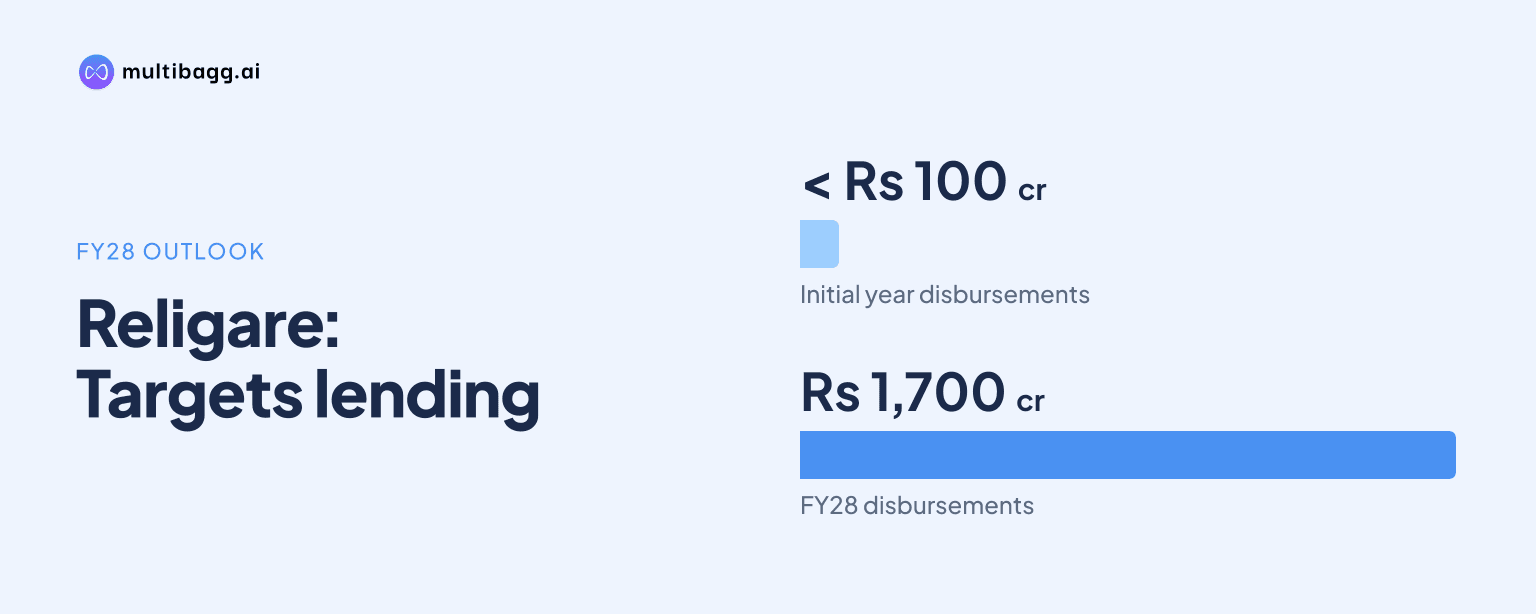
Religare Finvest targets Rs 1,500-1,700 crore of disbursements by March 2028 after expecting less than Rs 100 crore in its initial operating year, while management aims to build a Rs 10,000-15,000 crore lending book over four to five years. The plan depends on branch maturation, technology deployment, product launches and ground-team hiring.
Know Religare Enterprises inside out
Results, valuation, peers and who's buying, in one view.
What is RFL targeting for March 2028 disbursements?
RFL is targeting Rs 1,500-1,700 crore of disbursements by March 2028. Management described the target as the next-year objective after lending began in the current year, when it expects to disburse less than Rs 100 crore. The March 2028 range is therefore an originations goal for a business at an early stage of operations.
The increase from less than Rs 100 crore in the initial year to as much as Rs 1,700 crore by March 2028 reflects the planned expansion of branches, teams and products. Management did not provide a quarterly disbursement schedule, a March 2028 closing loan-book target, or a product-wise split of the Rs 1,500-1,700 crore range. It also did not disclose an existing asset-under-management figure during the call.
Disbursements and the loan book measure different things. Disbursements represent lending originated during a period, whereas the book represents loans outstanding after repayments and other portfolio movements. Management’s stated Rs 10,000-15,000 crore longer-term objective is a lending-book aspiration, not the amount it expects to disburse in March 2028.
Why is RFL scaling lending over several years?
RFL is scaling gradually because management said a new branch takes 15 to 18 months to reach full productivity. When asked why Rs 1,500 crore of next-year disbursements appeared limited relative to available backing, management cited the time required to open branches, hire a new team and introduce products. The branch-ramp period is therefore a stated constraint on early lending volumes.
Management said its physical infrastructure includes a pan-India branch network that will take a couple of years to roll out fully. It also described the broader build-out as extending over the next 12 to 16 quarters, covering technology, branches and ground teams. These periods overlap: branch rollout may take about two years, while individual branches need a further 15 to 18 months to attain full productivity.
RFL said it is in the final stages of building the first phase of its technology stack. The company is also launching products progressively rather than describing a complete national suite already in operation. Management did not specify the number of branches opened, the eventual branch count, branch locations, or dates for individual product launches.
What lending model does RFL plan to build?
RFL plans to become a multi-line non-banking financial company, or NBFC, focused on retail lending across customer segments and anchored by secured products. Management said the lending journey had just begun, including the disbursement of its first loan, and framed the following 12 to 16 quarters as a period for building the operating platform.
The secured-product focus is important because management gave separate return-on-assets expectations for secured and unsecured lending. It said secured products would typically deliver return on assets, or ROA, of around 2% to 2.5%, while unsecured products could produce a slightly higher ROA. RFL did not identify the secured products, unsecured products, borrower segments or expected mix of each category.
Management’s four- to five-year Rs 10,000-15,000 crore book aspiration sits beyond the initial branch-ramp phase. The upper end of Rs 15,000 crore is Rs 5,000 crore above the lower end of Rs 10,000 crore, leaving the eventual scale dependent on execution across branch rollout, team formation and product expansion. RFL did not disclose assumptions on repayment rates, loan tenors, repeat borrowing or portfolio churn that would connect annual originations to the target book.
Got a follow-up? Ask IRIS
What return and yield targets has RFL disclosed?
RFL is aspiring to an overall short-term ROA of around 2.5% to 2.8% and a target yield of around 15.5% on its book. Management said the overall ROA will depend on the product mix, particularly the relative contribution of secured products, for which it cited a typical 2% to 2.5% ROA, and unsecured products, which it said could generate a somewhat higher result.
The 15.5% figure is a target yield across the book rather than a reported lending yield. Management did not provide separate secured and unsecured yields, borrowing costs, credit costs, operating expenses, fee income or a cost-to-income ratio. As a result, the call gives headline targets but no numerical bridge from the planned March 2028 disbursements to the 2.5% to 2.8% ROA aspiration.
RFL’s target economics should also be distinguished from results. The company had just started lending and expected less than Rs 100 crore of disbursements in the current year, so management presented the 15.5% yield and 2.5% to 2.8% ROA as aspirations for the developing platform. No reported RFL profit, loss, non-performing loan ratio or credit-cost figure was disclosed in the call.
How will investors be able to track RFL’s execution?
RFL’s first measurable operating checkpoint is the Rs 1,500-1,700 crore disbursement target for March 2028. Progress can be assessed against management’s stated timelines of 15 to 18 months for a branch to become fully productive, a couple of years for broad branch-network rollout, and 12 to 16 quarters for the overall technology, physical-infrastructure and team build-out.
The most useful future disclosures would be those that connect the Rs 1,500-1,700 crore annual-originations objective to the Rs 10,000-15,000 crore book aspiration. These include the outstanding book, branch count and maturity, secured versus unsecured mix, portfolio yield and credit performance. None of those operating measures was quantified on this call, beyond management’s 15.5% yield target and 2.5% to 2.8% overall ROA aspiration.
Conclusion
RFL has outlined a staged lending expansion rather than immediate scale. It expects less than Rs 100 crore of disbursements in its initial year, targets Rs 1,500-1,700 crore by March 2028, and aspires to a Rs 10,000-15,000 crore book over four to five years. The timetable reflects management’s view that branch productivity, technology infrastructure, product rollout and ground-team development must precede larger volumes.
The next point to watch is progress toward the March 2028 disbursement range as branches move through the stated 15-to-18-month productivity cycle. Management has also set a 12-to-16-quarter build-out period and a four-to-five-year book target, so future updates on branch rollout, product mix, outstanding loans and the path toward the 15.5% yield and 2.5% to 2.8% ROA aspirations will show whether the plan is developing as intended.