










Carysil Products Limited to double appliance and faucet capacity
Key highlights
- Carysil plans to double kitchen-appliance capacity from 50,000 to 100,000 units a year by end-FY27.
- Carysil plans to double faucet capacity from 50,000 to 100,000 units a year by end-FY27.
- Quartz-sink utilisation was 92% in Q2 FY27, with 250,000 additional annual units planned by end-FY27.
- Carysil’s consolidated H1 FY27 revenue rose 15.0% to Rs 537.9 crore.
powered by IRIS
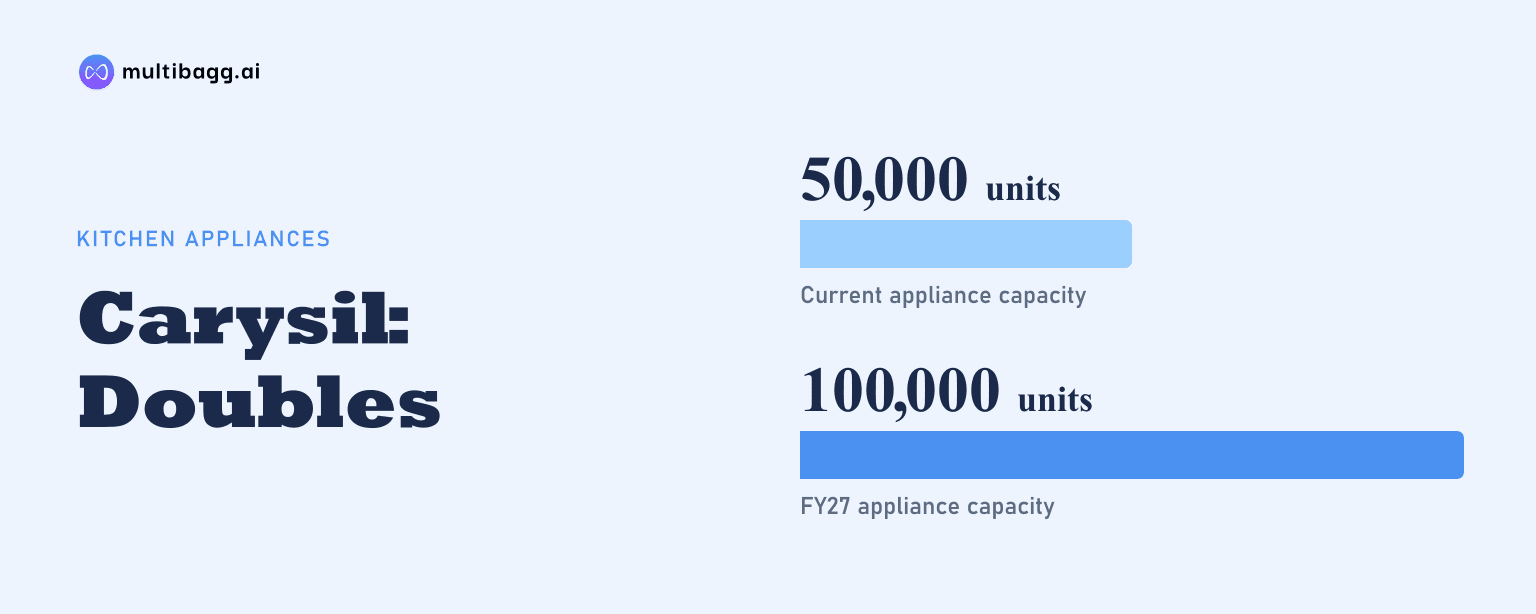
Carysil Products Limited plans to double annual kitchen-appliance and faucet capacity to 100,000 units each by end-FY27, while quartz-sink capacity utilisation reached 92% in Q2 FY27. The company also plans to commission 250,000 additional quartz-sink units a year by end-FY27, extending its manufacturing expansion across multiple product lines.
Know Carysil inside out
Results, valuation, peers and who's buying, in one view.
What capacity additions is Carysil planning by end-FY27?
Carysil plans to raise kitchen-appliance capacity from 50,000 to 100,000 units a year by end-FY27. The project covers hobs, ovens, microwaves and food-waste disposers, and commercial operations are expected by the end of FY27. The company’s Q2 FY27 overview listed installed kitchen-appliance capacity of 50,000 units a year before this planned expansion.
Carysil is also expanding faucet capacity from 50,000 to 100,000 units a year, with commissioning on track for end-FY27. Each project therefore adds 50,000 annual units. The expansion moves beyond the company’s larger sink operations into appliances and faucets, while the company is simultaneously planning a 250,000-unit annual addition in quartz sinks.
How fully is Carysil using its sink capacity?
Carysil reported quartz-sink capacity utilisation of 92% in the second quarter, or Q2, of FY27, compared with 90% for the first half, or H1, of FY27. Its installed quartz-sink capacity stood at 1,000,000 units a year as of Q2 FY27. The company said the additional 250,000 annual quartz-sink units remained on track for commissioning by end-FY27.
Stainless-steel sink utilisation was 91% in Q2 FY27 and 85% in H1 FY27. Carysil listed installed stainless-steel sink capacity of 250,000 units a year at Q2 FY27, one-fourth of its quartz-sink capacity. The two sink categories both recorded utilisation above 90% in the quarter, although their installed capacities and reported unit volumes differ substantially.
The company’s stated utilisation figures do not specify the capital expenditure for the planned capacity additions. Its standalone balance sheet showed capital work in progress of Rs 38.1 crore at September 2026, compared with Rs 24.4 crore at March 2026. That increase coincided with the projects that Carysil says are scheduled for commissioning or commercial operations by end-FY27.
What does recent unit growth show across Carysil’s products?
Carysil reported 217,000 quartz-sink units in Q2 FY27, up 9.9% from 198,000 units in Q2 FY26. H1 FY27 quartz-sink units rose 8.2% to 419,000 from 387,000 in H1 FY26. Q2 FY27 volume was also higher than the 202,000 units reported in Q1 FY27, alongside the disclosed 92% quarterly capacity utilisation.
Stainless-steel sink units rose 7.8% year on year to 47,000 in Q2 FY27 and 12.0% to 96,000 in H1 FY27. Faucet units increased 25.1% in H1 FY27 to 23,000 from 18,000, the highest disclosed H1 growth rate among the four product categories. Its Q2 FY27 faucet volume was 10,000 units, compared with 9,000 units a year earlier.
Kitchen appliances and others reported 11,000 units in Q2 FY27, broadly unchanged from Q2 FY26, while H1 FY27 units increased 6.9% to 20,000. Carysil defines this category as including Sternhagen, tiles and other products, so it is not a measure of built-in appliance volumes alone. This differs from faucets, which were separately reported and are receiving a dedicated capacity doubling.
Got a follow-up? Ask IRIS
How does the expansion fit Carysil’s revenue mix?
Carysil derived 53.8% of Q2 FY27 revenue from quartz sinks, up from 48.7% in Q2 FY26. Stainless-steel sinks represented 11.1% of Q2 FY27 revenue, compared with 10.2% a year earlier, while kitchen appliances and others represented 12.4%, down from 14.1%. The capacity plan combines investment in the largest disclosed revenue category with additional manufacturing scale in smaller categories.
The company’s H1 FY27 product mix also showed quartz sinks at 52.5% of revenue, up from 49.2% in H1 FY26. Surfaces declined to 23.9% from 26.3%, while kitchen appliances and others declined to 12.1% from 14.6%. Faucet revenue was not separately disclosed in the product-mix table, despite faucet unit volumes being reported separately.
Geographically, India accounted for 21.1% of H1 FY27 revenue, up from 18.8% in H1 FY26, while the United States accounted for 27.6%, up from 25.6%. The United Kingdom’s share declined to 31.1% from 34.2%. Carysil reported that exports represented 81% of FY26 revenue and that it had a presence in more than 55 countries.
What financial trends accompany Carysil’s investment phase?
Carysil reported consolidated revenue of Rs 537.9 crore in H1 FY27, up 15.0% from Rs 467.7 crore in H1 FY26. Total income, which includes foreign-exchange gains or losses, increased 15.2% to Rs 542.8 crore. Q2 FY27 consolidated revenue was Rs 275.7 crore, up 14.6% year on year and 5.2% from Rs 262.1 crore in Q1 FY27.
H1 FY27 earnings before interest, tax, depreciation and amortisation, or EBITDA, rose 17.6% to Rs 110.1 crore from Rs 93.6 crore. EBITDA margin increased to 20.3% from 19.9% in H1 FY26, while Q2 FY27 margin was 19.4%, below 20.3% in Q2 FY26. Consolidated profit after tax before minority interest rose 21.3% to Rs 61.1 crore in H1 FY27.
Management characterises the current period as an investment-led transition phase. It states that near-term profit-after-tax margins are affected by higher operating costs and growth investments, and that operating leverage is expected as scale improves. Consolidated net cash from operating activities was Rs 65.2 crore in H1 FY27, compared with Rs 71.4 crore in H1 FY26, while investing cash outflow was Rs 16.8 crore.
What manufacturing infrastructure supports Carysil’s expansion?
Carysil says it has four fully integrated manufacturing facilities in a single-location hub at Bhavnagar, Gujarat. The site includes faucet and appliance, steel and quartz-sink plants, as well as a warehouse. The company states that the hub covers about 1 lakh square metres of land, providing room for phased capacity expansion.
The wider group had six manufacturing plants as of Q2 FY27, comprising four in India and two overseas. Carysil also reported more than 5,000 dealers in India, more than 150 galleries including shop-in-shop locations, and five showroom-cum-experience centres. These channels sit alongside the company’s planned domestic-business expansion, which management says could grow three times over the next three to four years.
Conclusion
Carysil’s end-FY27 programme combines 50,000-unit annual additions in both kitchen appliances and faucets with a 250,000-unit annual quartz-sink addition. The plan follows Q2 FY27 utilisation of 92% in quartz sinks and 91% in stainless-steel sinks, while H1 unit growth was highest in faucets at 25.1% and quartz sinks remained the largest revenue category at 52.5%.
The next disclosed milestones are commercial operations for the appliance project, commissioning of the enlarged faucet facility and commissioning of additional quartz-sink capacity, all by end-FY27. Management’s stated expectation of operating leverage as scale improves leaves future margins, sales volumes in the expanded categories and execution against those commissioning timelines as the matters to watch.