










Carysil targets threefold domestic growth through dealer expansion
Key highlights
- Carysil targets threefold domestic-business growth over the next 3-4 years.
- Carysil’s dealer network rose from 1,500-plus in FY22 to 5,000-plus in FY26.
- Carysil’s distributor footprint increased from 82 in FY22 to 107 in FY26.
- India represented 19% of Carysil’s FY26 revenue, compared with 27% in FY20.
powered by IRIS
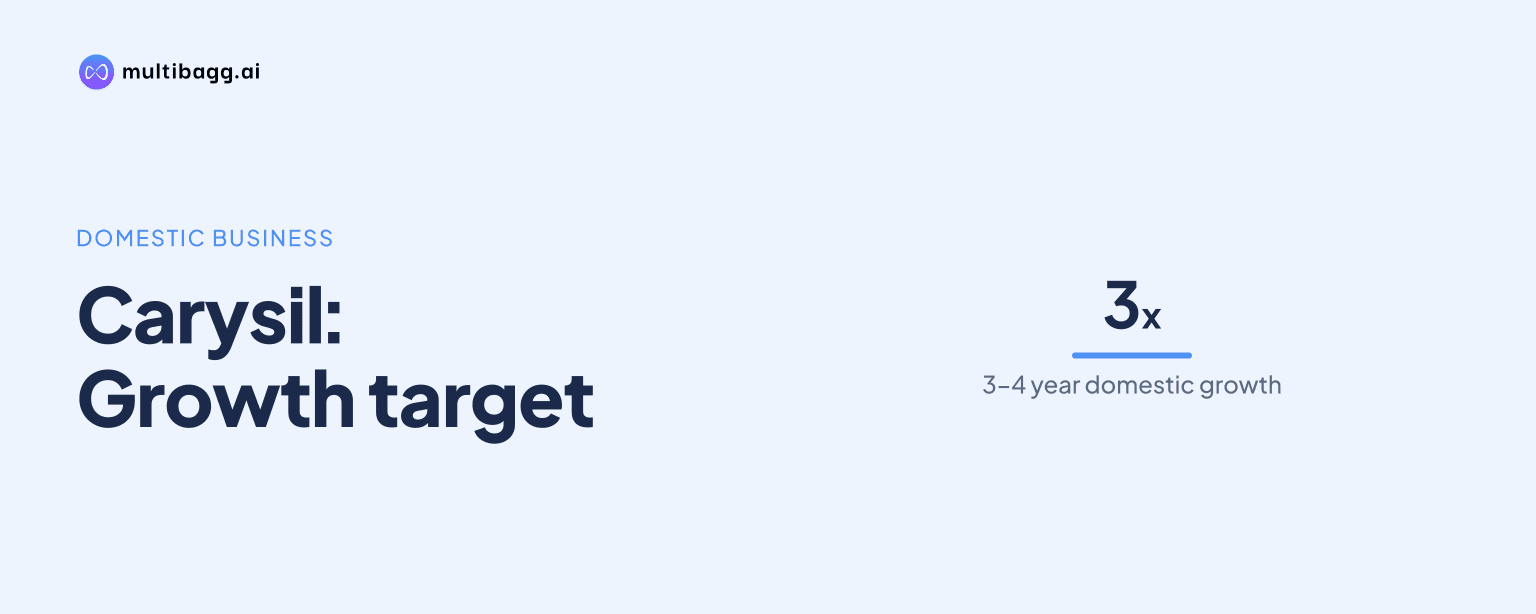
Carysil targets threefold growth in its domestic business over the next three to four years, supported by a dealer network of more than 5,000 in FY26, up from more than 1,500 in FY22. The presentation links the plan to wider distribution, experience centres, Carysilshop.com and a Mira Kapoor marketing campaign.
Know Carysil inside out
Results, valuation, peers and who's buying, in one view.
How fast has Carysil’s domestic channel expanded?
Carysil’s dealer network reached more than 5,000 in FY26, compared with more than 4,000 in FY25, more than 3,200 in FY24 and more than 3,100 in FY23. The FY26 total was more than three times the 1,500-plus dealer level shown for each year from FY19 through FY22.
Carysil’s distributor footprint rose to 107 in FY26 from 95 in FY25 and 85 in FY24. It had remained at 82 from FY19 to FY23, including the period when dealers rose from more than 1,500 in FY22 to more than 3,100 in FY23.
The channel build changed after FY22 because dealer additions accelerated before the distributor count began increasing. Dealers more than doubled from 1,500-plus in FY22 to 3,100-plus in FY23 while distributors stayed at 82, then dealers rose by at least 1,900 from FY23 to FY26 as distributors increased by 25 to 107.
What supports Carysil’s threefold domestic growth target?
Carysil says its domestic business is to grow three times in the next three to four years, but it does not disclose the domestic-revenue starting base, annual milestones or a target fiscal year. The target appears alongside the FY26 channel figures of more than 5,000 dealers and 107 distributors, which are the operating measures provided for wider domestic reach.
Carysil has four fully integrated facilities at one manufacturing hub in Bhavnagar, Gujarat, covering faucets and appliances, steel, quartz sinks and warehousing. The company says the site spans about 1 lakh square metres, has headroom for phased capacity expansion and uses end-to-end in-house production for quality consistency, turnaround and margin control.
The presentation also shows current granite-sink capacity of 2,50,000 and an expansion range of 12,50,000 to 15,00,000, alongside Rs 150 crore. It does not specify the capacity unit, the completion date, the domestic allocation or the use of the Rs 150 crore, so this disclosure does not quantify expected domestic sales.
Carysil’s FY26 product mix was broader than its FY20 mix. Quartz sinks accounted for 51% of FY26 revenue versus 73% in FY20, while surfaces represented 26% in FY26 but were not listed in FY20; stainless-steel sinks fell from 16% to 11%, and kitchen appliances and others rose from 11% to 12%.
Got a follow-up? Ask IRIS
How is Carysil building customer visibility in India?
Carysil is using a Mira Kapoor campaign, Carysilshop.com and experience-centre openings to build brand visibility and direct customer engagement. The company says it signed the public figure and influencer for a new campaign for the Carysil brand, while identifying Carysilshop.com as the anchor of its omnichannel strategy.
Carysil recently unveiled an Experience Centre in Gurugram and listed new experiential-retail openings in Pune, Indore, Ahmedabad and Muscat. The four named openings include three Indian cities and Muscat, so the disclosed retail expansion includes domestic and overseas locations.
The presentation distinguishes the physical channel from direct engagement through experience centres. FY26 had more than 5,000 dealers and 107 distributors, while the centres in Gurugram, Pune, Indore and Ahmedabad are described as strengthening direct customer engagement; Carysilshop.com adds an online route, though the presentation gives no traffic, conversion or online-sales figures.
Carysil provides no marketing-spend figure, dealer-productivity measure, store count or sales contribution from its experience centres. The disclosed evidence therefore establishes the campaign, the named locations and the online platform, but not a measured return from those initiatives.
How does domestic expansion fit with Carysil’s export business?
Carysil’s domestic plan sits alongside exports to more than 55 countries and a stated overseas expansion plan through new customers and geographies. The company describes its overseas model as asset-light and cites long-standing partnerships with global customers as part of its international approach.
India’s revenue share declined to 19% in FY26 from 27% in FY20, while the United Kingdom rose to 33% from 24% and the United States increased to 25% from 14%. Rest of world fell to 23% from 35%, meaning the UK and US together accounted for 58% in FY26 compared with 38% in FY20.
Carysil identifies several supply relationships within this export business. It partnered with IKEA Supply AG, Switzerland, in August 2020 to manufacture and supply quartz kitchen sinks and says it fulfils a major share of IKEA’s non-US quartz-sink sourcing; it also has a long-term agreement to supply Karran USA with 150,000 quartz sinks annually and says it is GROHE’s sole quartz-sink supplier.
Conclusion
Carysil’s domestic ambition is supported by a channel that reached more than 5,000 dealers and 107 distributors in FY26, plus an omnichannel platform, experience-centre openings and a named brand campaign. However, the company’s FY26 revenue mix remained internationally weighted, with India contributing 19% while the UK and US together contributed 58%.
What to watch next is execution against management’s three-to-four-year domestic growth plan and further detail on the granite-sink expansion. Carysil has disclosed current capacity of 2,50,000, a planned range of 12,50,000 to 15,00,000 and Rs 150 crore, but not its completion schedule, capacity unit, domestic allocation or domestic-revenue milestones.