










Cellecor Gadgets Ltd. expands appliances through partners
Key highlights
- Cellecor reported FY26 revenue of Rs 1,292 crore, compared with Rs 1,026 crore in FY25.
- Cellecor lists Fire TVs, steam irons, choppers and egg boilers among its new product categories.
- Cellecor reports more than 1,800 distributors, more than 100,000 retail touchpoints and more than 2,000 service centres.
- Cellecor’s white-label model assigns manufacturing to partners while it manages branding, pricing, quality and distribution.
powered by IRIS
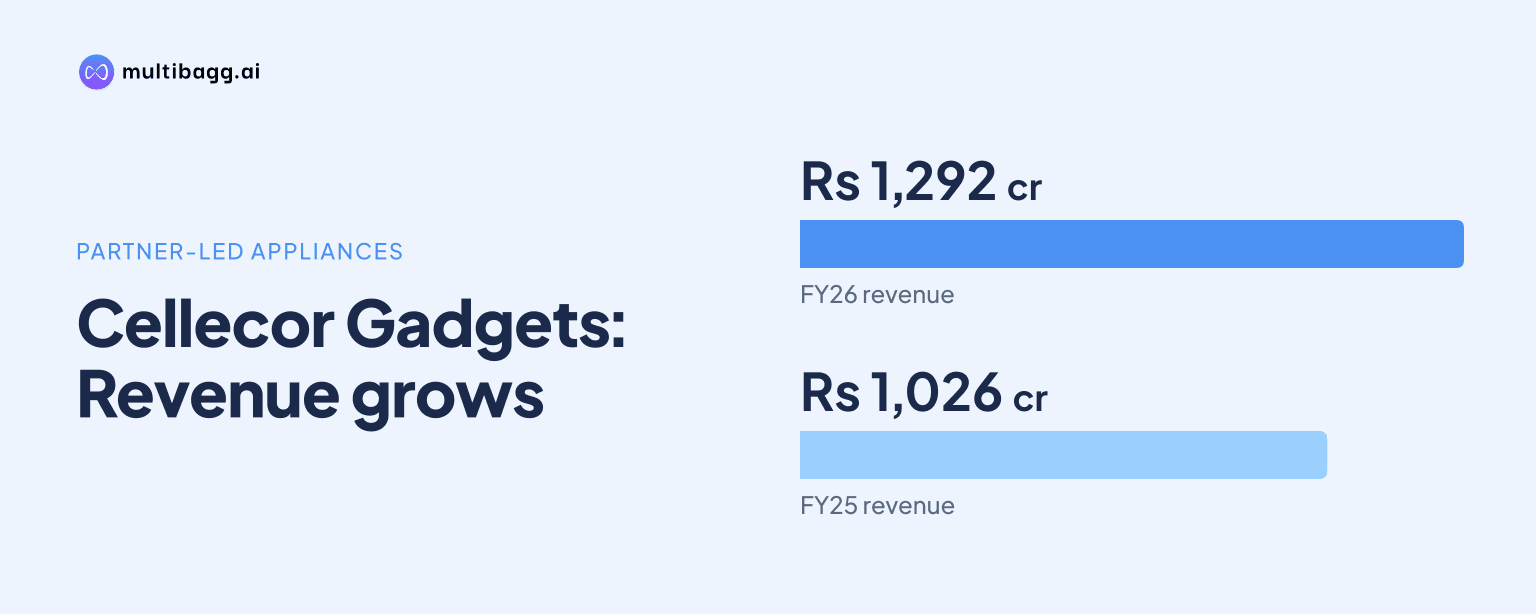
Cellecor is expanding from core consumer electronics into home, kitchen and lifestyle products through partner manufacturing, supported by FY26 revenue of Rs 1,292 crore and more than 1,800 distributors. The model leaves manufacturing with partners while Cellecor manages branding, pricing, quality and distribution across its enlarged catalogue.
Know Cellecor Gadgets inside out
Results, valuation, peers and who's buying, in one view.
What products is Cellecor adding to its portfolio?
Cellecor is adding Fire TVs, steam irons, choppers and egg boilers as new household categories, while also introducing semi-automatic and fully automatic washing machines, soundbars, party speakers and mixer grinders in existing or adjacent categories. These additions extend the range beyond connected electronics into products intended for daily home and kitchen use.
Cellecor lists smart TVs, refrigerators, irons, geysers, air conditioners, washing machines, immersion rods, heaters, coolers, pedestal fans and ceiling fans in home appliances. Its kitchen range includes mixer grinders, multi-cook kettles, air fryers, electric kettles, induction products, rice cookers, blenders and toasters, creating a broader product set than the television and gadget categories alone.
The technology and gadgets portfolio includes laptops, mobiles, headphones, smart watches, trimmers, wired earphones, accessories, speakers and chargers. Cellecor also identifies a lifestyle-oriented category containing a gun massager, showing that the planned portfolio is not limited to large appliances or entertainment products.
How does Cellecor source and manufacture appliances?
Cellecor uses a white-label manufacturing model under which partner manufacturers produce goods and Cellecor handles branding, pricing and distribution. The presentation describes this as an asset-light structure that lowers manufacturing capital expenditure and permits volume changes in response to market demand.
Cellecor says its supplier ecosystem spans key product categories and includes domestic manufacturing partnerships. It names ZETWERK, Noble, Epack Durable, Omega’s Home Appliances, Ekaa, Suman Enterprises, Dixon, GEM, Veeline, MEKR, RG Industries and PG Electroplast as strategic suppliers or manufacturers, but does not identify the products, volumes or terms associated with any individual partner.
The disclosed operating sequence is suppliers and manufacturers, Cellecor branding and quality, omnichannel distribution, and the end consumer. That structure assigns production capacity to partners while retaining product positioning, quality oversight, price setting and routes to market with Cellecor.
Got a follow-up? Ask IRIS
How can Cellecor distribute a wider appliance range?
Cellecor reports more than 1,800 distributors, more than 100,000 retail touchpoints and more than 2,000 service centres across 28 states and 2 Union Territories. It says this existing retail, distribution, e-commerce and manufacturing ecosystem can be used to scale categories such as Fire TVs, washing machines and kitchen appliances.
The physical network includes 12 warehouses, eight exclusive Cellecor stores and coverage of more than 25,000 pin codes. The listed store locations include Leh Ladakh, Punjab, Delhi, Bihar, Madhya Pradesh, Maharashtra, Mizoram, and Andaman and Nicobar Island, while the wider retail base extends beyond these owned outlets.
Cellecor’s channels include multi-brand outlets, large-format retailers, Amazon, Flipkart, Myntra, Ajio, JioMart and the Open Network for Digital Commerce, or ONDC. It also lists quick-commerce platforms such as Zepto, Blinkit and Instamart, plus corporate and institutional sales of electronics and home appliances.
The supply-chain presentation cites real-time inventory visibility, predictive demand planning, shipment tracking and route optimisation. It reports 14 warehouse locations in one summary, but refers to 12 locations in its operating model and states 12 warehouses on its distribution page; Cellecor does not explain this difference.
What does the portfolio shift mean for Cellecor’s growth model?
Cellecor says the wider portfolio is intended to increase its addressable household spending by moving from consumer electronics into everyday home and kitchen needs. Management also says the expansion is designed to deepen customer engagement and raise category penetration, although the presentation provides no category-level sales, margin or market-share data for new products.
Cellecor’s timeline reports revenue of Rs 1,026 crore in FY25 and Rs 1,292 crore in FY26, with the latter figure described as 26% year-on-year growth. Revenue therefore increased between the two reported periods, but the presentation does not separate the contribution from legacy electronics, new appliance categories, pricing or wider distribution.
Cellecor’s business timeline describes a shift from “single-category access” to “multi-category lifestyle technology.” The Cellecor brand was launched in 2017, the company was incorporated in 2020, and it listed on the NSE SME platform on 28 September 2023, preceding the FY25 and FY26 revenue milestones.
Conclusion
Cellecor’s expansion combines new home, kitchen, gadget and lifestyle categories with a white-label sourcing model. Partner manufacturers undertake production, while Cellecor retains branding, quality, pricing and an omnichannel sales system that includes more than 1,800 distributors, more than 100,000 retail touchpoints and more than 2,000 service centres.
The next disclosed development is Cellecor’s planned 2026 expansion into the United Kingdom and Africa. The presentation does not specify product launches, entry routes, local partners, investment, category sales targets or supplier allocations for those markets, and it also leaves unresolved the reported difference between 14 warehouse locations and 12 warehouses.