










Cellecor H1 profit rises 1.5% as sales grow 16.4% year on year
Key highlights
- Cellecor’s H1 FY27 net sales rose 16.4% year on year to Rs 746.8 crore.
- Cellecor’s H1 FY27 PAT rose 1.5% to Rs 19.9 crore as finance costs increased to Rs 14.6 crore.
- Cellecor’s total debt rose to Rs 396.7 crore at September 2026 from Rs 141.8 crore at March 2026.
- Cellecor reported H1 FY27 free cash flow of Rs (289.03 crore) after investments of Rs 291.87 crore.
powered by IRIS
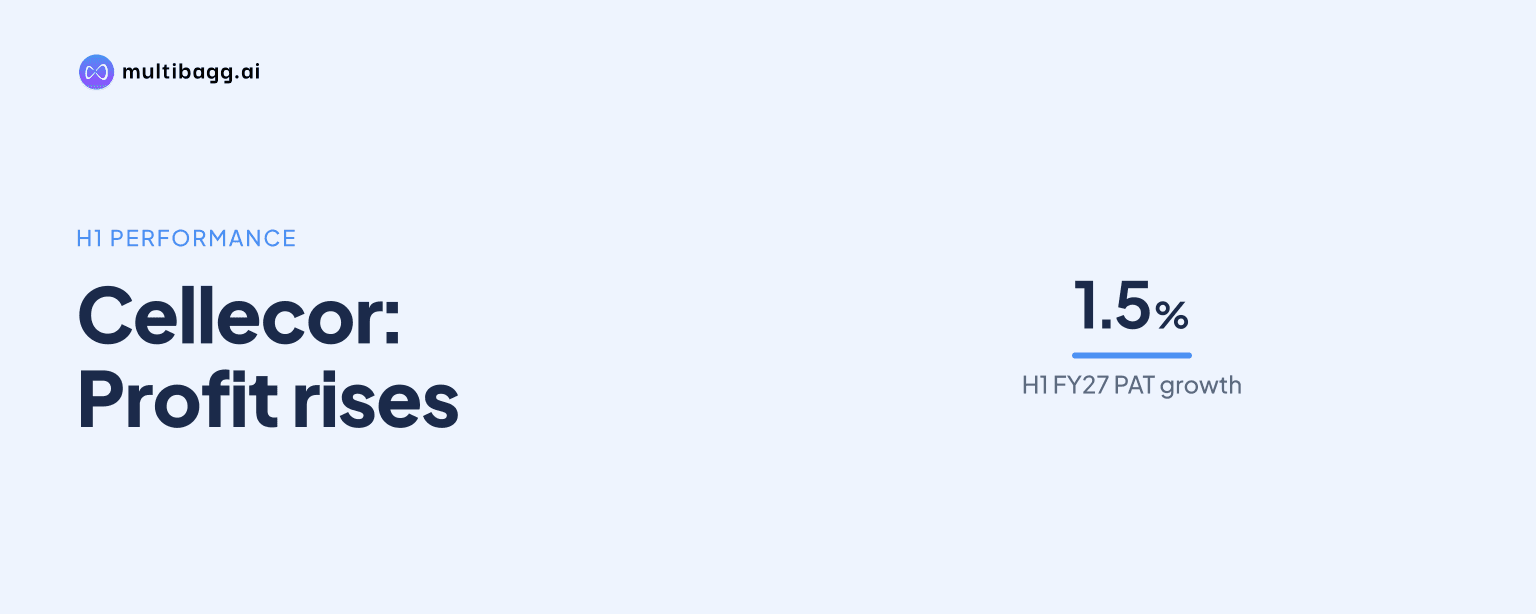
Cellecor Gadgets Limited reported profit after tax of Rs 19.9 crore in H1 FY27, up 1.5% year on year, while net sales rose 16.4% to Rs 746.8 crore; finance costs increased to Rs 14.6 crore from Rs 6.9 crore, and management cited higher marketing investment and input costs as profitability pressures.
Know Cellecor Gadgets inside out
Results, valuation, peers and who's buying, in one view.
How did Cellecor perform in H1 FY27?
Cellecor recorded net sales of Rs 746.8 crore in H1 FY27, compared with Rs 641.5 crore in H1 FY26 and Rs 650.3 crore in H2 FY26. The year-on-year increase was 16.4%, while sales were 14.8% higher than the second half of FY26, making H1 FY27 the highest of the three half-year periods presented.
Earnings before interest, tax, depreciation and amortisation, or EBITDA, rose 22.9% to Rs 41.9 crore from Rs 34.1 crore in H1 FY26. EBITDA margin increased to 5.6% from 5.3% a year earlier, but was below 5.7% in H2 FY26. Gross profit rose 18.5% to Rs 94.0 crore from Rs 79.3 crore, while gross margin was 12.5%, compared with 12.4% in H1 FY26.
Cellecor’s profit after tax, or PAT, was Rs 19.9 crore, compared with Rs 19.6 crore in H1 FY26 and Rs 12.6 crore in H2 FY26. PAT therefore increased by Rs 0.3 crore year on year despite a Rs 7.8 crore increase in EBITDA. PAT margin declined to 2.7% from 3.1% in H1 FY26, while basic earnings per share remained Rs 0.9 in both first-half periods.
Why did Cellecor’s profit rise more slowly than sales?
Cellecor’s finance costs rose to Rs 14.6 crore in H1 FY27 from Rs 6.9 crore in H1 FY26, an increase of Rs 7.7 crore. That movement was close to the Rs 7.8 crore rise in EBITDA over the same period, helping explain why operating-profit growth did not translate into a comparable increase in PAT.
Management said profitability was affected by increased marketing investment across offline and online channels and higher input costs across the electronics industry. It identified rupee depreciation against the dollar, memory-chip shortages, and higher plastic and metal prices as pressures during the preceding nine months. The presentation does not separately quantify marketing expenditure, so its direct effect on reported profit cannot be calculated from the disclosure.
The comparison with H2 FY26 also shows a change in gross profitability. Cost of goods sold rose to Rs 656.3 crore in H1 FY27 from Rs 557.7 crore in H2 FY26, while gross profit increased by Rs 1.4 crore to Rs 94.0 crore. Gross margin fell to 12.5% from 14.2%, while finance costs increased from Rs 10.3 crore and EBITDA rose by Rs 4.8 crore.
Cellecor expanded its range with garment steamers, steam irons, massage guns, tyre inflators and egg boilers alongside Smart TVs, washing machines, refrigerators, air conditioners and audio products. Management also cited the appointment of Kriti Sanon as brand ambassador for the TV and washing-machine categories, two television commercials, and the Gali Gali Cellecor campaign aimed at Tier 2, Tier 3 and emerging markets.
Got a follow-up? Ask IRIS
What changed in Cellecor’s balance sheet and cash flow?
Cellecor’s total assets rose to Rs 1,014.1 crore at September 2026 from Rs 467.8 crore at March 2026. Inventory increased by Rs 118.8 crore to Rs 361.8 crore, trade receivables rose by Rs 50.3 crore to Rs 157.5 crore, and other assets increased to Rs 319.3 crore from Rs 7.5 crore.
Total debt increased to Rs 396.7 crore at September 2026 from Rs 141.8 crore at March 2026. Total liabilities rose to Rs 727.4 crore from Rs 263.1 crore, including trade payables of Rs 251.0 crore versus Rs 91.6 crore. Shareholders’ funds increased to Rs 286.7 crore from Rs 204.7 crore as total assets and total equity and liabilities each expanded by Rs 546.3 crore.
Cellecor generated operating cash flow of Rs 15.20 crore in H1 FY27 after a Rs 118.80 crore increase in inventory and a Rs 50.15 crore change in receivables. The comparison is between a six-month period and FY26, a full-year period. Investments of Rs 291.87 crore, capital expenditure of Rs 0.38 crore and interest of Rs 11.98 crore resulted in free cash flow of Rs (289.03 crore).
Cellecor reported Rs 62.07 crore of capital increase and Rs 223.70 crore in borrowings and others during H1 FY27. Net cash fell to Rs 27.59 crore at the end of the period from opening cash of Rs 30.85 crore. The financial statements are standalone because the company said its subsidiaries had not yet commenced business operations.
What does Cellecor plan after H1 FY27?
Cellecor said it remains hopeful of better performance in the second half of FY27 while widening its product offering. Its stated new or expanded categories include air fryers, multi-cook kettles, nutri blenders, air conditioners and fans, commercial coolers, vacuum cleaners, coffee makers, air purifiers, wardrobe steamers and OTG ovens.
Management’s brand-building framework targets a 20% to 25% improvement in lifetime value, two times social engagement and three times brand recall. These are management targets rather than reported results. The H1 FY27 period included increased marketing investment, while PAT margin was 2.7%, versus 3.1% in H1 FY26.
Cellecor has also set out an international plan focused initially on the United Kingdom and Africa. In January 2026, it incorporated a wholly owned subsidiary in the UK and a step-down subsidiary in Africa. Its manufacturing roadmap refers to capacity alliances with Dixon Technologies, PG Electroplast, Empire Appliances and Winsharp Electronics, as well as automation, digital quality control and in-house research and development for Smart TVs, large appliances and connected devices.
Conclusion
Cellecor increased H1 FY27 sales to Rs 746.8 crore and EBITDA to Rs 41.9 crore, but PAT rose only Rs 0.3 crore year on year to Rs 19.9 crore. Higher finance costs, lower sequential gross margin and management’s stated marketing and input-cost pressures limited the conversion of revenue growth into profit, while inventories, receivables, assets and debt rose sharply.
The next reported period will show whether management’s expectation of better second-half performance is met as Cellecor broadens product categories and pursues its lifetime-value, social-engagement and brand-recall targets. The disclosed UK and Africa expansion plan, along with manufacturing alliances and the H1 FY27 investment outflow of Rs 291.87 crore, will remain relevant to the company’s reported cash and balance-sheet movements.