










Cellecor backs 100,000 touchpoints with real-time inventory
Key highlights
- Cellecor reports more than 100,000 retail touchpoints across 28 states and 2 union territories.
- Cellecor reports more than 1,800 distributors, more than 2,000 service centres and more than 25,000 pin codes covered.
- Cellecor identifies real-time inventory visibility, predictive demand planning and route optimisation as supply-chain mechanisms.
- Cellecor reports 12 warehouses in one disclosure and 14 warehouse locations in another.
powered by IRIS
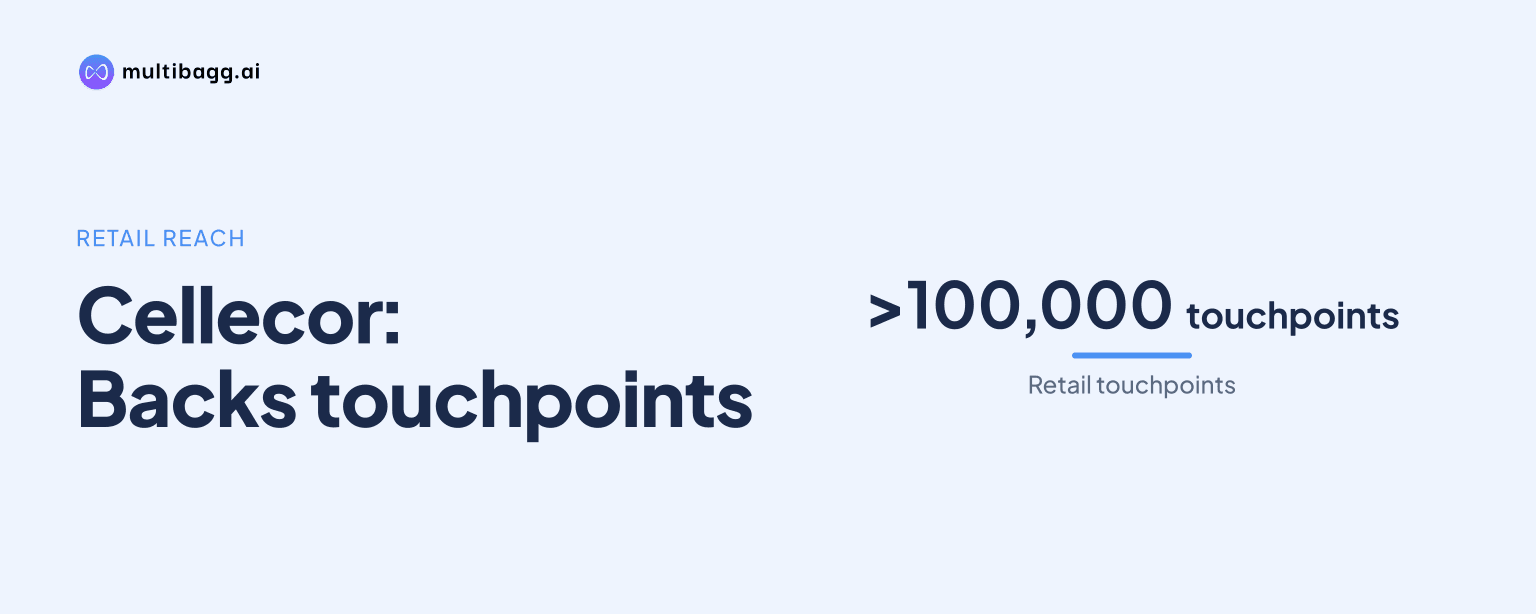
Cellecor supports more than 100,000 retail touchpoints through a network of more than 1,800 distributors, more than 2,000 service centres and real-time inventory visibility. Its presentation also reports coverage of more than 25,000 pin codes across 28 states and 2 union territories, supported by warehouse and logistics arrangements.
Know Cellecor Gadgets inside out
Results, valuation, peers and who's buying, in one view.
How does Cellecor reach more than 100,000 retail touchpoints?
Cellecor reaches more than 100,000 retail touchpoints through more than 1,800 distributors, more than 2,000 service centres and coverage of more than 25,000 pin codes. The presentation describes this physical network as the backbone of national availability for its consumer electronics and home-appliance portfolio.
The network spans 28 states and 2 union territories, or UTs, and includes 8 exclusive Cellecor stores. The presentation lists those stores in Leh Ladakh, Punjab, Delhi, Bihar, Madhya Pradesh, Maharashtra, Mizoram, and Andaman and Nicobar Island, giving the owned-store format a presence across several regions.
Cellecor reports more service centres than distributors, with the service-centre count exceeding the distributor count by at least 200 locations. The presentation does not state whether service centres are owned, franchised or partner-operated, but presents them alongside distributors as part of the infrastructure supporting retail availability.
Which channels complement Cellecor’s distributor network?
Cellecor complements distributors with 8 owned stores, retail partners, digital commerce and corporate and institutional sales. The presentation calls this an omnichannel model because it combines owned, partner-led, digital and business-to-business routes to market.
Retail partnerships include multi-brand outlets and large-format retailers, with the network expanded in FY25-26 across metros, Tier-II and Tier-III cities. Exclusive stores are intended to showcase the full range, while partner outlets extend distribution beyond the 8 direct locations; the presentation does not disclose revenue or sales volumes by either route.
Cellecor lists Amazon, Flipkart, Myntra, Ajio, JioMart and the Open Network for Digital Commerce, or ONDC, under digital commerce. Zepto, Blinkit and Instamart are named as quick-commerce channels, while corporate and institutional sales include enterprise partnerships, bulk product solutions and corporate gifting across electronics and home appliances.
How does Cellecor manage inventory and delivery fulfilment?
Cellecor describes real-time inventory visibility, predictive demand planning, warehouse automation, shipment tracking and route optimisation as the mechanisms supporting nationwide fulfilment. Its operating model moves from inventory planning to warehousing, logistics orchestration and customer fulfilment.
At the inventory-planning stage, Cellecor pairs real-time visibility with predictive demand. The presentation does not provide an inventory-turnover ratio, stock-out rate, forecast-accuracy measure or software-provider name, so it describes the operating mechanism rather than a quantified outcome from the system.
The logistics network includes DTDC, TCI Express, Om Logistics, V-Trans, Safexpress, NBEX, Emirates Logistics India, ST Courier, Jaydeep Logistics, XP India, Express Roadways and DNP Dox N Pack. Cellecor identifies shipment tracking and route optimisation as delivery tools, but does not disclose provider-level volumes, regional assignments, average delivery time or fulfilment cost.
Got a follow-up? Ask IRIS
What does Cellecor disclose about its warehouse network?
Cellecor discloses 12 warehouses on its distribution-and-retail page, but 14 warehouse locations on its supply-chain page. Its operating-model diagram refers again to 12 locations, leaving the difference between the 12- and 14-location figures unresolved in the presentation.
The stated role of the warehouse network is consistent across both disclosures: it connects predictive inventory planning with logistics orchestration and automation. Cellecor does not identify warehouse cities, storage capacity, ownership arrangements, inventory allocation or a schedule for further warehouse additions.
How does the network support Cellecor’s product expansion?
Cellecor presents its retail, distribution, e-commerce and manufacturing ecosystem as a route for scaling new categories including Fire TVs, steam irons, choppers and egg boilers. The same network also supports adjacent models in washing machines, soundbars, party speakers and mixer grinders.
Cellecor uses a white-label manufacturing model in which partner manufacturers produce goods while the company focuses on branding, pricing and distribution. The presentation names suppliers and manufacturers including Zetwerk, Noble, Epack, Dixon and PG Electroplast, and says the model provides flexibility to scale volumes with market demand without disclosing manufacturing capital expenditure.
Conclusion
Cellecor’s distribution model combines more than 100,000 retail touchpoints with more than 1,800 distributors, more than 2,000 service centres and more than 25,000 pin codes. Real-time inventory visibility, predictive demand planning, warehouse automation and a multi-provider logistics network are the mechanisms it identifies for linking this reach to fulfilment across 28 states and 2 UTs.
The next disclosure to watch is a reconciliation of the 12 warehouses and 14 warehouse locations reported in different parts of the presentation. Cellecor also reports retail-partnership expansion in FY25-26 and plans to use its existing network for categories such as Fire TVs, steam irons, choppers and egg boilers, but does not provide category-level sales or delivery-performance metrics.