










Cemindia expects data-centre MEP revenue traction in Q4
Key highlights
- Cemindia expects data-centre MEP revenue traction in Q4 as electromechanical scope accounts for about 80% of project value.
- Cemindia has Rs 5,000 crore to Rs 6,000 crore of data-centre work in hand across six active data centres.
- Management said Cemindia should not expect data-centre project margins to exceed 10%.
- Group entities account for roughly 53%-54% of Cemindia's order book, versus 35%-36% of current-year revenue.
powered by IRIS
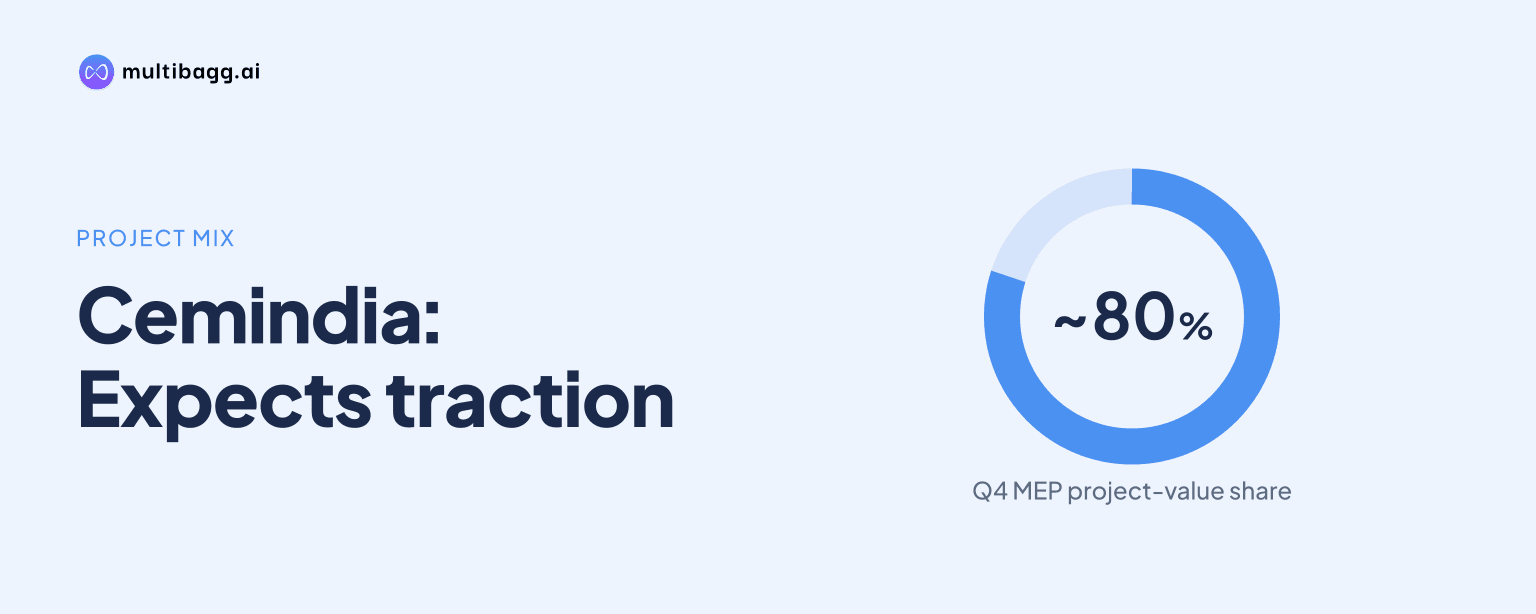
Cemindia expects data-centre mechanical, electrical and plumbing (MEP) revenue traction in Q4 from Rs 5,000 crore to Rs 6,000 crore of work in hand, as electromechanical packages worth about 80% of project value move toward installation. Management said the first projects should begin equipment erection in January or February of the next year.
Know Cemindia Projects inside out
Results, valuation, peers and who's buying, in one view.
When will Cemindia's data-centre MEP revenue begin?
Cemindia expects MEP revenue traction from data centres in Q4, with management saying the first projects should begin equipment erection in January or February of the next year. The trigger is the arrival, erection and placement of supplies, rather than the earlier civil-construction phase. Management said the MEP portion forms roughly 80% of a data-centre project by value, compared with 20% for civil work.
The timing remains linked to the speed of execution on the electromechanical package. Cemindia said vendors for the first two data centres were almost finalised and orders had been placed, but it did not quantify the value already executed. Management described the civil phase as typically taking about 24 months before electromechanical work starts, which places more project value in the later stage.
Cemindia's Q4 expectation concerns conversion of existing projects into revenue rather than a newly announced data-centre award. Management said a large revenue contribution should emerge once supplies reach sites and are erected. The January-February schedule is management's indicated execution plan, not a reported completion milestone.
How large is Cemindia's data-centre workload and construction footprint?
Cemindia has Rs 5,000 crore to Rs 6,000 crore of data-centre work in hand across projects at different stages. Management said it was working on six data centres, including two in Vizag and four at another location not identified in the call. It also said work had just started on a few further projects in Gujarat, extending the disclosed footprint beyond the initial six sites.
At the first and second data centres, civil structures had progressed well, according to management. It illustrated this with a 10-storey building where precast construction had reached almost the eighth storey. That civil progress contrasts with the larger MEP package, which was moving through vendor finalisation, ordering and the planned installation phase.
Cemindia did not provide site-by-site contract values, completion percentages or execution periods for the Rs 5,000 crore to Rs 6,000 crore workload. Management instead said data centres were at different stages, limiting a precise estimate of segment revenue in any individual quarter. The disclosed 20%-80% split between civil and MEP scope explains why the later installation phase could change the revenue mix.
Got a follow-up? Ask IRIS
What margin does Cemindia expect from data-centre work?
Cemindia does not expect data-centre margins to exceed 10%, because management characterised the segment as work that is not specialised. Management placed margins across its wider business in an 8%-13% range depending on the segment, and said underground and marine work provides better margins than data-centre projects. The 10% comment is a management expectation for the segment, not a reported data-centre profitability figure.
For the full year, management maintained guidance for an average margin of more than 10%. An analyst cited a first-quarter margin of 9.7% excluding other income and asked whether a 10.5% full-year result was achievable; management reiterated its guidance of more than 10% rather than adopting the analyst's 10.5% figure. It cited delayed certifications and delays in starting execution as factors that can affect reported margins.
Management also said several recently secured jobs had not reached the threshold required to declare margin, including Vadhavan Port and projects at Morsagar, Munger, K-RIDE, Delhi Metro Rail Corporation and Pune. It expects those jobs to convert to margin after one or two quarters. That portfolio-wide timing issue does not establish that data-centre MEP work will earn above the segment margin ceiling management indicated.
How do data centres fit into Cemindia's order book and growth plan?
Cemindia said group entities accounted for roughly 53%-54% of its total order book, while group-sourced revenue represented about 35%-36% in the current year. The order-book share was therefore higher than the revenue share, and management said revenue composition should gradually move toward the order-book mix. Data centres are part of this group-linked opportunity set, including an approximately Rs 1,000 crore Andhra Pradesh award received from a group company in the prior quarter.
The company said group work accounted for more than 70% of order inflow over the latest two or three quarters, compared with the 53%-54% group share in the overall order book. Cemindia also reported Rs 32,000 crore of total work in hand, versus a normal level of about Rs 20,000 crore to Rs 21,000 crore, and said it had secured around Rs 15,000 crore of jobs in the first two quarters. The data-centre workload is a separately identified part of that wider order base.
Management maintained its 20%-25% revenue-growth guidance and said its Rs 25,000 crore annual order-inflow target would be achieved and could be exceeded. It did not disclose a separate data-centre order-inflow target or a forecast for the segment's revenue contribution. While management said opportunities existed in Vizag and Gujarat and that it was pursuing further group projects, those potential projects were not quantified as future orders.
Conclusion
Cemindia's disclosed data-centre opportunity is concentrated in the transition from civil construction to the larger MEP package, which accounts for about 80% of project value versus 20% for civil work. The Rs 5,000 crore to Rs 6,000 crore workload gives the company a defined base for that transition, although management expects segment margins to remain at no more than 10%.
The next point to watch is whether the January-February equipment-erection plan produces the Q4 MEP revenue traction management anticipates. Further disclosures on new group-linked data-centre orders, delivery of electromechanical supplies and movement of group revenue toward the 53%-54% order-book share will indicate how quickly the segment is scaling.