










Cemindia links up to Rs 1,500 crore TBM capex to FY28
Key highlights
- Cemindia indicated normal additional capital expenditure of Rs 150 crore to Rs 200 crore after spending Rs 150 crore in H1.
- A secured larger tunnel project could lift Cemindia's TBM capital expenditure by up to Rs 1,500 crore in FY28.
- Management expects larger TBMs to require at least 14 to 16 months for deployment, with scale-up after about 24 months.
- Cemindia said it has at least four additional large tunnel opportunities in its pipeline.
powered by IRIS
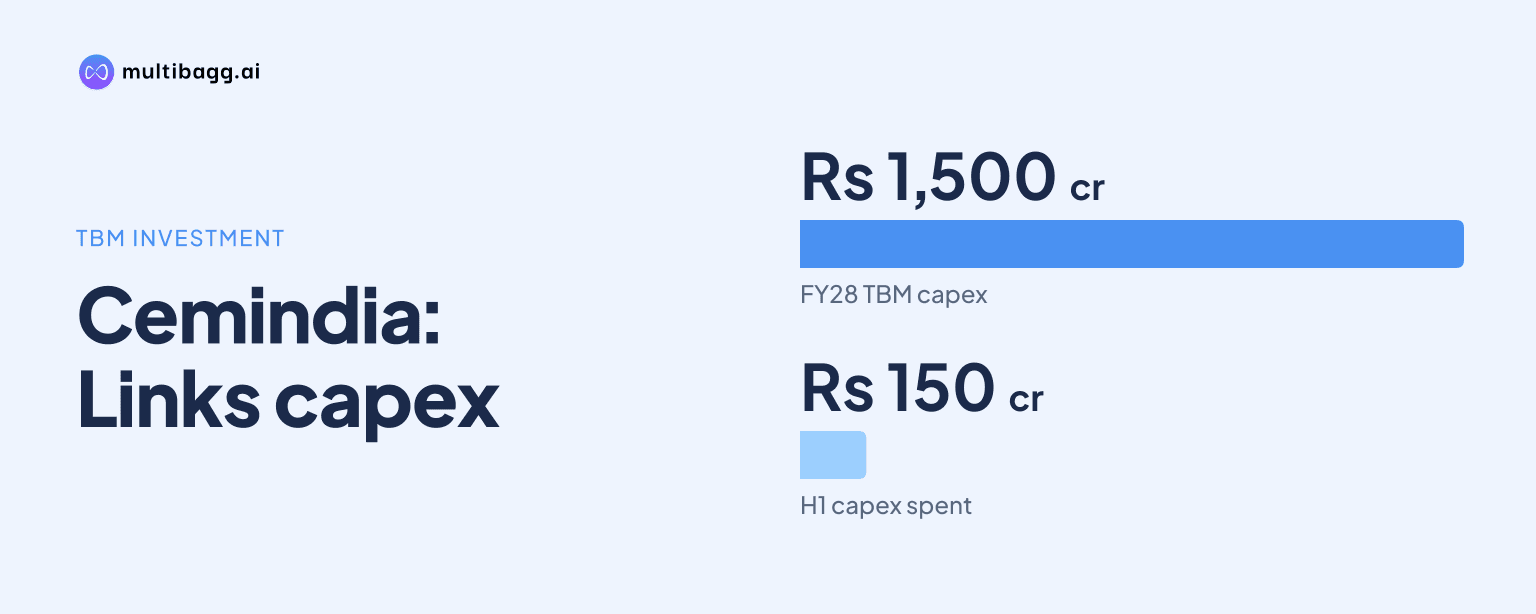
Cemindia said in its earnings call that a qualifying large tunnel contract could trigger up to Rs 1,500 crore of tunnel-boring-machine, or TBM, capital expenditure in FY28, despite potential short-term return-on-equity pressure. Management expects larger machines to contribute to revenue and profit only after deployment and a scale-up period of about 24 months.
Know Cemindia Projects inside out
Results, valuation, peers and who's buying, in one view.
What tunnel-boring-machine spending is Cemindia considering?
Cemindia is considering normal additional capital expenditure of Rs 150 crore to Rs 200 crore, with a further outlay of up to Rs 1,500 crore possible if it wins a job requiring larger-diameter tunnel-boring machines, or TBMs. Management said the larger spending case was not a committed base-case programme: it depended on securing a major project whose technical requirements call for those machines.
The immediate run rate is materially smaller than the contingent larger-machine plan. Cemindia had spent Rs 150 crore in the first half, and management indicated another Rs 150 crore to Rs 200 crore as the normal balance for the year. The possible Rs 1,500 crore TBM commitment would therefore represent a separate, project-linked step-up rather than routine annual equipment expenditure.
Management linked the potential investment to Cemindia's pursuit of larger contracts. It said the company had progressed from projects of Rs 20 crore to Rs 40 crore, then Rs 1,000 crore, towards opportunities worth Rs 3,000 crore, Rs 4,000 crore or more. Management said Cemindia is targeting these contracts because it can execute them and qualifies to bid for them.
When would Cemindia's larger TBMs affect revenue and ROE?
Cemindia expects the larger TBMs to be deployed in FY28, but management said the machines require at least 14 to 16 months for deployment and described the revenue and profit scale-up as occurring after about 24 months. This creates a timing gap between the capital commitment and the point at which equipment can add to the top line and bottom line.
Management explicitly acknowledged the near-term return-on-equity, or ROE, trade-off. An analyst estimated that ROE could fall to 17% in FY28 from 28% in FY26 even if revenue reached Rs 15,000 crore; management did not endorse those estimates. It said ROE may fall somewhat in the short term because the investment is intended to address a longer-term opportunity.
The intended mechanism is higher machine-led capacity after the TBMs become operational. Management said the larger machines should support both revenue and profit after deployment, rather than generate an immediate return. Its view was that short-term ROE pressure must be considered against the longer-term effect of executing larger underground contracts.
That timetable differs from Cemindia's current revenue outlook. Management maintained revenue-growth guidance of 20% to 25% and said it looked to sustain a 25% compound annual growth rate, or CAGR, in revenue for at least the next three years. It did not raise the current-year outlook, saying existing work in hand and expected new work should have a greater effect next year.
Got a follow-up? Ask IRIS
Does Cemindia have enough tunnel opportunities to justify the capex?
Cemindia said it sees multiple potential uses for large TBMs rather than relying on one Bengaluru project. Management referred to at least four other tunnel jobs in the pipeline besides that opportunity and said there were likely chances of securing at least one. However, it also said no opened tender had placed Cemindia in the lowest-bidder, or L1, position at that time.
The company did not say that any particular tunnel project had been awarded. Management said the group could receive the project discussed by an analyst, but Cemindia's potential role would depend on the group first winning it. It added that China would not prevent TBM procurement because Cemindia was pursuing equipment from other countries.
The tunnel opportunity set sits within a broader order strategy. Cemindia reported about Rs 2,500 crore of new orders in October, while group entities represented roughly 53% to 54% of its total order book. Management said more than 70% of order inflow in the preceding two or three quarters had come from group business.
Group affiliation does not guarantee contract allocation, according to management. It said contracts proceed through competitive bidding and Cemindia must be L1 to win, rather than receiving an automatic right to match another bidder's price. Management estimated potential business of about Rs 50,000 crore from the group's planned annual capital expenditure of Rs 2 lakh crore over the next five years.
How would Cemindia fund and execute the larger-equipment plan?
Cemindia said it would make funding decisions based on progress and conversion of opportunities in its pipeline, rather than treat an enabling approval of Rs 5,000 crore as certain equity dilution. Management said its balance sheet has scope for leverage at the level it considers appropriate to fund future growth pipelines.
The company also referred to its Rs 1,400 crore qualified institutional placement, or QIP, completed in October 2026, when discussing expansion funding. Management said the proceeds would be used prudently for the company’s benefit, but did not allocate a specific portion of the QIP to TBMs or disclose a fixed debt-equity mix for the potential Rs 1,500 crore programme.
Execution capacity is another condition for the strategy. Management contrasted a Rs 1,500 crore building project, which it said could require 2,500 workers, with a Rs 1,500 crore underground metro project requiring about 500 workers. It said Cemindia consciously seeks to avoid labour-intensive work where possible and instead pursue more mechanised jobs and technology-led execution.
The strategy also requires organisational capacity beyond machinery. Management said expanding from four or five divisions to seven or eight divisions could support more revenue if those units have capable leaders. It identified leadership development as a parallel focus as Cemindia targets Rs 3,000 crore to Rs 4,000 crore-plus projects while maintaining 20% to 25% revenue-growth guidance.
Conclusion
Cemindia's potential TBM expenditure is a conditional capacity investment rather than a confirmed Rs 1,500 crore purchase programme. The company is prepared to accept a period of lower reported ROE if larger machines enable it to execute bigger underground contracts, although management expects commercial benefits only after deployment and a roughly 24-month scale-up period.
The next items to watch are whether Cemindia converts any of the at least four additional tunnel opportunities it identified, the timing of FY28 TBM deployment, and its funding choice between leverage and any future equity action. Management also maintained 20% to 25% revenue-growth guidance and said current work in hand should have a greater effect next year than in the current year.