










Century Plyboards sets 1x leverage limit for large capex
Key highlights
- Century reported total net debt-to-EBITDA of 2.4x in the September quarter.
- Century will not pursue large capex while long-term debt-to-EBITDA is above 1x.
- H1 revenue rose to Rs 3,300 crore from Rs 2,500 crore a year earlier.
- Management expects EBITDA of close to Rs 900 crore in the current year and intends to direct most profit to debt repayment.
powered by IRIS
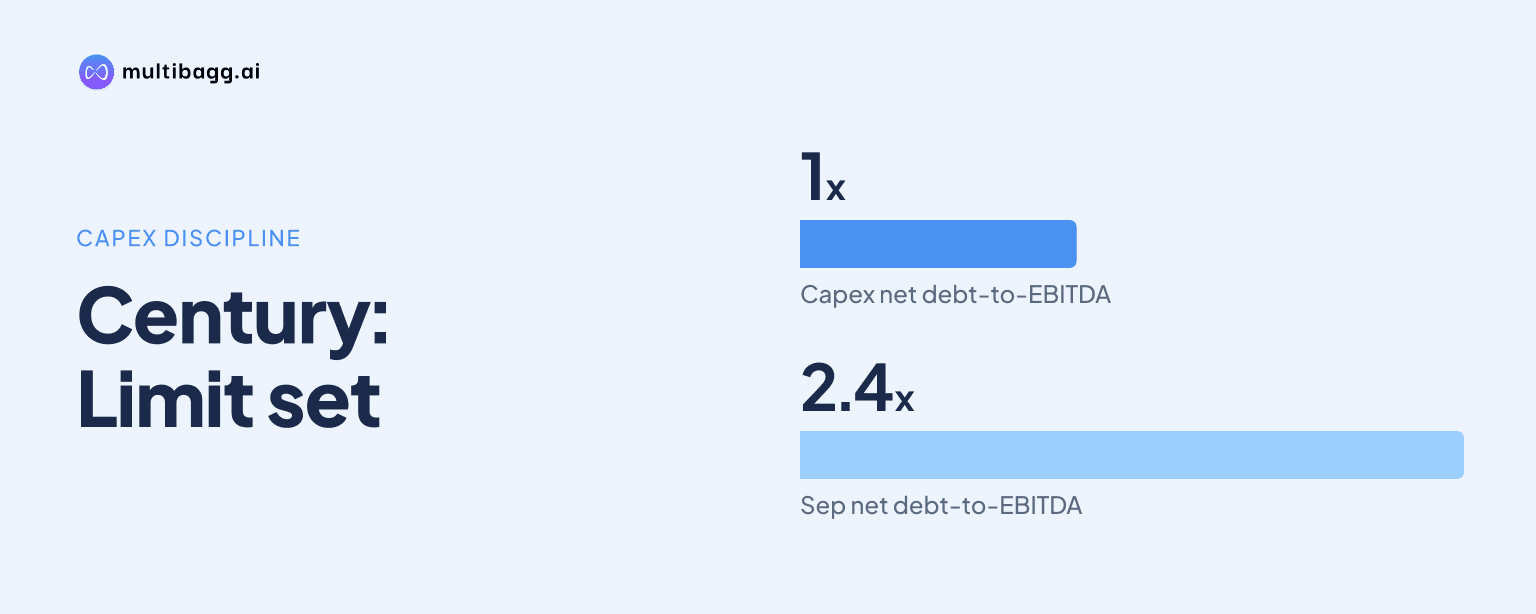
Century Plyboards said it will not pursue large capital-expenditure projects while long-term debt-to-EBITDA exceeds 1x, after total net debt-to-EBITDA reached 2.4x in the September quarter. Management attributed the higher debt to recent capex and an Rs 800 crore year-on-year increase in H1 revenue to Rs 3,300 crore.
Know Century Plyboards (India) inside out
Results, valuation, peers and who's buying, in one view.
Why is Century limiting large capex?
Century is limiting large capex because management considers debt elevated following investment and faster working-capital needs. Management said the business typically operates with a 60-day working-capital cycle, while H1 revenue increased to Rs 3,300 crore from Rs 2,500 crore a year earlier. The Rs 800 crore rise in revenue required additional funding for operating assets as well as the capex already undertaken.
The stated threshold applies to long-term debt-to-EBITDA, rather than total net debt-to-EBITDA. EBITDA means earnings before interest, tax, depreciation and amortisation. Keshav Bhajanka said Century's long-term debt-to-EBITDA target has always been 1:1 and that it would not pursue a large capex project when this ratio exceeds 1x.
Management distinguished that target from total net debt because the latter can move with the growth rate and resulting working-capital requirement. In response to a question on the September-quarter total net debt-to-EBITDA ratio of 2.4x, Bhajanka said a company growing at 30% would naturally need working capital. Century therefore targets its long-term debt position, rather than setting a disclosed ceiling for total net debt.
When does Century expect debt to decline?
Century expects debt to decline from next year, with management saying debt has peaked and that it intends to direct the maximum amount of profit generated towards repayment. Bhajanka said Century was looking at close to Rs 900 crore of EBITDA in the current year. He said the absence of further large capex, other than planned plywood capacity in Uttar Pradesh, should leave a substantial share of cash generation available for debt reduction.
Management also expects future working-capital requirements to be less substantial and funded through internal generation. This expectation follows the unusually rapid H1 revenue increase from Rs 2,500 crore to Rs 3,300 crore. Century did not disclose an absolute debt target, a target for total net debt-to-EBITDA, or a date for reaching a specified total-debt level.
The specific management target is for long-term debt-to-EBITDA to be well below 1x next year. That target is more restrictive than a general expectation of lower debt because it is the metric Century says will govern large projects. The September-quarter 2.4x figure cited by the analyst was total net debt-to-EBITDA, so it should not be treated as the company's capex approval threshold.
Which expansion projects can Century still undertake?
Century can continue selected plywood additions despite its restriction on large capex. Its Hoshiarpur plywood plant was officially commissioned from November 2 after an October launch, and management said the facility was at 100% capacity utilisation. Century also plans to bring its Sainik MR range in-house next year, expand within existing plants and further expand Hoshiarpur next year.
The first Uttar Pradesh phase is planned as a plywood facility with annual capacity of about 108,000 cubic metres. Land acquisition was under way, and management said work would start once Century has the land. These projects explain why management said its displayed capex requirement had increased, even as it set a condition for any larger new project.
The proposed Uttar Pradesh medium-density fibreboard, or MDF, plant is less certain. Century had previously discussed a 330,000-cubic-metre MDF project for commissioning in Q2 FY29, but management said it now has no firm commissioning date. It said the first Uttar Pradesh phase would be plywood, with an MDF decision to be made as conditions develop.
Got a follow-up? Ask IRIS
How do MDF conditions shape Century's capex decisions?
Century's cautious position on MDF reflects substantial industry supply additions. Management said more than 30% of industry capacity would be added over the three months before the call and the following nine months. It described that period as the last large-scale addition currently visible, but did not say that excess capacity had already been absorbed.
Management expects a substantial MDF margin recovery from FY29, with a trajectory back towards 20%. It said FY28 should be better than the current year, without quantifying the extent of improvement. For the nearer term, Century said it was targeting about 10% MDF margins in the second half, rather than double-digit margins for the full year.
Century is seeking to improve MDF and particle-board profitability through a higher-value product mix, cost efficiency and fuel and energy measures. Management said renewable energy could offer a meaningful saving but did not quantify the potential benefit. It also said particle-board utilisation was below 70%, rejecting the 80% to 85% utilisation level suggested by an analyst.
Particle board provides capacity headroom without a new major plant, according to Century. Existing particle-board capacity of about 240,000 cubic metres annually can produce about Rs 600 crore of revenue at current pricing, management said. Efficiency improvements could lift capacity to about 300,000 cubic metres, while pre-laminated board has grown faster than plain particle board.
What should readers watch in Century's balance-sheet plan?
The main measure to watch is whether Century can move long-term debt-to-EBITDA below 1x next year while reducing debt from the September-quarter position. Management expects close to Rs 900 crore of EBITDA in the current year and said most of the resulting profit would go toward repayment. The outcome will also depend on whether working-capital needs remain manageable after H1 revenue rose by Rs 800 crore year on year.
Investors can also track progress on Uttar Pradesh land acquisition and the planned 108,000-cubic-metre plywood phase. Century has no firm commissioning date for the 330,000-cubic-metre MDF project previously indicated for Q2 FY29. Management said MDF and particle-board capacity should not constrain growth until FY29, giving it time to assess the balance sheet and return ratios before committing to another large MDF plant.
Conclusion
Century has set a defined capital-allocation condition: large capex will wait until long-term debt-to-EBITDA is at or below 1x. The policy follows a September-quarter total net debt-to-EBITDA ratio of 2.4x and an Rs 800 crore increase in H1 revenue, which management said raised working-capital funding needs alongside recent capex.
The next disclosures to watch are progress toward management's expectation of long-term debt-to-EBITDA well below 1x next year, use of close to Rs 900 crore of current-year EBITDA for repayment, and Uttar Pradesh plywood expansion. The timing of the 330,000-cubic-metre MDF project remains unresolved, while management expects a more substantial MDF-margin recovery from FY29.