










Century Plyboards defers MDF plant amid capacity glut
Key highlights
- Century Plyboards has no firm commissioning date for its Uttar Pradesh MDF plant.
- Management estimates more than 30% MDF industry capacity addition over roughly 12 months.
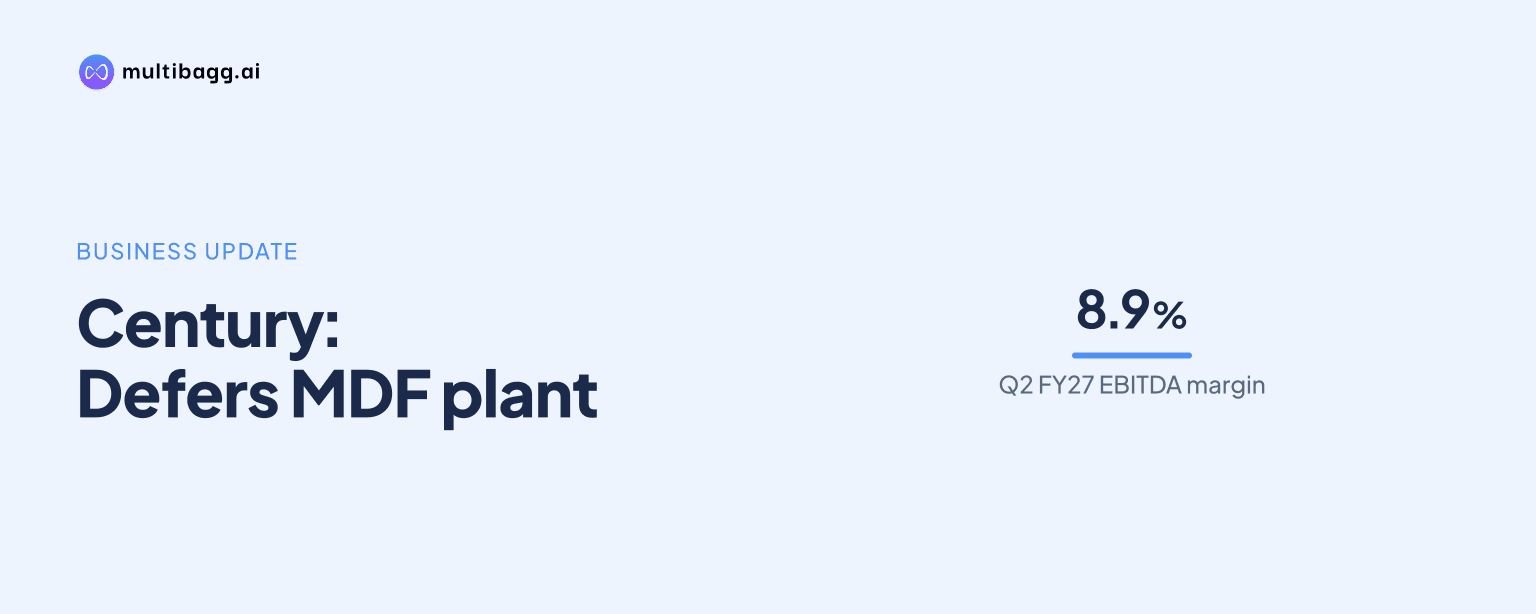
- Century Plyboards targets a double-digit MDF EBITDA margin in H2 FY27 after reporting 8.9% in Q2 FY27.
- The first Uttar Pradesh phase is planned as plywood capacity of about 108,000 cubic metres annually.
powered by IRIS
Century Plyboards India Limited has no firm commissioning date for its Uttar Pradesh MDF plant, replacing the earlier Q2 FY29 timetable cited by an analyst, as management expects more than 30% industry capacity additions over roughly 12 months and does not foresee substantial MDF margin recovery before FY29.
Know Century Plyboards (India) inside out
Results, valuation, peers and who's buying, in one view.
Why has Century Plyboards deferred its Uttar Pradesh MDF plant?
Century Plyboards has deferred a firm MDF commissioning schedule because management will decide on the plant as market conditions develop. On the November 5, 2026 Q2 FY27 earnings call, Executive Director Keshav Bhajanka said land acquisition was under way and the company expected to receive the land soon, but stated that there was “no firm date” for MDF commissioning.
The first Uttar Pradesh phase will instead be a plywood facility with annual capacity of about 108,000 cubic metres. An analyst referred to the previously announced MDF proposal as a 330,000-cubic-metre project due for commissioning in Q2 FY29, but management neither confirmed that timing nor provided a revised date, capital-expenditure amount or capacity plan for the MDF facility.
The land process itself remains active. Century Plyboards said it had received a letter of allotment from the Government of Uttar Pradesh for the proposed state project, while its plywood expansion elsewhere is progressing: the 60,000-cubic-metre-a-year Hoshiarpur greenfield plant commenced operations in Q3 FY27, and expanded output at Guwahati and Kandla is expected from July 2027.
How much MDF capacity is entering the market?
Management estimates that more than 30% of MDF industry capacity is being added over the three months before the call and the following nine months. Bhajanka specifically cited new capacity from Action and Elixrr, describing the current cycle as the last large-scale addition presently visible, with no further concrete additions fixed after it.
Century Plyboards described the sector as being in a typical overcapacity situation, in which surplus supply must be absorbed before margins can return toward the earlier 20% range. Management expects the next two quarters to involve consolidation, followed by gradual margin recovery in the next financial year. This was management’s market assessment, rather than a formal earnings forecast.
The deferred MDF decision fits management’s stated emphasis on using existing assets rather than expanding aggressively. Century Plyboards said most recent capacity additions are now operational and its focus is on raising utilisation, asset productivity and returns. That approach leaves the company able to complete the Uttar Pradesh plywood phase without committing to a new MDF line during the supply increase.
What is Century Plyboards targeting for MDF margins and growth?
Century Plyboards is targeting a double-digit MDF earnings before interest, tax, depreciation and amortisation, or EBITDA, margin in H2 FY27, not for FY27 as a whole. Management made that distinction after an analyst estimated the H1 MDF EBITDA margin at roughly 8%. Q2 FY27 MDF EBITDA margin, excluding foreign-exchange losses, was 8.9% and improved sequentially.
MDF revenue rose 13.6% sequentially and 10.5% year on year in Q2 FY27. Management attributed the more moderate growth rate partly to a high prior-year base and maintained its expectation of 17% to 18% MDF growth for the full year, including H2. It said it would not seek growth aggressively at the cost of margins while raw-material costs remain under pressure.
Management’s margin outlook has three stages. It aims for double-digit margin in H2 FY27, expects FY28 to be better but did not quantify the improvement, and expects a substantial recovery from FY29 onward. Bhajanka said FY29 should bring a trajectory back toward the prior 20% margin range once the current capacity addition is absorbed.
Got a follow-up? Ask IRIS
What could lift Century Plyboards MDF profitability?
Century Plyboards expects value-added products and cost measures, rather than utilisation alone, to support MDF profitability. Management said it is focusing on higher-value MDF products and expects to unlock further growth in high-end offerings. It also identified fuel and energy efficiency as areas where some measures are already used and others are under way.
Renewable energy is one possible cost lever, according to management, which said green energy has become more sustainable and cost-efficient. However, Century Plyboards did not disclose a renewable-energy project, expected savings, a timing plan or a pricing forecast. The call therefore supports a cost-reduction effort but not a numerical estimate of its financial effect.
Particle board provides a contrast in operating conditions. Its Q2 FY27 revenue crossed Rs 100 crore for the first time, rising 16.8% sequentially and 211% year on year, while EBITDA margin excluding foreign-exchange losses increased to 7.4% from 3.7% in the preceding quarter. Management said particle-board utilisation remained below 70%, and that pre-laminated board grew faster than plain particle board.
How does capital discipline affect Century Plyboards expansion?
Century Plyboards said it will consider large capital expenditure only after meeting its long-term debt-to-EBITDA target of 1:1. Management said debt was elevated because of recent capital expenditure and working-capital needs associated with a 60-day cycle. H1 revenue rose to Rs 3,300 crore from Rs 2,500 crore a year earlier, increasing the funding requirement for working capital.
Management expects long-term debt to EBITDA to be well below 1:1 in the next financial year and expects future working-capital needs to be funded through internal generation. It clarified that the target applies to long-term debt, while total net debt can be affected by the pace of revenue growth. This policy places balance-sheet targets alongside the market outlook in assessing major MDF investment.
The company’s other segments reported different Q2 FY27 conditions. Plywood revenue grew 28.6% year on year and 14% sequentially, with a 15.7% EBITDA margin, while laminate revenue increased 20.6% year on year and its margin improved to 11.6%. Those results contrast with MDF, where management is pursuing 17% to 18% growth while managing sector-wide oversupply.
Conclusion
Century Plyboards has made the Uttar Pradesh MDF project conditional rather than scheduled. Land acquisition continues and the 108,000-cubic-metre annual plywood phase is planned first, but management has removed the firm commissioning commitment for MDF amid a more than 30% industry capacity addition cycle and a slower expected margin recovery.
Investors should watch whether Century Plyboards reaches its stated double-digit MDF EBITDA margin in H2 FY27, how the industry supply addition affects the next two quarters, and whether management sets a new MDF decision date after securing Uttar Pradesh land. Management’s FY29 margin-recovery expectation and its 1:1 long-term debt-to-EBITDA target remain the disclosed benchmarks for that decision.