










Chambal Fertilisers Reports ₹69,995 Million Q2 Income, Up 9%
Key highlights
- Chambal Fertilisers reported Q2 FY27 operational income of ₹69,995 million, up 9% year on year.
- Consolidated EBITDA rose 7% to ₹9,009 million, while EBITDA margin declined to 12.87%.
- Consolidated PAT fell 3% to ₹6,319 million, while standalone PAT rose 6% to ₹6,350 million.
- Q2 FY27 urea production was 9.13 lakh metric tonnes, compared with 8.81 lakh metric tonnes a year earlier.
powered by IRIS
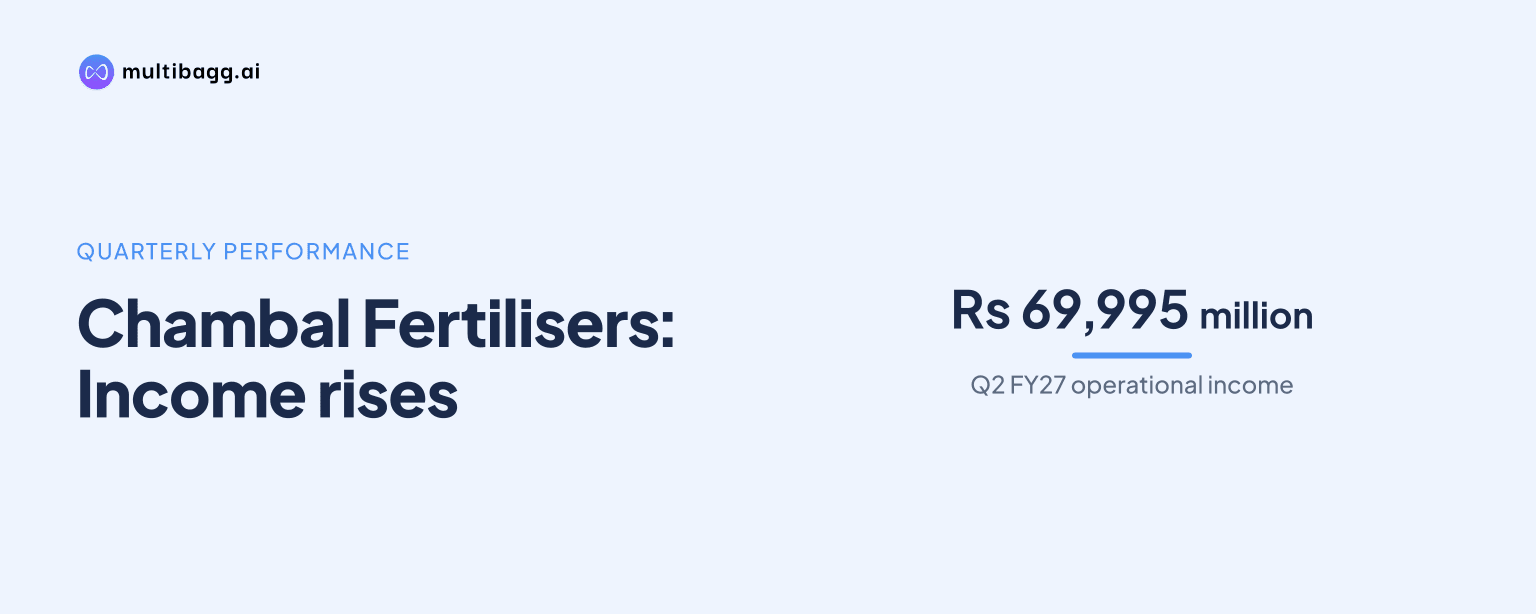
Chambal Fertilisers and Chemicals Limited reported Q2 FY27 operational income of ₹69,995 million, a 9% increase from ₹64,128 million a year earlier, while consolidated EBITDA margin was 12.87%. The quarter showed higher operating income and urea production, but lower profitability margins and a 3% decline in consolidated profit after tax.
Know Chambal Fertilisers & Chemicals inside out
Results, valuation, peers and who's buying, in one view.
What did Chambal Fertilisers report for Q2 FY27?
Chambal Fertilisers reported operational income of ₹69,995 million for Q2 FY27, compared with ₹64,128 million in Q2 FY26. The investor presentation describes this measure for standalone and consolidated operations. The reported year-on-year increase was 9%.
The company reported consolidated EBITDA of ₹9,009 million, up 7% from the corresponding quarter of the prior year. Consolidated profit after tax was ₹6,319 million, down 3% year on year. On a standalone basis, profit after tax was ₹6,350 million, up 6% year on year.
The presentation is the principal source for the quarter's figures because Chambal Fertilisers had not published an earnings-call transcript for Q2 FY27 at the time of the material. The company had scheduled an analyst and investor call on November 4, 2026, to discuss financial results for the quarter and six months ended September 30, 2026. The call time was rescheduled to 9:45 am IST from 11:00 am IST.
How did Chambal Fertilisers' margins change in the quarter?
Chambal Fertilisers' consolidated EBITDA margin declined to 12.87% in Q2 FY27, reported as 2% lower year on year. This indicates that EBITDA grew more slowly than operational income during the quarter, despite the 7% increase in the absolute EBITDA amount.
The pressure was also visible at the net-profit level. Consolidated PAT margin was 9.03%, reported as down 11% year on year, while consolidated PAT fell 3% to ₹6,319 million. The difference between the increase in standalone PAT and the decline in consolidated PAT is reflected in the separate results reported for the two reporting bases.
The presentation highlighted a stronger performance in the seeds segment, where revenue grew 32% year on year and margin improved 69% year on year. It also reported sales EBIT of ₹785 million for complex fertilisers and ₹870 million for the CPC, SN and seeds businesses. These figures identify the segment-level operating contributions disclosed in the presentation but do not provide a complete segment revenue split for the quarter.
Got a follow-up? Ask IRIS
What were the key operating trends for Chambal Fertilisers?
Chambal Fertilisers produced 9.13 lakh metric tonnes of urea in Q2 FY27, compared with 8.81 lakh metric tonnes in Q2 FY26. The increase in production was 0.32 lakh metric tonnes, supporting the reported growth in operational income.
Urea sales were 8.90 lakh metric tonnes, compared with 9.09 lakh metric tonnes a year earlier. Therefore, urea production increased while sales volume was lower than the prior-year quarter. The presentation did not provide an explanation for the difference between production and sales volumes.
For complex fertilisers, the presentation listed H1 FY27 volumes of 0.67 lakh metric tonnes for DAP/TSP, 0.76 lakh metric tonnes for MOP and 4.13 lakh metric tonnes for NPK. It did not provide a complete set of Q2-only figures for these categories. This limits direct quarterly comparisons across the full traded fertiliser portfolio.
Chambal Fertilisers describes itself as India's largest private-sector urea manufacturer, with 3.4 million metric tonnes per annum of capacity. Its investor material also refers to activities in crop protection chemicals, biologicals, seeds and industrial chemicals, making the company’s performance relevant beyond its core manufactured-fertiliser operations.
What does the Q2 update mean for investors and operations?
The Q2 FY27 update shows that Chambal Fertilisers increased operational income and EBITDA, but that margin and consolidated PAT trends were weaker. For investors, the key reported figures are the 9% growth in operational income, the 12.87% EBITDA margin and the 3% decline in consolidated PAT.
For agricultural customers and distribution operations, urea availability is also relevant. Higher urea production during the quarter came alongside lower reported urea sales. The presentation does not disclose customer-level effects, regional supply issues or changes in demand conditions, so no conclusion on these factors can be drawn from the available material.
The company did not provide explicit revenue, volume or margin guidance in the Q2 FY27 presentation. It also did not disclose a current-quarter capital expenditure figure. Earlier investor material stated that ₹11,836 million had been invested in the technical ammonium nitrate, or TAN, project through Q3 FY26, but this is historical project information rather than Q2 FY27 capex.
The absence of formal forecasts means that the presentation should be read as a record of reported quarterly performance rather than management guidance. Further detail may emerge through subsequent company disclosures or the scheduled investor interaction, but no such additional claims are included in the Q2 presentation data.
Conclusion
Chambal Fertilisers delivered 9% year-on-year growth in Q2 FY27 operational income to ₹69,995 million and increased EBITDA by 7% to ₹9,009 million. However, consolidated EBITDA margin declined to 12.87%, consolidated PAT margin was 9.03%, and consolidated PAT fell 3%, showing that higher income did not translate into stronger consolidated profitability.
Investors will watch for management commentary from the November 4, 2026 analyst and investor call, including any clarification on margin movement, the gap between urea production and sales, and progress on the TAN project. The Q2 presentation itself offers no explicit financial or volume guidance for the periods ahead.