










Chandan Healthcare H1 FY27 PAT rises 257% to ₹25.37 crore
Key highlights
- Chandan Healthcare reported H1 FY27 PAT of ₹25.37 crore, up 257% year on year.
- H1 FY27 EBITDA increased 67%, according to the results update.
- The board disclosed a ₹10.23 crore exceptional item in H1 FY27.
- Q2 FY27 standalone PAT was ₹18.61 crore, including a ₹10.23 crore one-time gain.
powered by IRIS
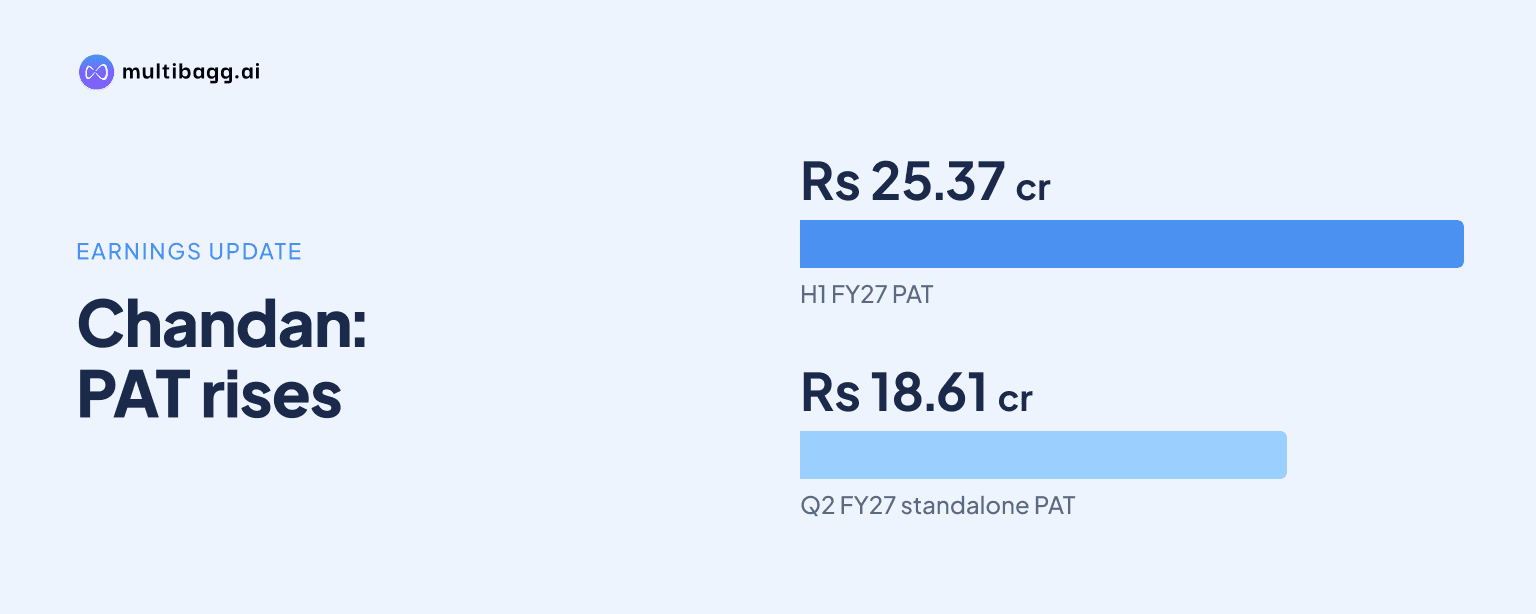
Chandan Healthcare Limited reported H1 FY27 profit after tax of ₹25.37 crore, up 257% year on year, while EBITDA rose 67%. The profit included a one-time gain from the sale of its stake in Chandan Pharmacy, making the result significant both for earnings comparison and the company's transition to a diagnostics-focused business.
Know Chandan Healthcare inside out
Results, valuation, peers and who's buying, in one view.
What did Chandan Healthcare report for H1 FY27?
Chandan Healthcare reported H1 FY27 PAT of ₹25.37 crore, representing year-on-year growth of 257%, with EBITDA increasing 67%. The earnings update points to a sharp rise in reported profitability during the first half of the financial year.
The reported PAT, however, includes a one-time gain linked to the Chandan Pharmacy stake sale. This means the headline profit combines diagnostics operations with an exceptional transaction, rather than reflecting only recurring operating performance.
The board's outcome dated November 14, 2026 also disclosed consolidated PAT of ₹24.90 crore for H1 FY27 and an exceptional item of ₹10.23 crore. The difference between the ₹25.37 crore figure in the results update and the board-disclosed consolidated PAT is not explained in the provided material. Investors will need to distinguish between reported figures based on their stated financial scope.
Why did H1 FY27 profit increase so sharply?
Chandan Healthcare's reported H1 FY27 profit increased sharply because it included a one-time gain from the divestment of Chandan Pharmacy. The exceptional item disclosed by the board was ₹10.23 crore, a material component when compared with the reported PAT figures.
The company has repositioned itself as a pure-play diagnostics business following the pharmacy divestment. The information provided states that Chandan Healthcare sold an 83.56% stake in Chandan Pharmacy for about ₹16.77 crore, with the transaction effective from September 1, 2026.
The pharmacy operation had been described as a lower-margin trading business. Its exit is intended to simplify the corporate structure and release capital and management attention for diagnostics network expansion and capacity creation.
For investors, the distinction between operational growth and exceptional income is central. EBITDA growth is a measure of operating earnings before interest, tax, depreciation and amortisation, while PAT in this period was lifted by the stake-sale-related gain.
How did the second quarter contribute to Chandan Healthcare's performance?
Chandan Healthcare reported Q2 FY27 standalone revenue of ₹57.94 crore and PAT of ₹18.61 crore, with the quarterly profit including a ₹10.23 crore one-time gain. The standalone EBITDA margin for the quarter was 37.26%.
The Q2 figures show why the exceptional item had a substantial effect on the reported half-year profit. The ₹10.23 crore gain represented more than half of the stated Q2 standalone PAT of ₹18.61 crore.
For comparison, Chandan Healthcare reported Q1 FY27 consolidated total income of ₹82.26 crore, EBITDA of ₹20.98 crore and PAT of ₹7.50 crore. Q1 EBITDA margin stood at 25.51%, while PAT margin was 9.11%.
The different reporting bases matter. Q1 figures are consolidated, while the cited Q2 figures are standalone, so they should not be added or directly compared as if they represented the same financial perimeter.
Got a follow-up? Ask IRIS
What is Chandan Healthcare's diagnostics expansion plan?
Chandan Healthcare is expanding its diagnostics network through owned centres, franchisees, government projects and higher-end diagnostic facilities. The company has stated that it intends to direct pharmacy divestment proceeds towards diagnostics capacity and network growth.
At the end of Q1 FY27, the company reported a network of 327 centres, including 23 comprehensive diagnostic centres, 18 diagnostic centres, 24 standalone laboratories and 15 radiology centres. It also reported more than 325 franchisees at that stage.
The company has outlined plans for eight new comprehensive diagnostic centres and more than six diagnostic centres to become operational over the next three to four months. It has also referred to a genome sequencing laboratory in Lucknow and PET-CT facilities planned in Kanpur and Gorakhpur.
Chandan Healthcare has set a target of 1,000 franchisees in FY27 and 3,000 franchisees within two years. These are company targets rather than confirmed financial outcomes, and their execution will be relevant to revenue mix, capacity utilisation and capital requirements.
How does the pharmacy exit affect investors and operations?
The pharmacy exit leaves Chandan Healthcare focused on diagnostics, a business where the company has highlighted higher margins and opportunities to scale through franchises and diagnostic centres. The separation also changes how investors should assess future results, as pharmacy revenue and its lower-margin trading activity will no longer form part of the operating mix.
The company has indicated a goal of maintaining a broadly balanced mix across B2C, B2B and B2G business, with B2G below 40% to manage receivables. It reported Q1 FY27 standalone diagnostics revenue of ₹49.75 crore, EBITDA of ₹18.19 crore and PAT of ₹6.70 crore.
Chandan Healthcare has scheduled a post-earnings conference call on November 18, 2026, at 12:00 PM IST to discuss its Q2 and H1 FY27 results. Clarification on the basis for the reported H1 PAT figures, the exceptional item and the post-divestment financial structure will be relevant for shareholders.
Conclusion
Chandan Healthcare's H1 FY27 earnings show a substantial increase in reported PAT, with ₹25.37 crore of profit and 257% year-on-year growth. But the one-time gain from the Chandan Pharmacy stake sale was a significant contributor, so recurring diagnostics performance and EBITDA trends remain important measures of underlying progress.
The next key event is the November 18, 2026 earnings call, where management may provide more detail on Q2 and H1 reporting, the use of divestment proceeds and diagnostics expansion. Investors will also watch the progress of planned centres, franchise additions and the company's stated move towards a pure-play diagnostics model.