










Chemplast sees growth pipeline shift beyond agrochemicals
Key highlights
- Chemplast has 14 CMCD products in commercial manufacturing and close to four pre-commercial candidates.
- Chemplast said its roughly 50-molecule CMCD pipeline is gaining pharmaceutical and specialty-material opportunities beyond agrochemicals.
- Specialty chemicals generated Rs 488 crore in Q2 FY27, up 31% year on year and 14% sequentially.
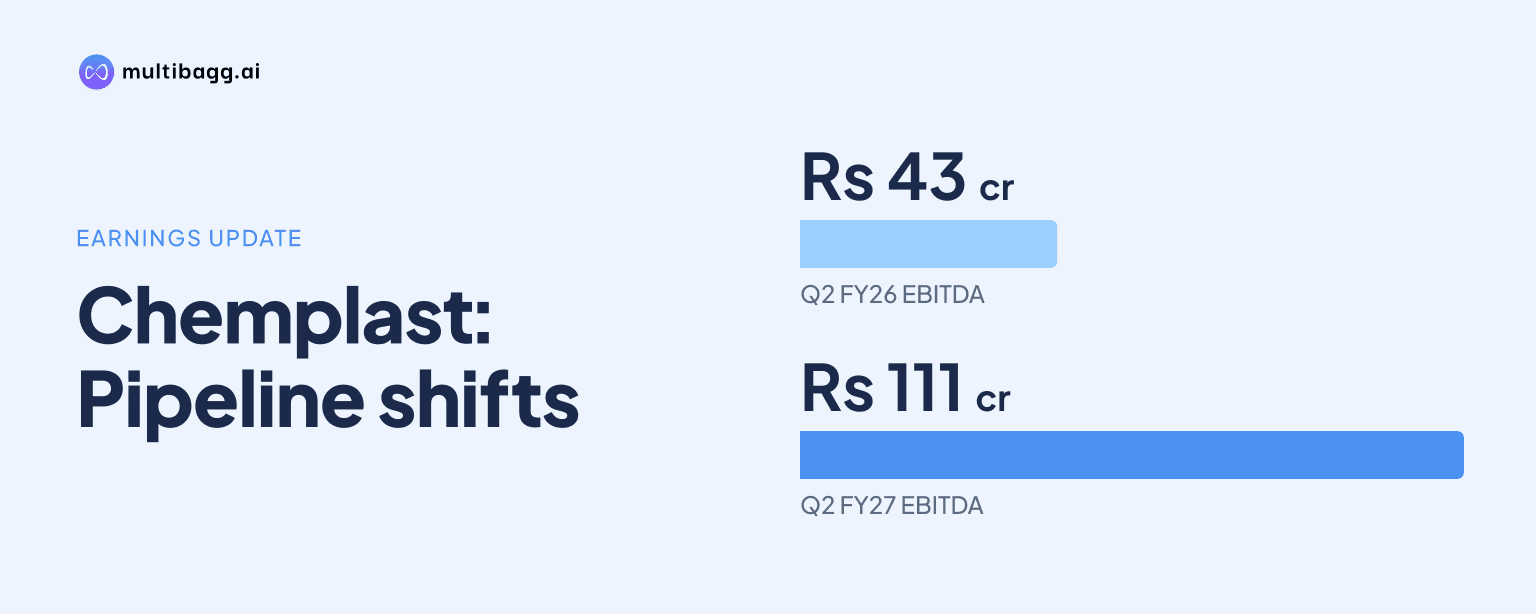
- Chemplast reported Q2 FY27 EBITDA of Rs 111 crore, compared with Rs 43 crore in Q2 FY26.
powered by IRIS
Chemplast Sanmar Limited said its Custom Manufactured Chemicals Division, or CMCD, has 14 commercial products, about four pre-commercial candidates and a roughly 50-molecule pipeline, with pharmaceutical and specialty-material opportunities increasingly supplementing agrochemicals after a 12-to-18-month delay in product ramp-ups.
Know Chemplast Sanmar inside out
Results, valuation, peers and who's buying, in one view.
How is Chemplast's custom chemicals pipeline changing?
Chemplast said its CMCD pipeline is expanding beyond agrochemicals into pharmaceutical and other specialty-material applications. Management said it has invested in business development in Europe and Japan, where traction is both in agrochemicals and, significantly, in non-agrochemical products. The company described the broader pipeline as around 50 molecules during its November 5, 2026, Q2 FY27 earnings call.
The current portfolio has 14 products in commercial manufacturing and close to four pre-commercial candidates, according to CMCD head Krishna Rangachari. Pre-commercial status means laboratory trials have been completed and pilot campaigns are under way; management said some of these candidates will be commercialised in FY27. A further 35 to 40 projects are in development or at the request-for-quotation, or RFQ, stage.
This structure indicates that Chemplast is pursuing growth through both existing commercial products and earlier-stage opportunities. Agrochemicals remain relevant because the company’s model focuses mainly on innovator customers and their new or pipeline molecules, but management identified pharma and specialty materials as additional sources of inquiries rather than presenting the portfolio as agrochemical-only.
What delayed Chemplast's molecule ramp-ups?
Chemplast said an overall agrochemical slowdown shifted ramp-ups of newly commercialised pipeline molecules by 12 to 18 months. Rangachari said the delay had constrained volumes even for molecules already commercialised, but added that this pressure appeared to be slowly receding, with the company beginning to see better traction over the three to six months before the November call.
The company did not quantify CMCD revenue for Q2 FY27 or disclose product-level volumes. It did say the division performed strongly in the quarter as molecules commercialised in prior periods ramped up, maintained healthy margins and held a healthy order book. Management added that dispatches are typically weighted toward the fourth quarter, making Q4 a seasonally important period for the division.
Chemplast’s response to input-cost inflation also depends on contract structure. Management said raw-material increases are pass-throughs for some products; for other products, it has discussed sharing cost escalation with customers while seeking manufacturing-efficiency improvements. This mechanism is relevant because Q2 FY27 was affected by higher raw-material and logistics costs across the company amid disruptions in key shipping routes.
What financial evidence supports Chemplast's growth plan?
Chemplast reported consolidated Q2 FY27 revenue of Rs 1,323 crore, up 28% year on year, while earnings before interest, tax, depreciation and amortisation, or EBITDA, rose to Rs 111 crore from Rs 43 crore in Q2 FY26. The EBITDA margin rose to 8% from 4%, although the company still reported a net loss of Rs 5 crore due to depreciation, borrowing costs and losses in certain commodity businesses.
Specialty chemicals, the segment containing CMCD, generated Rs 488 crore in Q2 FY27, 31% higher year on year and 14% above the preceding quarter. It accounted for 37% of consolidated revenue, compared with 54% for suspension polyvinyl chloride, or PVC, and 9% for Value-Added Chemicals. The segment mix shows that specialty chemicals were smaller than suspension PVC by revenue but were a material contributor to the quarter’s growth.
For the first half of FY27, Chemplast reported revenue of Rs 2,448 crore, up 15% from Rs 2,133 crore in H1 FY26, but EBITDA was a loss of Rs 3 crore and net loss was Rs 181 crore. That contrast between the improved Q2 result and the six-month loss reflects the difficult first quarter, when Q2 EBITDA of Rs 111 crore followed an EBITDA loss of Rs 115 crore in Q1 FY27.
Got a follow-up? Ask IRIS
Can Chemplast meet its custom chemicals revenue objective?
Management said it remains focused on a previously indicated CMCD revenue objective of Rs 1,100 crore for FY28, after an analyst noted that achieving the earlier FY27 target looked challenging. Rangachari said CMCD should record significant growth over the prior year in FY27 and that the company intends to continue that trajectory next year, but he did not give a revised FY27 revenue forecast.
Order visibility is the immediate support for that objective. Management said it has almost full commitment for current-year sales and no near-term need for additional capital expenditure for CMCD. The company also said CMCD’s order book provides visibility for the remainder of FY27, while identifying Q4 as a potentially strong period because dispatches are generally concentrated late in the financial year.
The wider capital programme remains focused on refrigerant gas capacity rather than a new disclosed CMCD project. Chemplast said commercial R32 production from a swing plant began in May 2026, with full 20-kiloton capacity expected to be operational by the end of FY27. It said the R32 project has an allocated capital expenditure of Rs 250 crore; apart from completing that project, management cited normal maintenance capital expenditure of about Rs 60 crore to Rs 70 crore.
What risks remain for Chemplast's earnings recovery?
Chemplast said CMCD margins remained healthy, but its consolidated profitability remains exposed to commodity businesses. Value-Added Chemicals stayed subdued in Q2 FY27 as caustic soda faced operational and pricing challenges, while lower caustic-soda intake limited hydrogen availability for hydrogen peroxide. The Karaikal shutdown also affected caustic-soda volumes and constrained Mettur production because of chlorine-disposal challenges.
Suspension PVC revenue rose 37% year on year and 26% sequentially to Rs 715 crore in Q2 FY27, but management said spreads could remain volatile as vinyl chloride monomer, or VCM, prices and freight costs move. Management also cited structural industry oversupply and Chinese supply pressure, and declined to provide specific guidance on when the company could return to a positive bottom line.
Conclusion
Chemplast’s stated CMCD strategy combines an established manufacturing portfolio with a development pipeline that is less dependent on a single end-market. Specialty chemicals delivered Rs 488 crore of Q2 FY27 revenue, while management said current-year CMCD sales are almost fully committed; however, the earlier 12-to-18-month agrochemical delay shows that product commercialisation does not necessarily translate immediately into volume ramp-up.
The next test is Q4 FY27, when CMCD dispatches are typically weighted, and whether some of the four pre-commercial candidates enter commercial production during FY27. Management’s disclosed milestones also include full 20-kiloton R32 capacity by the end of FY27 and continued focus on the Rs 1,100 crore CMCD revenue objective for FY28, while VCM prices and commodity-business losses remain unresolved variables for consolidated earnings.