










Chemplast Sanmar custom capacity rises fivefold to 5,410 mtpa
Key highlights
- Chemplast Sanmar increased custom-manufacturing capacity from 1,068 mtpa in 2021 to 5,410 mtpa in May 2026.
- Phase 1, Phase 2 and Phase 3 added 2,000 mtpa, 1,432 mtpa and 910 mtpa, respectively.
- Specialty chemicals represented 37% of Chemplast Sanmar sales in Q2 FY ’27, compared with 36% in FY ’26.
- Chemplast Sanmar targets Q3 FY ’27 to complete civil and infrastructure work for its next multipurpose block.
powered by IRIS
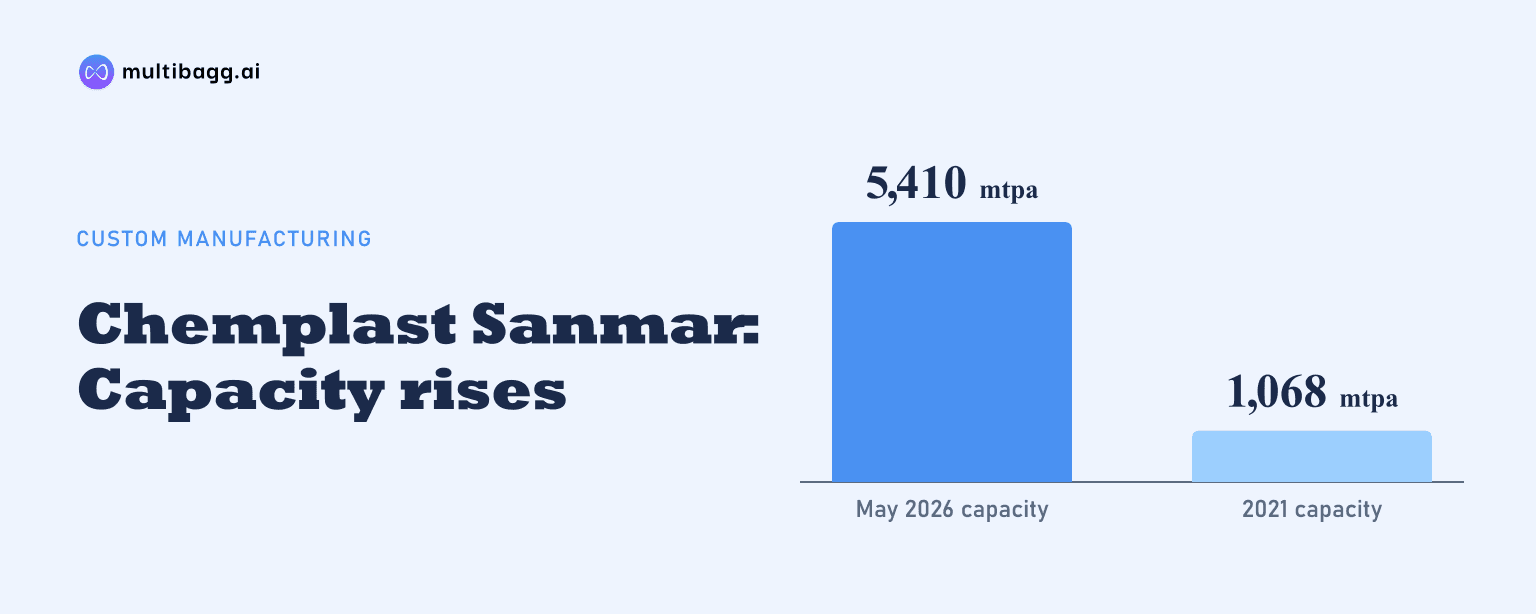
Chemplast Sanmar Limited increased custom-manufacturing capacity more than fivefold, to 5,410 metric tonnes per annum (mtpa) in May 2026 from 1,068 mtpa in 2021, after commissioning three expansion phases. The completed additions totalled 4,342 mtpa, with the largest, Phase 1, contributing 2,000 mtpa in September 2023.
Know Chemplast Sanmar inside out
Results, valuation, peers and who's buying, in one view.
How did Chemplast Sanmar reach 5,410 mtpa of custom capacity?
Chemplast Sanmar reached 5,410 mtpa by commissioning three capacity phases after its 1,068-mtpa starting point in 2021. Phase 1 added 2,000 mtpa in September 2023, Phase 2 added 1,432 mtpa in December 2024, and Phase 3 added 910 mtpa in May 2026. The company identifies the business as Custom Manufactured Chemicals within its specialty chemicals division.
The 4,342-mtpa aggregate addition took capacity to just over 5.1 times the 2021 level. Phase 1 was the largest of the three installations, followed by Phase 2 and Phase 3. Chemplast Sanmar says commercial production from Multipurpose Block 3 Phase 3 began in May 2026.
Chemplast Sanmar’s presentation separately reports specialty chemicals as 36% of FY ’26 sales and 37% of Q2 FY ’27 sales, a one-percentage-point increase. Specialty chemicals include specialty paste polyvinyl chloride resin, Custom Manufactured Chemicals and refrigerant gases, so the presentation does not disclose a sales share specifically for the custom-manufacturing business.
What does Chemplast Sanmar make for custom-manufacturing customers?
Chemplast Sanmar custom manufactures starting materials, advanced intermediates and active ingredients for global innovator companies under a stated one-product-to-one-customer strategy. The presentation identifies pharmaceuticals, agrochemicals and fine chemicals as end markets, while listing agri and pharma innovators as the business’s end users.
The Berigai facility has chemistry capabilities including cyanation, hydrogenation and liquid purification. Chemplast Sanmar says in-house process research, process engineering and large-scale manufacturing allow it to support newly discovered molecules, while the site can also undertake laboratory-scale and pilot-scale development work.
The 5,410-mtpa custom-manufacturing capacity is much smaller than Chemplast Sanmar’s 331,000-mtpa suspension PVC capacity, 119,000-mtpa caustic soda capacity and 107,000-mtpa specialty paste PVC capacity. The difference reflects the custom business’s focus on customer-specific starting materials, intermediates and active ingredients rather than standard PVC resin or value-added chemical volumes.
Chemplast Sanmar describes 15 years of client relationships in custom manufacturing and cites environmental and safety stewardship, intellectual-property care and complex-chemistry capability as factors in its offering. These are company-stated attributes, and the presentation does not disclose the number of customers, contracts, products or customer-specific capacity allocations.
Got a follow-up? Ask IRIS
Why is Chemplast Sanmar prioritising custom manufacturing?
Chemplast Sanmar says Custom Manufactured Chemicals is its top priority for capital allocation and is intended to drive future growth. Management links the opportunity to outsourced agrochemical manufacturing, a China +1 sourcing approach, European Union regulatory constraints and increased penetration of active pharmaceutical ingredient manufacturing in India.
The company says India’s share of the global outsourced agrochemical custom-manufacturing market is increasing at 10% to 12%. It does not provide Chemplast Sanmar’s market share, divisional revenue, operating margin, utilisation or order book, so the presentation does not quantify the company’s financial capture of that market trend.
The strategic focus contrasts with conditions described for some larger-volume operations. Chemplast Sanmar says global supply-demand imbalances continue to pressure suspension PVC spreads, while significant capacity additions are pressuring industry economics for caustic soda, hydrogen peroxide and chloromethanes. In Q2 FY ’27, suspension PVC accounted for 54% of sales, compared with 37% for specialty chemicals and 9% for value-added chemicals.
Chemplast Sanmar says customer engagement and new-product-development efforts have advanced as expected, supported by a senior hire in Japan and Europe. The presentation does not state how many products are in the pipeline, whether they have cleared customer approvals, or what revenue could arise from the 4,342 mtpa commissioned between September 2023 and May 2026.
What remains in Chemplast Sanmar’s expansion plan?
Chemplast Sanmar targets completion of civil and infrastructure work for its next multipurpose block by Q3 FY ’27. The project is planned at Berigai and is intended to leverage infrastructure already available at the location, where the company also says land is available for future expansion.
The Q3 FY ’27 target covers civil and infrastructure work, not a disclosed capacity, commissioning date or commercial-production start. As a result, the presentation does not support an estimate of the next block’s output, capital expenditure, utilisation or sales contribution.
Chemplast Sanmar operates four manufacturing sites, with custom manufacturing located at Berigai. Its other disclosed capacities include 331,000 mtpa of suspension PVC at Cuddalore, 66,000 mtpa of paste PVC at Mettur, 41,000 mtpa of paste PVC at Cuddalore and 2,000 mtpa of R32 refrigerant gas at Mettur.
The company says it has a zero-liquid-discharge policy and achieved 100% zero liquid discharge across all plants in September 2009. The presentation does not specify whether the next Berigai block will require separate environmental approvals, nor does it quantify how sustainability systems affect the block’s construction timing or operating costs.
Conclusion
Chemplast Sanmar has made custom manufacturing a distinct specialty-chemicals growth platform through three completed multipurpose-block phases and a customer-specific operating model for agrochemical and pharmaceutical innovators. The specialty chemicals segment’s reported sales share rose to 37% in Q2 FY ’27 from 36% in FY ’26, although the company does not separately report custom-manufacturing revenue or utilisation.
The next disclosed milestone is completion of civil and infrastructure work for another multipurpose block by Q3 FY ’27. What to watch is whether Chemplast Sanmar subsequently discloses the block’s capacity, commissioning schedule, customer approvals, utilisation and financial contribution, none of which is specified in the presentation.