










CIFL H1 disbursements rise 39% to Rs 386.68 crore in FY27
Key highlights
- CIFL disbursed Rs 386.68 crore in H1 FY27, up 39% year on year.
- CIFL's AUM reached Rs 1,284.13 crore on September 30, 2026, up 25%.
- CIFL's standalone interest income rose 47% to Rs 119.01 crore in H1 FY27.
- CIFL reported gross NPA of 2.89%, net NPA of 1.65% and CAR of 40.77%.
powered by IRIS
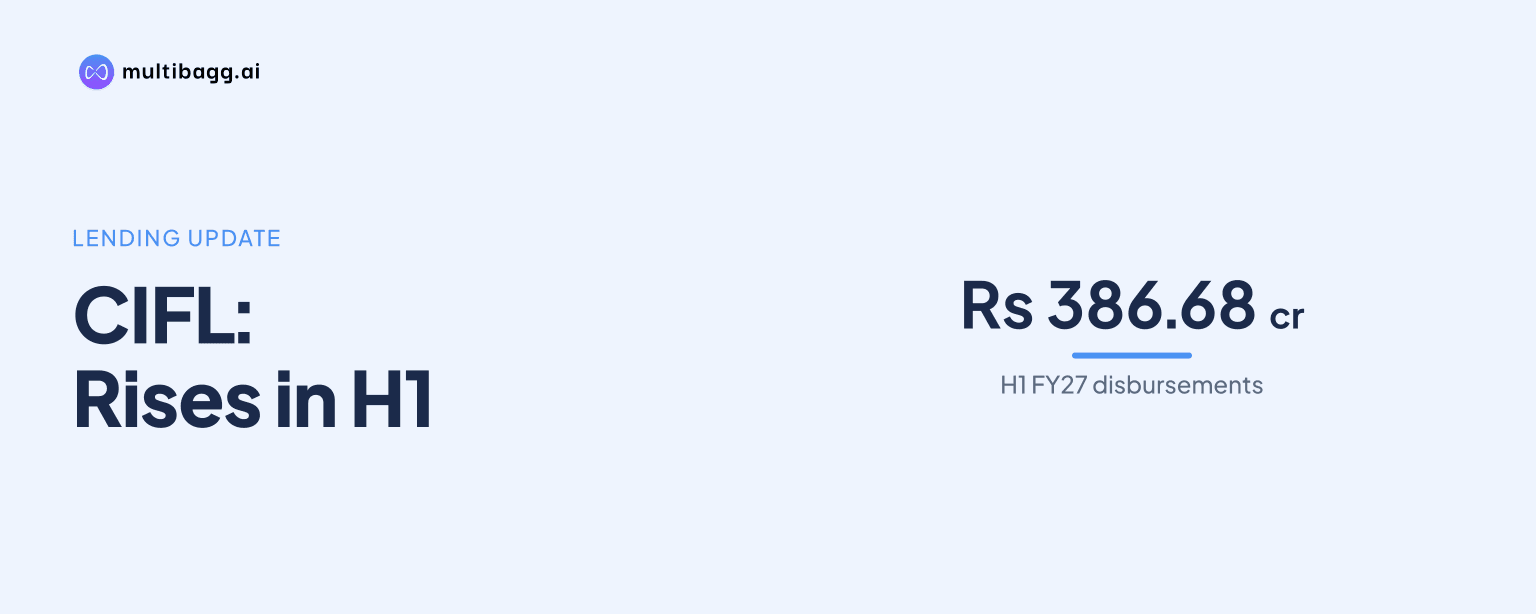
Capital India Finance Limited reported H1 FY27 disbursements of Rs 386.68 crore, up 39% year on year, while assets under management reached Rs 1,284.13 crore on September 30, 2026. CIFL also recorded 47% growth in standalone interest income to Rs 119.01 crore during the half year ended September 30, 2026.
Know Capital India Finance inside out
Results, valuation, peers and who's buying, in one view.
What drove CIFL's H1 FY27 lending growth?
CIFL's lending activity increased in both disbursements and the outstanding loan book during H1 FY27, the half year ended September 30, 2026. Disbursements rose 39% year on year to Rs 386.68 crore, while assets under management, or AUM, increased 25% to Rs 1,284.13 crore. The company linked the disbursement increase to improving business momentum and deeper market penetration.
Disbursements grew 14 percentage points faster than AUM in the reported period, based on the disclosed 39% and 25% growth rates. This comparison shows new lending rose more quickly than the closing loan portfolio during H1 FY27. CIFL did not disclose the prior-year rupee values for disbursements or AUM, borrower numbers, loan yields, or a split of disbursements by customer segment.
CIFL is a Middle Layer, non-deposit-taking non-banking financial company, or NBFC, focused on secured micro, small and medium enterprise, or MSME, and retail lending. Its stated model combines local market expertise with phygital distribution and disciplined underwriting. As of September 30, 2026, CIFL had 46 branches across nine states, the network supporting the H1 FY27 lending expansion.
How did CIFL's income change in H1 FY27?
CIFL's standalone interest income rose 47% year on year to Rs 119.01 crore in H1 FY27, exceeding the 44% increase in total standalone income to Rs 145.32 crore. The company said the interest-income increase reflected the growing scale of its core lending operations. Interest income represented about 82% of total standalone income, calculated from the two reported H1 FY27 figures.
Interest income grew 22 percentage points faster than AUM, comparing its 47% increase with the 25% growth in the September 30, 2026 AUM balance. The disclosed figures establish that income growth outpaced the closing portfolio's growth rate. CIFL did not provide average AUM, lending yields, fee-income details, funding costs, or a breakdown of the Rs 145.32 crore total income.
CIFL reported standalone profit after tax, or PAT, of Rs 7.71 crore for H1 FY27, but gave no year-on-year comparison for that result. The release separately reported consolidated total revenue of Rs 256.61 crore and a consolidated loss after tax of Rs 11.77 crore for the same half year. CIFL did not provide a reconciliation between the standalone PAT and the consolidated loss in its November 6, 2026 announcement.
Got a follow-up? Ask IRIS
What did CIFL report on asset quality and capital?
CIFL reported gross non-performing assets, or gross NPA, of 2.89% and net NPA of 1.65% as of September 30, 2026. Management said asset quality improved sequentially during the second quarter of FY27 compared with the first quarter. The company did not disclose the Q1 FY27 or Q2 FY27 gross and net NPA ratios.
The difference between CIFL's reported gross NPA and net NPA ratios was 1.24 percentage points at September 30, 2026. Its capital adequacy ratio, or CAR, was 40.77% at that date. CIFL said the capital position provided headroom to support future growth, while management also cited disciplined underwriting and robust asset quality as operating priorities.
CIFL's chief executive said the company would focus on higher productivity, improved operating efficiencies and sustainable profitable growth after H1 FY27. These are management priorities rather than a disclosed growth or profit target. The filing did not provide H1 FY27 credit-cost, collection, restructuring, provisioning, or sector-level delinquency figures for the Rs 1,284.13 crore AUM portfolio.
How is CIFL reshaping its business portfolio?
CIFL is seeking to sharpen its focus on MSME lending through a proposed transfer of certain assets of its foreign-exchange division, operating under the RemitX brand. The company approved the transaction in August 2026, subject to fulfilment of the agreement's terms. CIFL said the transaction follows the FY26 divestment of Capital India Home Loans Limited and supports simplification of its business portfolio.
CIFL also reported further diversification of funding sources during H1 FY27 through participation from existing and new lenders and access to capital markets through a non-convertible debenture, or NCD, issuance. The November 6, 2026 release did not disclose the NCD amount, pricing, maturity, total borrowings, or funding mix. It also did not quantify the contribution of new lenders to the liability franchise.
RapiPay Fintech Private Limited, CIFL's material subsidiary, reported total revenue of Rs 133.25 crore and a loss after tax of Rs 18.34 crore for H1 FY27. The subsidiary's loss was Rs 10.63 crore larger than CIFL's standalone PAT of Rs 7.71 crore. At the group level, CIFL reported the Rs 11.77 crore consolidated loss after tax, but did not disclose RapiPay's operating metrics or reasons for its loss.
Conclusion
CIFL's H1 FY27 disclosure shows growth across lending activity, the loan book and income, with disbursements rising 39% to Rs 386.68 crore and AUM increasing 25% to Rs 1,284.13 crore. Standalone interest income rose 47% to Rs 119.01 crore, while the company reported gross NPA of 2.89%, net NPA of 1.65% and CAR of 40.77% at September 30, 2026.
The next disclosed matters to watch are whether the RemitX asset transfer approved in August 2026 meets its agreement conditions, and management's plan to increase productivity and operating efficiency while maintaining underwriting discipline. CIFL also said asset quality improved in Q2 FY27 versus Q1 FY27, making subsequent disclosure of NPA ratios relevant to its stated MSME lending focus.