










Capital India Finance Limited Q2 Revenue Rises 8.7% to ₹75.80 Crore
Key highlights
- Capital India Finance Limited reported Q2 FY27 standalone revenue of ₹75.80 crore, up 8.7% quarter-on-quarter.
- First-half FY27 standalone revenue rose 44.5% year-on-year to ₹146.32 crore from ₹101.22 crore.
- Capital India Finance Limited's FY26 AUM increased 22% year-on-year to ₹1,227.37 crore.
- The company raised ₹100 crore through 27-month secured NCDs carrying a 10% annual coupon.
powered by IRIS
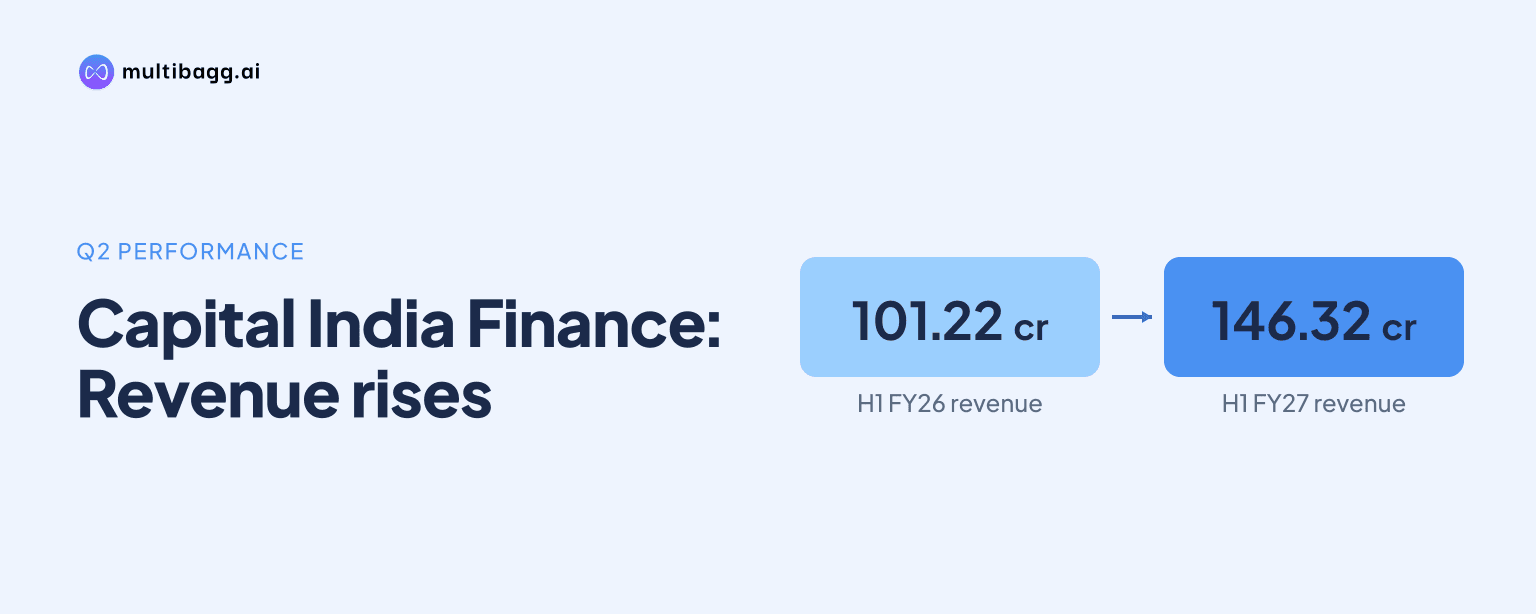
Capital India Finance Limited reported standalone revenue of ₹75.80 crore for the quarter ended September 30, 2026, an 8.7% increase from ₹69.53 crore in the preceding June quarter. The NBFC's revenue for the first half of FY27 reached ₹146.32 crore, up 44.5% from ₹101.22 crore in the corresponding half of the previous year.
Know Capital India Finance inside out
Results, valuation, peers and who's buying, in one view.
What did Capital India Finance Limited report for Q2 FY27?
Capital India Finance Limited reported standalone revenue of ₹75.80 crore for Q2 FY27, covering the three months ended September 30, 2026. The result places the September-quarter revenue ₹6.27 crore above the ₹69.53 crore reported in the immediately preceding quarter.
The company operates as a non-deposit-taking non-banking financial company in the financial services sector. Its lending focus includes secured MSME and retail loans. Capital India Finance had announced on October 31 that its board would meet on November 6, 2026, to consider the unaudited Q2 and half-year FY27 financial results.
The reported number is a standalone revenue figure and should be read on that basis. The supplied financial information also includes separate references to total income and consolidated performance for earlier periods, which are not directly comparable with the Q2 standalone revenue disclosure.
How did the September quarter compare with the June quarter?
Capital India Finance Limited's Q2 FY27 standalone revenue increased 8.7% quarter-on-quarter from ₹69.53 crore in Q1 FY27 to ₹75.80 crore in Q2 FY27. This follows the company's reported Q1 FY27 standalone total income of ₹69.53 crore, which was stated to be 32% higher than a year earlier.
The sequential rise comes after a period in which the company had disclosed growth in lending activity. Capital India Finance said Q1 FY27 disbursements rose 36% year-on-year and assets under management, or AUM, increased 20% year-on-year. These operating metrics provide context for the higher revenue reported in the September quarter.
The available data does not provide a Q2 FY27 profit, expense, disbursement, or AUM figure. Therefore, the revenue increase alone does not establish the change in quarterly margins or net profitability.
What does the half-year revenue data show?
Capital India Finance Limited generated standalone revenue of ₹146.32 crore in the first half of FY27, compared with ₹101.22 crore in the year-earlier half, representing a 44.5% year-on-year increase. The half-year figure combines the June and September 2026 quarters.
The growth follows a broader expansion in the company's lending operations during FY26. Capital India Finance reported that AUM rose 22% year-on-year to ₹1,227.37 crore in FY26, while disbursements increased 62% to ₹753.54 crore. It reported total income of ₹229.67 crore for FY26.
The company also expanded its physical distribution network. By Q1 FY27, Capital India Finance had 46 branches across nine states, compared with 29 branches in FY25. The wider network is relevant to its secured MSME and retail lending model, which depends on loan sourcing, underwriting, servicing, and collection capabilities across local markets.
Got a follow-up? Ask IRIS
What is the funding and capital position of Capital India Finance Limited?
Capital India Finance Limited raised ₹100 crore through privately placed secured non-convertible debentures in September 2026. The listed, rated, senior secured NCDs have a 27-month tenure and carry a fixed annual coupon of 10%, payable quarterly.
The NCD issue diversified the company's funding sources while its loan book and disbursements were expanding. For an NBFC, the cost, tenor, and availability of funding are relevant because lending growth requires continuing access to capital and borrowings.
Capital India Finance reported a capital adequacy ratio of 43.58% as of June 30, 2026. The ratio is a measure of capital relative to risk-weighted assets and is an important disclosed indicator of the lender's capital position. The supplied information does not provide an updated capital adequacy ratio as of September 30, 2026.
How could the Q2 revenue result matter to investors and operations?
Capital India Finance Limited's Q2 revenue increase and 44.5% half-year revenue growth indicate a higher reported standalone revenue base than in the comparable periods disclosed. The figures coincide with reported growth in AUM, disbursements, and branch coverage during the preceding financial year and first quarter of FY27.
For investors, revenue data should be assessed alongside profitability, asset quality, borrowing costs, capital adequacy, and disbursement trends. The Q2 information provided does not include these corresponding financial or operating measures, so the effect on earnings and return metrics cannot be determined from revenue alone.
For customers and local lending operations, the 46-branch network across nine states indicates a larger distribution footprint than the 29 branches reported for FY25. The company has stated that its lending activity is concentrated in secured MSME and retail segments, where branch reach and funding availability can support loan origination and servicing.
Conclusion
Capital India Finance Limited reported a sequential improvement in standalone Q2 FY27 revenue to ₹75.80 crore and a 44.5% year-on-year increase in first-half revenue to ₹146.32 crore. The result sits alongside previously disclosed expansion in AUM, disbursements, and branch presence, as well as the ₹100 crore NCD fund raise.
The next disclosed areas to watch are the company's Q2 profitability, expenses, asset quality, disbursements, AUM, and capital adequacy position, none of which were provided with the September-quarter revenue figure. Investors may also track the utilisation and funding implications of the 27-month NCD issue carrying a 10% annual coupon.